All posts by AI REV LABS

PROPHET MOSES s LAST SERMON SUMMARIZED

While the concept of a single “last sermon” from Prophet Moses, exactly like the Farewell Sermon of Muhammad, isn’t present in the Hebrew Bible, his final address to the Israelites is a central and powerful theme.

This address is encapsulated in the Book of Deuteronomy, which itself means “Second Law” or “Repetition of the Law.” The entire book is presented as Moses’ final speeches to the new generation of Israelites on the plains of Moab, just before they enter the Promised Land without him.

Deuteronomy chapters 27-30, in particular, contain the core of this final charge, often called the Covenant at Moab. This is where Moses lays out the blessings of obedience and the severe warnings for disobedience in the most explicit terms.


Summary of Moses’ Final Charge: The Two Ways

Moses presents the Israelites with a fundamental choice between life and death, blessing and curse. This is the ultimate summary of his message.

1. The Call to Obedience

  • The Commandment is Attainable: Moses emphasizes that God’s law is not too difficult or mysterious. It is very near to them, in their mouths and hearts, so they can obey it (Deuteronomy 30:11-14).
  • A Covenant of Love: Obedience is framed not just as following rules, but as a response to God’s love and faithfulness. The core command is to “love the LORD your God with all your heart and with all your soul and with all your strength” (Deuteronomy 6:5).
  • The Promise of Blessing: If they are obedient, they will receive immense blessings. These are detailed in Deuteronomy 28:1-14 and include:
    • Prosperity in the Promised Land.
    • Victory over their enemies.
    • Abundant harvests and children.
    • Being established as a holy people, a nation set apart for God.

2. The Warnings of Disobedience

This is the most striking and lengthy part of the warning. The consequences of turning away from the covenant are described in graphic and severe terms.

  • The Curses: The list of curses in Deuteronomy 28:15-68 is extensive and terrifying. It serves as a stark contrast to the blessings and includes:
    • Disease, drought, and famine.
    • Defeat and oppression by their enemies.
    • Exile from the land God gave them.
    • Extreme suffering, to the point of parents turning against their children in desperation.
    • Being scattered among all the nations, from “one end of the earth to the other.”
  • The Ultimate Consequence: The ultimate warning is that persistent disobedience will lead to them being uprooted from the Promised Land and going into exile, where they will serve foreign gods and live in constant fear and suffering.

3. The Promise of Restoration

Even in the midst of the warnings, there is a path back. Moses prophesies that after the people experience the curses of exile due to their disobedience, they will eventually return to God.

  • Repentance is Possible: “When you and your children return to the LORD your God and obey him with all your heart and with all your soul… then the LORD your God will restore your fortunes and have compassion on you” (Deuteronomy 30:2-3).
  • The Choice is Theirs: The final message is a powerful exhortation to choose life.
    > “This day I call the heavens and the earth as witnesses against you that I have set before you life and death, blessings and curses. Now choose life, so that you and your children may live and that you may love the LORD your God, listen to his voice, and hold fast to him. For the LORD is your life…” (Deuteronomy 30:19-20).

Comparison with Prophet Muhammad’s Farewell Sermon

Feature Moses (in Deuteronomy)Muhammad (Khutbat al-Wada’)Context Before entering the Promised Land, addressing a new generation. After establishing the Islamic state in Medina, during the Hajj pilgrimage. Core Message A choice between blessing (life) and curse (death) based on obedience to God’s covenant and law. A confirmation of completed principles: equality, sanctity, and brotherhood under one God. FocusVertical Relationship: Primarily between the people and God, with social laws flowing from that. Horizontal Relationship: Primarily on the social and ethical rights between people, rooted in faith.

Warnings Explicit, lengthy, and national: Exile, defeat, and suffering for collective disobedience. A general warning not to stray after him, and to hold fast to the Quran and Sunnah.

Legacy Left The Torah (Law) as their guide and constitution. The Quran and the Sunnah (his example) as the guide.

In conclusion, Moses’ “last sermon” in Deuteronomy is a powerful, prophetic discourse that sets the theological stage for the entire subsequent history of the Israelites in the Hebrew Bible. It establishes the pattern of blessing for obedience and exile for disobedience that the prophets would point back to for centuries.

Prophet Mohammed PBUH.. a brief summary

Prophet Muhammad (ﷺ) transformed Arabia from a land of ignorance (**Jahiliyyah**) to a beacon of faith, knowledge, and justice. His life remains the **ultimate model** of leadership, patience, and devotion to Allah.  

To know more, please proceed>>>>>>>>

Prophet Muhammad, born around 570 CE in Mecca (modern-day Saudi Arabia), was the founder of Islam. Raised as an orphan in the Quraysh tribe, he worked as a merchant and was known for his integrity, earning the nickname “Al-Amin” (the trustworthy). At age 40, in 610 CE, he received his first revelation from God (Allah) through the angel Gabriel in the Cave of Hira. These revelations, over 23 years, formed the Qur’an, Islam’s holy book.

Mission

Prophet Muhammad’s mission was to call people to monotheism (Tawhid), urging them to worship one God and abandon idolatry. He preached social justice, compassion, and moral conduct, challenging Mecca’s powerful elites. Facing persecution, he and his followers migrated to Medina in 622 CE (the Hijra), marking the start of the Islamic calendar. In Medina, he established a community based on Islamic principles, uniting diverse tribes. He led defensive battles against Meccan opposition and, by 630 CE, peacefully conquered Mecca, cleansing the Kaaba of idols.

Legacy

Prophet Muhammad died in 632 CE, leaving a profound legacy:

– **Religious**: Islam, based on the Qur’an and his Sunnah (teachings and practices), spread rapidly, shaping a global faith with over 1.9 billion followers today.

– **Political**: He laid the foundation for the Islamic state, with the Constitution of Medina promoting coexistence and governance.

– **Social**: His emphasis on charity, equality, and community reformed Arabian society, influencing laws and ethics.

He is revered as the “Seal of the Prophets” in Islam, the final messenger in a line including Abraham, Moses, and Jesus. His legacy endures through Islamic scholarship, institutions, and the global Muslim community.

Xxxxxx

Concise yet comprehensive summary of **Prophet Muhammad’s (ﷺ) biography, mission, and legacy**:

1. Early Life (570–610 CE)**  

– **Birth & Lineage:** Born in **Makkah** (570 CE) into the **Quraysh tribe** (Banu Hashim clan). His father, **Abdullah**, died before his birth, and his mother, **Aminah**, passed away when he was six. He was raised by his grandfather **Abdul-Muttalib** and later by his uncle **Abu Talib**.  

– **Character:** Known as **Al-Amin (The Trustworthy)** for his honesty and integrity. Worked as a merchant, earning the respect of his community.  

– **Marriage to Khadijah (RA):** At 25, he married **Khadijah**, a wealthy widow, who later became the first believer in his prophethood.  

### **2. Prophethood & Mission (610–632 CE)**  

#### **Revelation & Early Preaching (610–613 CE)**  

– **First Revelation (610 CE):** At age 40, while meditating in **Cave Hira**, the Angel **Jibril (Gabriel)** brought the first verses of the Quran (Surah Al-Alaq 96:1–5).  

– **Early Converts:** His wife **Khadijah**, cousin **Ali ibn Abi Talib**, close friend **Abu Bakr**, and freed slave **Zayd ibn Harithah** were among the first Muslims.  

– **Secret Preaching:** For three years, Islam spread quietly due to persecution.  

#### **Public Declaration & Persecution (613–622 CE)**  

– **Open Dawah:** After being commanded to preach publicly (Surah Al-Hijr 15:94), the Quraysh leaders (like **Abu Lahab & Abu Jahl**) opposed him fiercely.  

– **Persecution:** Muslims faced **boycotts, torture, and social exclusion**. Some migrated to **Abyssinia (Ethiopia)** under King Negus’s protection.  

– **Year of Sorrow (619 CE):** Deaths of **Khadijah** and **Abu Talib**, his main supporters, left him vulnerable.  

#### **The Hijrah (Migration to Madinah, 622 CE)**  

– **Invitation from Madinah:** The people of **Yathrib (later Madinah)** pledged allegiance at **Aqabah**, inviting him to mediate tribal conflicts.  

– **Escape from Makkah:** After an assassination plot, he and **Abu Bakr** migrated, marking the start of the **Islamic calendar (Hijri)**.  

#### **Madinah Period (622–632 CE)**  

– **Establishing the First Islamic State:**  

  – **Constitution of Madinah:** A treaty ensuring rights for Muslims, Jews, and pagans.  

  – **Brotherhood (Mu’akhah):** Pairing **Muhajireen (Makkan migrants)** and **Ansar (Madinan helpers)**.  

– **Major Battles:**  

  – **Badr (624 CE):** Victory against Quraysh despite being outnumbered.  

  – **Uhud (625 CE):** A setback due to archers disobeying orders.  

  – **Trench (627 CE):** Victory in a siege against a Meccan coalition.  

– **Treaty of Hudaybiyyah (628 CE):** A 10-year truce with Quraysh, later broken by them.  

– **Conquest of Makkah (630 CE):** A bloodless victory after Quraysh violated the treaty. The Prophet (ﷺ) forgave his former enemies.  

– **Farewell Pilgrimage & Sermon (632 CE):** Delivered a timeless message on equality, justice, and human rights.  

### **3. Death & Legacy (632 CE)**  

– **Passing:** Fell ill and died in **Madinah (June 632 CE)** at age 63. Buried in his house (now part of **Masjid an-Nabawi**).  

– **Final Revelation:** Last verses of Surah Al-Baqarah (2:281–286) emphasized accountability before Allah.  

### **4. Prophet Muhammad’s (ﷺ) Mission & Legacy**  

#### **Core Teachings:**  

– **Tawhid (Oneness of God):** Rejection of idolatry; worship of Allah alone.  

– **Social Justice:** Abolished tribalism, racism, and oppression. Elevated women’s rights (e.g., inheritance, consent in marriage).  

– **Mercy & Compassion:** “I have been sent only to perfect good character.” (Ahmad)  

– **Universal Message:** Quran 21:107 – *”We have sent you only as a mercy to the worlds.”*  

#### **Global Impact:**  

– **Spread of Islam:** Within 100 years of his death, Islam reached Spain, India, and China.  

– **Civilizational Influence:** Advanced science, medicine, philosophy, and law during the Islamic Golden Age.  

– **Moral Exemplar:** His **Sunnah (traditions)** remain a guide for over **1.8 billion Muslims** today.  

#### **Key Quotes:**  

– *”The best among you are those who have the best manners and character.”* (Bukhari)  

– *”None of you truly believes until he loves for his brother what he loves for himself.”* (Bukhari)  

### **Conclusion**  

Prophet Muhammad (ﷺ) transformed Arabia from a land of ignorance (**Jahiliyyah**) to a beacon of faith, knowledge, and justice. His life remains the **ultimate model** of leadership, patience, and devotion to Allah.  

Thanks to Grok & Deepseek in compiling the data from

Available information.


Prophet Abraham,his mission,his progeny .. a brief summary

Summarized audio version…

https://notebooklm.google.com/notebook/35a69852-bdb7-474b-be5b-6c64f19e34fd/audio

(2:122) O children of Israel, *123remember that special favour 1 bestowed upon you, and that I exalted you above all the communities of the world.

Summary from Tafheemul Quran footnote of verse 2:122

His travels to spread the message
(1) After Noah, Abraham was the first Prophet appointed by God to spread the universal message of Islam. At the outset, he journeyed for many years from Iraq to Egypt, and from Syria and Palestine to various parts of Arabia inviting people to serve and obey God. Later he appointed deputies in various regions to carry on his mission. He sent his nephew Lot to Transjordan, his son Isaac to Syria and Palestine, and his eldest son Ishmael to Arabia. Then he built, in Makka, the shrine called the Ka’bah which subsequently, and under God’s own command, was made the centre of the prophetic mission.

About his progeny
(2) Abraham’s progeny descended in two main branches. One of these, the Children of Ishmael, lived in Arabia. The Quraysh and other Arabian tribes belonged to this branch of Abraham’s line. Even those Arabian tribes which were not related to him by blood identified themselves with Abraham, since they had been influenced in varying degrees by his religious ideas. The other branch consisted of the Children of Isaac. In this branch there arose a great number of Prophets, for example Jacob, Joseph, Moses, David, Solomon, John, and Jesus. Since Jacob was called Israel, his offspring came to be known as the Children of Israel. Other peoples who accepted their faith as a result of preaching either lost their former identity and became assimilated with them, or remained separate from them ethnically but identified with them religiously. At the time when decadence flourished this branch of the Abrahamic family gave birth first to Judaism, and subsequently to Christianity.*

His assigned mission
(3) The true mission of Abraham was to invite people to obey God and to mould the entire system of individual and collective life according to Divine Guidance. He was himself obedient to God and followed the teaching received from Him, and constantly strove to spread it and make all human beings live in obedience to it. It was because of this that he was appointed the religious leader and guide of the whole world. After his death, the task of guiding the world was entrusted to the branch which had issued from Isaac and Jacob, and which came to be known as the Children of Israel. It is in this branch that many Prophets were born. It was also this branch which was given the knowledge of the Straight Way, and was designated to lead all the nations of the world along that Way. It is of this favour that God again and again reminds these people.
In the time of Solomon this branch took Jerusalem as the centre of its mission. Jerusalem maintained its central position for all devotees of God and remained the qiblah (direction) in which all worshippers of God were required to turn in their Prayer.

Reminder to Jews about their records
(4) While addressing the Children of Israel in the last ten sections, God set forth the criminal record of the Jews, exposed their decadent state at the time of the revelation of the Qur’an, and made it clear to them that they had totally lacked gratitude to God for His favours and bounties. Not only had they ceased to guide the world, but had turned away from Truth and righteousness to such an extent that nearly all of them had lost the capacity to do good and to respond to Truth.

Irrelevance of lineage in matters of true faith
(5) It is also intimated that the religious leadership of all mankind is not an exclusive privilege of Abrahamic blood, but rather the fruit of Abraham’s sincere obedience and service to God, to which he had wholly consecrated himself. Only those who follow the way of Abraham, and guide the world along that way, are therefore entitled to the position of guidance and leadership. And since the Jews had abandoned it and become incapable of carrying out the mission of Abraham they were being removed from that position.

Hint to those nominal affiliates of Abraham
(6) At the same time it is hinted that the non-Israelite peoples who identified themselves with Abraham through Moses and Jesus had also veered from the way of Abraham. The same was true of the polytheists of Arabia, who felt proud of belonging to Abraham and Ishmael and based this pride on lineage alone. For, so far as their faith and conduct were concerned, they had not even the remotest tie with Abraham and Ishmael. They did not deserve, therefore, to be entrusted with the religious leadership of the world.

Prophet Mohammed as from his another son Ishmael.
(7) It is also made clear that by God’s will a Prophet, for whose advent Abraham and Ishmael had once prayed, was born in the other branch of the Abrahamic family, i.e. the Ishmaelites. The way propounded by this Prophet is exactly the same as that by Abraham, Isaac, Ishmael, Jacob and in fact all the Messengers. His followers also confirm the truth of all those designated in the past to serve as God’s Messengers, and call mankind to the same message those Messengers preached earlier. Thus, leadership now naturally devolves on those who follow this Prophet.

Proclamation of change in change in leadership
(8) This proclamation of a transfer of leadership naturally called for the proclamation of a change in the direction of Prayer. As long as the Israelites held the reins of the world’s religious leadership, Jerusalem remained the centre of the mission of Islam and the qiblah of truth-loving people. The Arabian Prophet (peace be on him) as well as his followers had accepted Jerusalem as the qiblah until God duly proclaimed the removal of the Jews from their position of leadership. With this proclamation Jerusalem ceased to enjoy its central position. So it was proclaimed that from then on the centre of God’s true religion would be the place from which the message of the Prophet Muhammad (peace be on him)had radiated. Since in the past it had been the centre of the mission of Abraham (peace be on him), it was difficult even for the polytheists and for the People of the Book to deny that the Ka’bah had a greater right to be made the qiblah. There was thus every reasonable ground for the decision to change the qiblah and its opponents could only object out of irrational adamance.

Kaaba as center of Islam
(9) The proclamation that the followers ef the Prophet Muhammad (peace be on him)had been designated to the religious leadership of mankind, and that the Ka’bah would now be the focal point of man’s religious life, was followed by directives (beginning with verse 153 and continuing to the end of the surah)addressed to the Muslims. These directives were aimed at enabling the Muslims to acquit themselves creditably of the duties laid upon their shoulders as the bearers of this mission.
 

Prophecies: meaning, in general & islamic perspectives

General Meaning of Prophecies

Prophecies refer to messages or predictions that are believed to originate from a divine, supernatural, or inspired source, often foretelling future events, revealing hidden truths, or providing guidance. At its core, a prophecy is an inspired utterance or declaration of divine will, typically delivered through a prophet or seer. 0 This can include predictions based on spiritual insight rather than mere speculation, and they appear across religions, mythologies, and even fiction. 3 For instance, prophecies might manifest as visions, dreams, or direct revelations, serving purposes like warning, instruction, or exhortation. 7 In broader terms, the concept encompasses not just future-telling but also interpreting divine purpose, with the act of prophesying being the proclamation of such a message from a higher power. 2 While often associated with Judaism and Christianity, prophecies are a universal phenomenon in human belief systems, sometimes viewed skeptically as guesses or retrofitted interpretations. 4 8

Islamic Perspectives on Prophecies

In Islam, prophecies hold profound significance as evidence of divine revelation and the authenticity of prophethood (Nubuwwah). Central to Islamic theology is the belief that prophets, from Adam to Muhammad (the final prophet, or “Seal of the Prophets”), received messages from Allah through the angel Gabriel or direct inspiration, which included foreknowledge of events as signs (ayat) to affirm faith. 10 The Quran itself is seen as containing numerous prophecies, many of which Muslims believe have been fulfilled, serving as proofs of its miraculous nature (i’jaz). 11 For example, historical prophecies include the predicted defeat of the Byzantine Romans by the Persians and their subsequent recovery (Quran 30:2-4), the fall of the Sassanian Empire, and the expansion of Islam. 12 16

Islamic prophecies also extend to scientific and technological advancements, such as references interpreted as predicting genetic engineering, plastic surgery, or modern infrastructure like roads through mountains (Quran 21:31). 11 Additionally, many are eschatological, detailing “signs of the Hour” (end times), including the appearance of the Antichrist (Dajjal), the return of Jesus (Isa), and global events like the rise of Western dominance. 14 15 18 These are drawn from both the Quran and authentic Hadith (sayings and actions of Muhammad), with over 100 documented fulfillments cited in Islamic scholarship as validations of the faith. 13 17 From an Islamic viewpoint, true prophecies are infallible when from Allah, distinguishing them from false claims, and they reinforce tawhid (monotheism) and submission to divine will. However, interpretations can vary among scholars, with some emphasizing literal fulfillments and others metaphorical ones, and critical perspectives question the specificity or post-hoc nature of some claims. 14

PROPHECIES FROM QURAN

Examples of Quranic Prophecies

The Quran contains numerous verses that Muslims interpret as prophecies—predictions of future events, scientific discoveries, or historical outcomes revealed in the 7th century CE, which are seen as evidence of its divine origin. These are often categorized into historical fulfillments, scientific foresights, and eschatological signs. Below are some commonly cited examples, drawn from Islamic scholarship and interpretations. Note that interpretations can vary, and some see these as metaphorical or requiring contextual understanding.

Historical Prophecies

  • Victory of the Romans over the Persians: In Surah Ar-Rum (30:2-5), the Quran states: “The Romans have been defeated in a nearby land. But following their defeat, they will triumph within a few years. The ˹whole˺ matter rests with Allah before and after ˹victory˺. And on that day the believers will rejoice at the victory willed by Allah.” This was revealed around 615 CE, when the Byzantine Romans were defeated by the Persians. Within about nine years (by 624-627 CE), the Romans under Emperor Heraclius reversed the losses, reclaiming territories, which aligned with the prediction of victory “within a few years” (bid’i sineen, often 3-9 years). Muslims also rejoiced around this time due to their own victory at the Battle of Badr. 9
  • Defeat of the Meccan Pagans: Surah Al-Qamar (54:45) says: “Their forces will be routed and they will turn tail and flee.” Revealed during a period of Muslim persecution in Mecca (around 610-622 CE), this foretold the defeat of the powerful Meccan army. It was fulfilled at the Battle of Badr in 624 CE, where a small Muslim force defeated a larger Meccan one, leading to the pagans’ retreat. 9
  • Establishment of Israel: Surah Al-Isra (17:104) states: “And We said after Pharaoh to the Children of Israel, ‘Dwell in the land, and when there comes the promise of the Hereafter, We will bring you forth in [one] gathering.'” This is interpreted as predicting the gathering of Jews from various nations to form the state of Israel in 1948, after centuries of dispersion, fulfilling the “promise of the Latter Days.” 19

Scientific and Technological Prophecies

These are verses interpreted as foreshadowing modern knowledge unavailable in the 7th century, often presented as “scientific miracles” (i’jaz ‘ilmi).

  • Embryological Development: Surah Al-Mu’minun (23:12-14) describes: “And certainly did We create man from an extract of clay. Then We placed him as a sperm-drop in a firm lodging. Then We made the sperm-drop into a clinging clot, and We made the clot into a lump [of flesh], and We made [from] the lump, bones, and We covered the bones with flesh; then We developed him into another creation.” This is seen as accurately outlining stages of human embryonic development (nutfa: sperm-drop, alaqah: clinging clot/leech-like, mudghah: chewed lump), confirmed by modern embryology in the 20th century, including by experts like Keith L. Moore. 20
  • Expansion of the Universe: Surah Adh-Dhariyat (51:47) says: “And the heaven We constructed with strength, and indeed, We are [its] expander.” Interpreted as predicting the expanding universe, a concept discovered in the 1920s via Hubble’s observations and confirmed by cosmic microwave background radiation in 1965, aligning with Big Bang cosmology. 20
  • Iron Sent Down from Space: Surah Al-Hadid (57:25) states: “And We sent down iron, wherein is great military might and benefits for the people.” This is viewed as foretelling that iron originates from extraterrestrial sources like meteorites, a fact established in modern geology (iron not native to Earth’s crust but deposited via impacts billions of years ago). 20
  • Barrier Between Seas: Surah Ar-Rahman (55:19-20) describes: “He released the two seas, meeting [side by side]; between them is a barrier [so] neither of them transgresses.” This refers to the meeting of fresh and salt waters without immediate mixing, due to density differences, observed in places like the Mediterranean and Atlantic, confirmed by oceanography. 20
  • Genetic Engineering and Alteration of Creation: Surah An-Nisa (4:119) warns: “And I will mislead them, and I will arouse in them [sinful] desires, and I will command them so they will slit the ears of cattle, and I will command them so they will change the creation of Allah.” Interpreted as predicting human alteration of God’s creation through plastic surgery, genetic engineering, and cloning, technologies developed in the 20th-21st centuries. 19

Other Prophecies

  • Preservation of the Quran: Surah Al-Hijr (15:9) states: “Indeed, it is We who sent down the Qur’an and indeed, We will be its guardian.” This is seen as a promise of the text’s unchanged preservation, fulfilled through oral memorization (hafiz tradition) and manuscripts, with no proven alterations over 1,400 years, unlike other scriptures. 9
  • Pollution on Land and Sea: Surah Ar-Rum (30:41) says: “Corruption has appeared throughout the land and sea by [reason of] what the hands of people have earned.” Interpreted as foretelling environmental pollution from human activities, like industrial waste and ozone depletion, evident in modern times. 19

Criticisms and Skeptical Perspectives

While many Muslims view these as miraculous, critics argue that Quranic “prophecies” are often vague, subject to post-hoc interpretations (fitting events after they occur), or based on pre-existing knowledge from ancient civilizations (e.g., Greek embryology influencing descriptions). Some are seen as failed predictions or scientific errors when taken literally. Here are examples from critical analyses:

  • Failed Prediction of Islam Prevailing Over All Religions: Verses like Surah At-Tawbah (9:33) and Al-Fath (48:28) claim: “It is He who has sent His Messenger with guidance and the religion of truth to manifest it over all religion.” Critics note that after 1,400 years, Islam has not dominated globally, with Christianity, Hinduism, and secularism thriving, contradicting classical interpretations of real-world supremacy. 21
  • Imminence of the Hour (End Times): Surah Al-Qamar (54:1) and others (21:1, 53:57) state: “The Hour has come near.” Critics argue this created urgency for 7th-century audiences, but 1,400 years later, no Judgment Day has occurred, rendering “near” meaningless if stretched to millennia. 21
  • Criticism of Embryology Claims: While praised, Surah Al-Mu’minun (23:12-14) is criticized for echoing ancient Greek ideas (e.g., Aristotle’s blood clot stage) and inaccuracies like bones forming before flesh (they develop simultaneously) or sex determination post-clot (it’s at conception via genetics). 22
  • Mountains as Stabilizers: Surah An-Naba (78:6-7) describes mountains as “pegs” preventing earth-shaking. Critics point out mountains result from tectonic activity, which causes earthquakes, not prevents them, contradicting the stabilizing role. 22
  • Barrier Between Seas: Surah Ar-Rahman (55:19-20) is critiqued as waters do mix gradually in estuaries, and the “barrier” is a natural pycnocline, not a supernatural divider; similar observations were known in ancient times. 22

These debates highlight differing viewpoints: proponents emphasize fulfilled interpretations as proof of divinity, while skeptics see them as reflective of 7th-century knowledge or biases in historical transmission. 11 12 For deeper study, consulting original texts and scholarly commentaries is recommended.

PHAROAH EXAMPLE

The Quranic Prophecy of Pharaoh’s Body Preservation

The “Pharaoh’s Body Prophecy” refers to a verse in the Quran, Surah Yunus (Jonah) 10:92, which is interpreted by many Muslims as a divine prediction that the body of the Pharaoh who opposed Moses (Musa) and drowned in the Red Sea would be preserved as a sign for future generations. This is often cited as one of the “scientific miracles” or fulfilled prophecies in the Quran, demonstrating its divine origin since the text was revealed in the 7th century CE, long before modern archaeology uncovered preserved Egyptian mummies. Below, I’ll explain the verse, its Islamic interpretation, claimed fulfillment, and criticisms from skeptical perspectives.

The Quranic Verse and Context

In the story of Moses and Pharaoh (Fir’awn in Arabic), the Quran recounts how Pharaoh pursued the Israelites across the parted sea, only for the waters to close and drown his army. Addressing Pharaoh directly in his final moments, Surah Yunus 10:92 states (in various translations):

  • “So today We will save you in body that you may be to those who succeed you a sign. And indeed, many among the people, of Our signs, are heedless.” (Sahih International)
  • “Today, We will preserve your body, to set you up as a lesson to future generations…” (alternative rendering)

This occurs after Pharaoh’s belated attempt to submit to God as he drowns (10:90-91), where God rejects it as too late but decrees the preservation of his body. The context emphasizes God’s power over tyrants and the use of historical events as warnings. 1 3 13 Islamic tafsirs (exegeses) like Tafsir al-Jalalayn and Maarif-ul-Quran explain that “save you in body” means extracting Pharaoh’s corpse from the water intact, not reviving him, so it serves as a visible sign of divine punishment for his people and posterity. 3 7

Islamic Interpretation and Claimed Fulfillment

Muslims view this as a prophecy because:

  • Preservation as a Miracle: At the time of revelation (around 610-632 CE), the fate of ancient Pharaohs’ bodies was unknown to Arabs. The verse predicts not just survival of the body but its role as a “sign” (ayat) for later generations, implying long-term preservation beyond natural decay. 0 2
  • Historical Fulfillment: This is linked to the discovery of Egyptian mummies in the 19th-20th centuries. Specifically:
  • In 1881, the mummy of Merneptah (r. 1213-1203 BCE, son of Ramses II) was found in the Valley of the Kings, remarkably preserved despite being over 3,000 years old. Some identify him as the Pharaoh of the Exodus due to a stele mentioning Israel. 5 10 16
  • Alternatively, Ramses II (r. 1279-1213 BCE) is cited, whose mummy was discovered in 1881 and shows signs of possible drowning (e.g., salt crystals, as if from seawater). It’s now displayed in Cairo’s Egyptian Museum as a “sign” for visitors. 6 17 18
  • Scientific Angle: Proponents argue that the Quran’s mention of bodily preservation aligns with modern Egyptology, where mummification techniques (embalming, natron) prevented decomposition. This is seen as foreknowledge, as Muhammad couldn’t have known about undiscovered mummies. 2 4 Figures like Maurice Bucaille (a French surgeon who examined Ramses II’s mummy in 1976) converted to Islam partly due to this, claiming it matches Quranic descriptions. 6

This interpretation is popular in dawah (Islamic outreach), with videos and articles calling it a “living miracle” that validates the Quran’s divine source. 6 16

Criticisms and Skeptical Perspectives

While celebrated in Islamic circles, the prophecy faces scrutiny from historians, biblical scholars, and ex-Muslims, who argue it’s a case of retrofitting, misinterpretation, or coincidence. Key criticisms include:

  • Ambiguous Interpretation: Classical tafsirs (e.g., by Ibn Kathir or al-Tabari) suggest the verse means Pharaoh’s body was immediately cast ashore for his contemporaries (the Egyptians and Israelites) to see as proof of his death, not long-term mummification for future discovery. The word “save” (nunajjīka) implies rescue from water, not eternal preservation. Modern apologetic readings stretch it to fit archaeology. 15 12
  • Historical Inaccuracies: The Pharaoh of the Exodus isn’t definitively identified—Merneptah or Ramses II are candidates, but evidence is debated. Ramses II died of old age (dental issues, arthritis), not drowning, and his mummy was found in a tomb, not “saved” from the sea. Salt on the body could be from embalming natron, not seawater. The Exodus itself lacks strong archaeological corroboration, seen by some as legendary. 5 12 14
  • Mummification Was Common Knowledge: Egyptians mummified pharaohs for millennia as part of their religion (to preserve for the afterlife), a practice known in the ancient world via trade and stories. The Quran’s author could have drawn from biblical (Exodus) or regional lore. Preserving bodies isn’t unique—many mummies exist, so linking one to the verse is selective. 4 12 15
  • Post-Hoc Rationalization: Skeptics argue the “prophecy” only gained prominence after 19th-century discoveries (e.g., 1881 mummy finds). Before that, the verse wasn’t widely seen as predicting mummies. Bucaille’s claims are criticized as biased; he wasn’t an Egyptologist, and his book has factual errors. 12
  • Failed or Vague Prophecy: If meant for “future generations,” why specify one Pharaoh when dozens of mummies survive? Critics on forums like Reddit note it doesn’t predict specifics like discovery date or location, making it unfalsifiable. 4 12

In summary, from an Islamic viewpoint, this is a clear prophecy fulfilled by archaeology, reinforcing faith. 0 2 Skeptics see it as an overinterpretation of a verse about immediate events, aligned with known ancient practices rather than divine foresight. 12 15 For more, consult Quranic commentaries or Egyptology texts.

Xxxx

Comparison of the Pharaoh’s Body Prophecy to Other Quranic Prophecies

The Pharaoh’s Body Prophecy, based on Surah Yunus 10:92, is often highlighted in Islamic apologetics as a unique example of a Quranic prediction involving historical preservation and archaeological discovery. It shares common themes with other alleged Quranic prophecies—such as divine foreknowledge, fulfillment as a “sign” (ayat) for believers, and interpretations that align with modern findings—but differs in its specificity, evidence type, and interpretive debates. Below, I’ll compare it across categories, drawing from Islamic perspectives (which view these as miraculous proofs) and critical viewpoints (which often see them as vague, retrofitted, or derived from pre-existing knowledge). This ensures a balanced analysis, representing both proponents and skeptics.

Similarities Across Quranic Prophecies

  • Claim of Divine Foreknowledge: Like the Pharaoh’s body (predicted to be preserved as a sign despite drowning), other prophecies are presented as knowledge unattainable in the 7th century CE, pointing to Allah’s omniscience. For instance, scientific prophecies (e.g., embryology in Surah Al-Mu’minun 23:12-14) are said to describe processes only confirmed by modern microscopy, while historical ones (e.g., Roman victory in Surah Ar-Rum 30:2-4) predict geopolitical shifts. 1 7 13
  • Fulfillment Through Modern Discovery: Many, including the Pharaoh’s (linked to 19th-century mummy finds like Ramses II or Merneptah), are claimed to be verified post-revelation. Similarly, the universe’s expansion (Surah Adh-Dhariyat 51:47) aligns with 20th-century cosmology (Hubble’s law), and iron from space (Surah Al-Hadid 57:25) with meteoritic origins in geology. 2 6 9
  • Role as Signs for Posterity: The Quran frames these as warnings or proofs, much like Pharaoh’s body serving “future generations.” Eschatological prophecies (e.g., signs of the Hour in various surahs) also aim to affirm faith, though unfulfilled yet. 3 16
  • Interpretive Flexibility: Proponents often use post-hoc matching (fitting events after they occur), while critics argue vagueness allows this. This applies broadly, from Pharaoh’s “save you in body” to embryology’s stages echoing ancient ideas. 4 10 14 15

Differences and Specific Comparisons

Quranic prophecies can be grouped into historical, scientific/technological, and eschatological. The Pharaoh’s stands out as archaeological-historical, blending immediate events with long-term evidence.

  • Vs. Historical Prophecies (e.g., Roman Victory over Persians):
  • Similarities: Both involve specific events tied to biblical narratives (Exodus for Pharaoh, Byzantine-Persian wars for Romans) and are seen as quickly fulfilled signs. The Roman prophecy (defeat then triumph “within a few years”) occurred around 615-627 CE, paralleling Pharaoh’s drowning and body recovery as divine justice. 0 18
  • Differences: The Roman one has a short timeline (3-9 years), making it more testable and less reliant on distant archaeology. Pharaoh’s fulfillment waited 1,200+ years for mummy discoveries, leading to debates over identity (Ramses II vs. Merneptah) and whether preservation was miraculous or standard Egyptian mummification. 5 8 Critics note the Roman verse is vague (“few years” could fit many outcomes), but it’s stronger than Pharaoh’s in classical tafsirs, which interpret the body as for contemporaries, not modern museums. 15 17
  • Strengths/Weaknesses: Pharaoh’s offers tangible proof (viewable mummies), but is criticized as retrofitted; the Roman one is praised for near-term accuracy but dismissed as lucky geopolitics.
  • Vs. Scientific Prophecies (e.g., Embryology or Universe Expansion):
  • Similarities: All claim to predate modern science—Pharaoh’s via undiscovered mummies, embryology via fetal stages, and expansion via Big Bang theory. Proponents like Maurice Bucaille (who examined Ramses II) link Pharaoh to scientific miracles, similar to embryologist Keith Moore endorsing Quranic development descriptions. 1 19
  • Differences: Pharaoh’s is event-specific and archaeological (physical artifact), while embryology is descriptive (biological processes) and expansion cosmological (universal scale). Embryology (e.g., “clot” to “bones clothed in flesh”) is critiqued for borrowing from Greek philosophers like Galen, unlike Pharaoh’s, which ties to a unique biblical figure but faces issues with drowning evidence (Ramses II died of age-related ailments). 4 10 14 Expansion is more abstract, requiring 20th-century tech, whereas Pharaoh’s relies on 19th-century excavations.
  • Strengths/Weaknesses: Scientific ones like embryology are broader (applicable to all humans) but accused of inaccuracies (bones don’t form before flesh). Pharaoh’s is more concrete but weaker in classical interpretations, where it’s not seen as long-term prophecy. 3 15
  • Vs. Other Examples (e.g., Barrier Between Seas or Genetic Engineering):
  • The seas barrier (Surah Ar-Rahman 55:19-20) is oceanographic, like Pharaoh’s but natural rather than historical. It’s criticized as observable in antiquity (e.g., estuaries), similar to how mummification was known regionally. 12 Genetic alteration (Surah An-Nisa 4:119) is futuristic, unfulfilled like eschatological signs, contrasting Pharaoh’s claimed completion.
  • Overall, Pharaoh’s is unique in linking to a named antagonist (via Exodus), but shares criticisms of vagueness—e.g., “sign for those who succeed you” could mean immediate witnesses, not millennia later. 11 15

Broader Criticisms and Debates

From skeptical sources, the Pharaoh’s prophecy is often grouped with others as unfalsifiable or misapplied. For example, it’s debunked alongside the “Pharaoh vs. King” distinction (Quran uses “king” for Joseph’s era, “Pharaoh” for Moses, correcting Bible anachronisms), but critics argue this reflects historical knowledge, not miracle. 4 10 Unlike quicker fulfillments (e.g., Meccan defeat at Badr), its long delay invites post-hoc claims. Proponents counter that discoveries validate the Quran’s timelessness, as with Pharaoh inspiring conversions. 6 7 Debates persist, with Islamic sites emphasizing over 100 fulfilled prophecies, while critics like those on Reddit or Answering Islam view them as reflective of 7th-century lore. 14 15 17

In conclusion, the Pharaoh’s Body Prophecy is distinctive for its archaeological tangibility but shares the interpretive challenges of other Quranic claims. For deeper exploration, consult tafsirs or scholarly critiques.

Debate of prophet Mohammed coming

No, biblical resources do not contain an explicit prophecy foretelling a prophet named Ahmed (or Ahmad) coming after Jesus. The name “Ahmed,” an Arabic term meaning “the praised one” and considered a variant or synonym of Muhammad in Islamic tradition, does not appear anywhere in the Hebrew Bible (Old Testament) or the New Testament. Biblical texts, including the King James Version, New International Version, or original Hebrew/Greek manuscripts, make no direct reference to such a name.

However, this question often arises in interfaith discussions, particularly from Muslim perspectives, where certain biblical verses are interpreted as veiled prophecies about Muhammad (whom the Quran refers to as Ahmad in Surah As-Saff 61:6, claiming Jesus foretold him). These interpretations are based on phonetic similarities, word meanings, or contextual parallels rather than literal naming. Christian scholars and biblical experts generally reject these as misapplications, viewing them as post-hoc rationalizations that ignore original language, grammar, and historical context. Below, I’ll outline the main verses cited in such claims, drawing from biblical scholarship, Christian apologetics, and Muslim dawah sources for balance.

Key Verses Cited as Potential Prophecies

Muslim apologists (e.g., Ahmed Deedat, Zakir Naik) point to several passages, but none use the name “Ahmed.” Here’s a breakdown:

  1. John 14:16 (New Testament – Gospel of John):
  • Biblical Text: “And I will ask the Father, and he will give you another advocate [Paraclete/Comforter in Greek: paraklētos] to help you and be with you forever.” (NIV; Jesus speaking to his disciples about a helper to come after him.)
  • Muslim Interpretation: Some claim “Paraclete” is a corruption of “Periclytos” (meaning “praised one” in Greek), which aligns with “Ahmed.” They argue this foretells Muhammad as a future prophet guiding humanity. 21 23 24 25 26 27 28
  • Christian/Skeptical Response: No manuscript evidence supports “Periclytos”—all ancient Greek texts use “Parakletos,” meaning “advocate” or “helper,” referring to the Holy Spirit (explicitly stated in John 14:26, 15:26, and 16:7-14). The context is Jesus promising an invisible, eternal spirit to indwell believers immediately after his departure, not a human prophet 600 years later. This is seen as fulfilled at Pentecost (Acts 2). Scholars note the theory relies on unsubstantiated textual corruption claims. 19 20 22 23 25
  1. Song of Solomon 5:16 (Old Testament – Poetic Book):
  • Biblical Text: “His mouth is sweetness itself; he is altogether lovely [Hebrew: machmadim/maḥammadim]. This is my beloved, this is my friend, daughters of Jerusalem.” (NIV; a romantic poem where a woman describes her lover.)
  • Muslim Interpretation: “Maḥammadim” sounds like “Muhammad” (or Ahmed, as synonyms), so it’s claimed as a prophecy naming him. Some translate it as “he is Muhammad” and argue it’s a hidden reference to a future prophet. 10 12 15 18
  • Christian/Skeptical Response: “Maḥammadim” is not a proper name but a common Hebrew adjective (plural for emphasis) meaning “desirable,” “lovely,” or “precious” (used elsewhere in the Bible, e.g., Hosea 9:6, Ezekiel 24:16, without prophetic intent). Treating it as a name creates grammatical errors in the sentence. The chapter is erotic poetry about King Solomon or a bridegroom, not prophecy. Hebrew scholars confirm no link to Muhammad, and the claim ignores context. 9 11 13 14 16 17
  1. Deuteronomy 18:18 (Old Testament – Torah):
  • Biblical Text: “I will raise up for them a prophet like you [Moses] from among their fellow Israelites, and I will put my words in his mouth. He will tell them everything I command him.” (NIV; God speaking to Moses about future prophets.)
  • Muslim Interpretation: This “prophet like Moses” is Muhammad (or Ahmed), as both were leaders, warriors, and law-bringers (unlike Jesus, who didn’t lead armies or establish nations). Parallels include natural births, marriages, and deaths. 29 30 32 34 36
  • Christian/Skeptical Response: The verse specifies “from among their fellow Israelites” (Jewish lineage), excluding Muhammad (an Arab). Christians see it fulfilled in Jesus (e.g., Acts 3:22-23 quotes it about him) or a line of Hebrew prophets like Joshua or Elijah. Muhammad doesn’t fit criteria like performing miracles akin to Moses or being from Israel. Biblical tests for prophets (Deut. 18:20-22) would deem false ones punishable, and critics argue Muhammad fails them. 31 32 33 34 35 37 38
  1. Isaiah 42:1-4 (Old Testament – Prophets):
  • Biblical Text: Describes a “servant” bringing justice, often seen as the Messiah (Jesus in Christian view).
  • Muslim Interpretation: Verse 1’s “my servant whom I uphold” is linked to “Ahmed” (praised one), with geographic references (e.g., “Kedar” as Arabia) pointing to Muhammad. 0 1
  • Christian/Skeptical Response: No name “Ahmed” appears. The servant is typically Israel, a prophet, or Jesus (Matthew 12:18-21 applies it to him). Phonetic or thematic stretches are unsubstantiated, and the chapter fits Jewish messianic expectations, not a 7th-century Arab prophet. 0 3 4

Broader Context and Debates

  • Islamic Viewpoint: The Quran (61:6) states Jesus announced “a messenger to come after me whose name is Ahmad,” implying biblical corruption hid this. Prophecies are seen as confirmatory signs of Muhammad’s prophethood. 2 5 6 7 8
  • Christian Viewpoint: Jesus is the final prophet and fulfillment of all prophecies (Hebrews 1:1-2). No post-Jesus prophets are foretold by name, and such claims contradict biblical warnings against false prophets (Matthew 24:11, 2 Peter 2:1). 3 4
  • Scholarly Consensus: Textual critics and historians (e.g., from sites like BibleGateway or academic forums) find no evidence for “Ahmed” in manuscripts. Claims often stem from 20th-century Muslim apologetics but lack support in ancient texts. 0 4

If you’re referring to a specific verse or translation, provide more details for further clarification. For direct reading, consult resources like BibleGateway.com or original-language interlinears.

CHALLENGE

Prove the prophecy is wrong by leaving the Jewish faith.. then no one would be left , no need to take refuge behind stones and trees …prophet Mohammed’s prophecy would be proven to be wrong. Is there any soul to take this challenge?

If not, stop doing mockery, spreading hatred by taking things out of context.

Prophecies of end times:

A Hadith explained by scholars

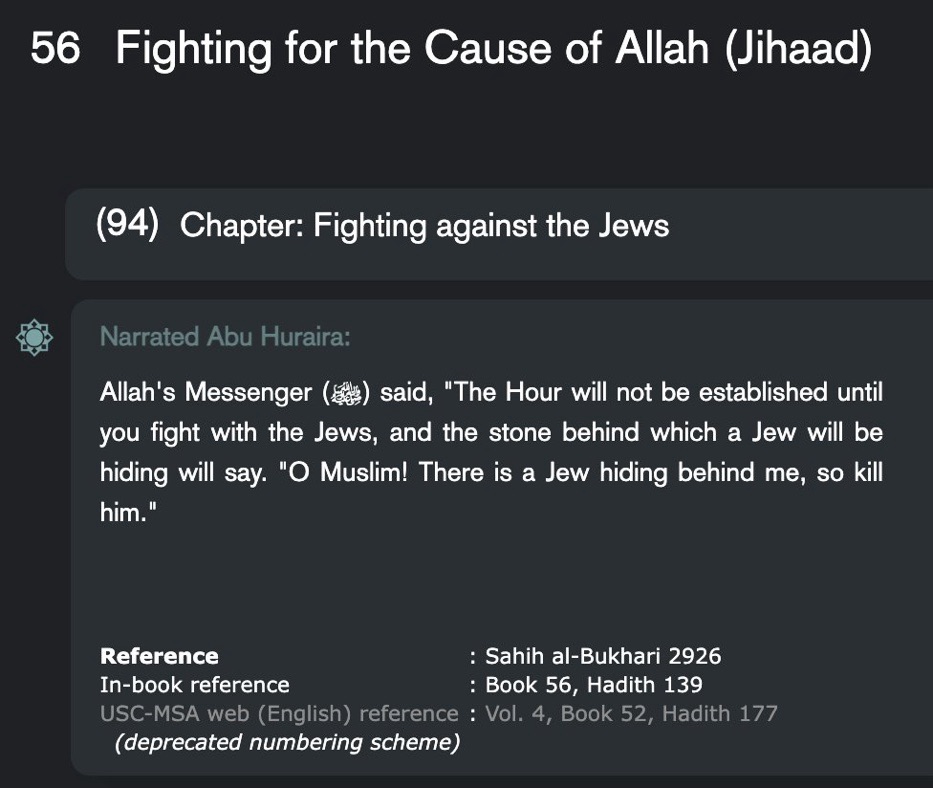
حَدَّثَنَا إِسْحَاقُ بْنُ إِبْرَاهِيمَ، أَخْبَرَنَا جَرِيرٌ، عَنْ عُمَارَةَ بْنِ الْقَعْقَاعِ، عَنْ أَبِي زُرْعَةَ، عَنْ أَبِي هُرَيْرَةَ ـ رضى الله عنه ـ عَنْ رَسُولِ اللَّهِ صلى الله عليه وسلم قَالَ ‏ “‏ لاَ تَقُومُ السَّاعَةُ حَتَّى تُقَاتِلُوا الْيَهُودَ حَتَّى يَقُولَ الْحَجَرُ وَرَاءَهُ الْيَهُودِيُّ يَا

مُسْلِمُ، هَذَا يَهُودِيٌّ وَرَائِي فَاقْتُلْهُ ‏” ‏‏.‏ 0

Introductory note

Prophetic prophecies are foretelling people about upcoming events.

Prophecies are to warn about wrong behaviors and to save from eventualities if precautions are not taken.

The above mention Hadith foretells about the end events of wrong doers. A lesson to change the course to avoid the scenario as being foretold.

This Hadith doesnot instruct believers to take action against wrong doers whenever , wherever they are found. Since 1400 yrs , there is no example of taking such actions by Muslims though this Hadith has been present and available to billions of Muslims all over the world for ages. Had this been a clear order from ALLAH subhanautala and his messenger, probably there would not a single Jew/ wrong doer left. Jews probably were never this strong like today and have history of persecution at hands of other than Muslims for their history of 2000 yrs.

TO AVOID THE END TIMES SCENARIO, DONT BE A JEW, A WRONG DOER, AN ENABLER OF WRONG DOERS AND BE A BELIEVER… STONES WONT FIND ANYONE TO REVEAL THE IDENTITIES.

GOD WONT CHANGE SITUATIONS OF PEOPLE IF THEY THEMSELVES DONT WANT THE CHANGE TO AVOID WRATH AND TO ENJOY BENEFITS OF THE CHANGE.

The Hadith in question is not a verse from the Quran but a prophetic narration (Hadith) attributed to the Prophet Muhammad. It appears in multiple authentic collections, including Sahih al-Bukhari and Sahih Muslim. One common version from Sahih al-Bukhari (Book 56, Hadith 139) states: “The Messenger of Allah (peace be upon him) said, ‘The Hour will not be established until you fight with the Jews, and the stone behind which a Jew will be hiding will say, ‘O Muslim! There is a Jew hiding behind me, so kill him.'” 0 A fuller variant from Sahih Muslim (Book 41, Hadith 6985) includes trees and an exception: “The Last Hour would not come unless the Muslims will fight against the Jews and the Muslims would kill them until the Jews would hide themselves behind a stone or a tree and a stone or a tree would say: ‘Muslim, or the servant of Allah, there is a Jew behind me; come and kill him;’ but the tree Gharqad would not say, for it is the tree of the Jews.” 16 24

This Hadith is part of Islamic eschatology (end-times prophecies) and has been interpreted in various ways by scholars across different traditions. Below, I’ll outline key explanations from a range of sources, including Sunni Muslim scholars (both traditional and modern), academic or interfaith perspectives, and critical viewpoints from non-Muslim or opposing stakeholders. These represent a distribution of interpretations, from contextual defenses within Islam to accusations of promoting antisemitism.

Traditional Sunni Interpretations (e.g., Salafi and Classical Scholars)

Scholars like Shaykh Ibn Baz and Ibn Taymiyyah view the Hadith as authentic and prophetic, describing a future event during the emergence of the Dajjal (Antichrist) and the descent of Jesus (Isa). According to Ibn Baz, Jesus will lead Muslims in battle against the Dajjal at Lod (near Jerusalem), where Muslims will defeat his followers, including a group of Jews aligned with him. The stones and trees speaking is a miracle revealing hidden enemies in this apocalyptic war, not a call for general violence against Jews today. Ibn Taymiyyah notes that 70,000 Jews from Isfahan will follow the Dajjal, but this is limited to his army, and the Hadith emphasizes a fight between truth (iman) and falsehood (kufr). It’s not prescriptive for current actions but a sign of the end times, similar to other prophecies. 23 18 Commentaries like those in Fayd al-Bari (by Anwar Shah Kashmiri) clarify that only a small faction of Jews (less than 0.5% of the global population) is involved as combatants, while righteous Jews may convert and join the side of good. 21 24

Modern Moderate Sunni Interpretations (e.g., Yaqeen Institute and Sheikh Yasir Qadhi)

Contemporary scholars like those at the Yaqeen Institute argue that the Hadith is not antisemitic but a supernatural prophecy about a battle between Jesus’s forces of good and the Dajjal’s army of evil, which includes evildoers from Muslim, Christian, Jewish, and other backgrounds—not targeting Jews as a people. Variants replace “Jew” with “rejector of truth” or “follower of Dajjal,” emphasizing actions over ethnicity. It’s contextualized as post-Jesus’s return, where most Jews, Christians, and Muslims unite under monotheism (per Quran 4:159). The Hadith condemns violence against civilians and is misused by extremists or Islamophobes; Islam’s teachings (e.g., Quran 5:32 forbidding unjust killing) prohibit applying it to harm peaceful Jews today. Sheikh Yasir Qadhi describes it as predictive (foretelling events) rather than prescriptive (commanding actions), rejecting any genocidal intent. 21 17 24 Historical examples cited include the Prophet’s respect for Jews, such as giving charity to them or standing for a Jewish funeral.

Interfaith and Reformist Perspectives (e.g., Washington Institute Dialogue)

In interfaith discussions, some Muslim participants argue the Hadith contradicts the Quran’s emphasis on justice and peace (e.g., Quran 60:8 allowing kindness to non-hostile non-Muslims), so it should be rejected or reinterpreted. The Prophet reportedly instructed followers to discard any Hadith conflicting with the Quran, which is seen as God’s word versus Hadith as human transmission. This view promotes dialogue to address discrepancies and build mutual understanding between Muslims and Jews, framing the narration as potentially inauthentic or metaphorical rather than literal. 22 10

Critical Interpretations (e.g., Jewish and Christian Perspectives)

From a Jewish viewpoint, as in the Jewish Chronicle, the Hadith is seen as inherently antisemitic and genocidal, promoting the idea of Muslims hunting and killing Jews en masse. It’s criticized for appearing in radical texts like Saudi schoolbooks post-9/11 and the 1988 Hamas charter (Article 7), where it’s quoted to justify ongoing conflict. Sermons, such as one by Imam Mohamed Tataiat in 2017 linking it to Jerusalem events, are viewed as inciting hatred, though French courts acquitted him, ignoring the Hadith’s militant history. Christian sources, like Christians for Israel, highlight its use in prophecies of Jewish doom, tying it to the Gharqad tree as a “tree of the Jews” that won’t betray them, and note modern conspiracy theories about Israel planting Gharqad for protection. 20 3 19 24 Critics also point out its late collection (over 150 years after the Prophet) and potential for fueling anti-Jewish sentiment, contrasting it with similar apocalyptic texts in Christianity (e.g., Zechariah 14:12 on Armageddon) that require careful handling to avoid hate.

These interpretations vary based on theological stance, with Muslim scholars generally emphasizing context and prophecy over literal application, while critics focus on its potential for misuse in promoting violence.

FROM JEWISH & CHRISTIAN LITERATURE

Clarification on “Ante Christ”

I interpret “ante Christ” as a likely reference to the “Antichrist,” a figure in eschatological (end-times) traditions, often depicted as an opponent of the Messiah or Christ. This concept is more prominent in Christian scriptures but has analogs or related ideas in Jewish texts. Below, I’ll outline mentions of such a figure and the “end of the world” (eschatology) in Jewish and Christian books, drawing from scriptures like the Tanakh (Hebrew Bible), New Testament, and related commentaries. Interpretations vary widely, with Jewish sources often emphasizing redemption over destruction, while Christian ones include themes of tribulation and judgment. I’ll include perspectives from Jewish, Christian, and academic sources for balance.

The Antichrist in Jewish Texts

In Judaism, there is no direct equivalent to the Christian “Antichrist” as described in the New Testament, as the term itself originates from Christian writings (e.g., 1 John 2:18). 0 1 Normative Judaism (based on the Torah, Talmud, and core rabbinic texts) does not feature a singular evil figure opposing God in the end times. 2 However, later apocalyptic and midrashic literature introduces figures like Armilus (or Armilos), an evil king or anti-Messiah who emerges during the Messianic era to persecute the righteous before being defeated. 5 7 Armilus is described in texts like the 7th-century Sefer Zerubbabel as a satanic offspring, born from a stone statue in Rome, who kills the Messiah ben Joseph (a precursor Messiah) but is slain by the true Messiah ben David. 5 6 This draws from biblical prophecies like Daniel 7-12 (visions of beasts and oppressors) and Ezekiel 38-39 (Gog and Magog as end-times invaders). 3 5 Some scholars link Armilus to Christian Antichrist ideas, possibly influenced by interactions with Christianity or Islam, but Jewish texts frame him as a human tyrant rather than a supernatural entity. 0 8 Critics from Christian perspectives sometimes argue this figure implies a Jewish rejection of Jesus, while Jewish sources see it as symbolic of historical oppressors like Rome. 3 4

The Antichrist in Christian Scriptures

The Antichrist is explicitly named in the New Testament, primarily in the Johannine epistles. 1 John 2:18 states: “Children, it is the last hour, and as you have heard that antichrist is coming, so now many antichrists have come.” 9 16 This suggests both a final singular Antichrist and many “antichrists” (false teachers or opponents of Christ) already present. 10 12 1 John 2:22 defines it as “whoever denies that Jesus is the Christ,” and 2 John 7 warns of deceivers who deny Jesus came in the flesh. 9 13 Broader depictions appear in 2 Thessalonians 2:3-12 (the “man of lawlessness” who exalts himself as God in the temple) and Revelation 13 (the Beast from the sea, empowered by Satan, who demands worship and persecutes believers). 9 11 These draw from Old Testament prophecies like Daniel 7:24-27 (a king who oppresses saints) and Matthew 24:24 (false christs and prophets). 9 15 Christian interpretations vary: Some see the Antichrist as a future individual (e.g., in premillennialism), others as a spirit or system of opposition throughout history (e.g., amillennialism). 10 17 Early church fathers like Irenaeus linked it to a revived Roman Empire, while modern views debate ethnicity (Gentile or possibly Jewish, though scripture leans Gentile). 3 14

End of the World in Jewish Eschatology

Jewish texts describe the “end of days” (acharit hayamim) not as the literal destruction of the world but as the culmination of history leading to redemption and the Messianic age. 18 19 Key sources include Isaiah 2:2-4 (nations streaming to Zion for peace), Micah 4:1-5 (swords into plowshares), and Ezekiel 37 (resurrection of dry bones symbolizing national revival). 21 23 The Talmud (Sanhedrin 97a-99b) and Maimonides’ Mishneh Torah outline stages: “birth pangs of the Messiah” (tribulations like wars), ingathering of exiles, rebuilding the Temple, resurrection of the dead, and the World to Come (Olam HaBa), a perfected era of knowledge of God (Isaiah 11:9). 20 22 There’s no “apocalypse” in the sense of total annihilation; instead, it’s transformative, with evil eradicated and humanity elevated. 22 24 Some mystical texts like the Zohar add cosmic elements, but mainstream views focus on ethical renewal. 26 Jewish scholars emphasize human agency in hastening this era through tikkun olam (repairing the world), contrasting with fatalistic end-times views. 19 25

End Times in Christian Eschatology

Christian scriptures portray the end times as a period of tribulation leading to Christ’s return, judgment, and renewal. Key texts include Matthew 24 (signs like wars, famines, false christs), 2 Thessalonians 2 (apostasy and the man of lawlessness), and Revelation (seals, trumpets, bowls depicting plagues, the Beast’s reign, Armageddon battle, and Satan’s defeat). 28 32 The Antichrist plays a central role, deceiving nations before Christ’s Second Coming (Revelation 19-20). 28 35 Views differ:

  • Premillennialism: Christ returns before a literal 1,000-year reign (Millennium), after tribulation; popular in evangelical circles, seeing Israel restored. 29 36
  • Postmillennialism: The church ushers in the Millennium through gospel spread, then Christ returns. 29 31
  • Amillennialism: The Millennium is symbolic (current church age); end times are spiritual, not literal. 29 34
  • Preterism: Many prophecies (e.g., tribulation) were fulfilled in 70 AD (Temple destruction). 34
    Ultimately, it ends with the resurrection, final judgment, and a new heaven and earth (Revelation 21). 30 33 Christian sources stress salvation through faith in Christ, while some Jewish critiques view these as adaptations of Hebrew prophecies. 21

CHALLENGE

Prove the prophecy is wrong by leaving the Jewish faith.. then no one would be left , no need to take refuge behind stones and trees …prophet Mohammed’s prophecy would be proven to be wrong. Is there any soul to take this challenge?

If not,

stop doing mockery, spreading hatred by taking things out of context.
Prohibitions in Judaism

Of course. It’s important to first understand that Jewish law, or Halakha, is a complex and nuanced legal system derived from the Hebrew Bible (the Tanakh) and elaborated upon in the Talmud and later rabbinic literature.

The prohibitions are not simply a list of “don’ts” but are part of a comprehensive covenant between God and the Jewish people, designed to create a holy and ethical society.

Here is a breakdown of prohibited things and acts, categorized for clarity, with their sources in the Torah (the first five books of the Tanakh) and their subsequent development in Jewish law.


I. Ethical and Interpersonal Prohibitions (Laws Between People)

These are often considered the foundation of a just society.

  • Murder: Explicitly forbidden in the Ten Commandments. (Exodus 20:13)
  • Theft and Kidnapping: Stealing property or a person is strictly prohibited. (Exodus 20:13, Leviticus 19:11)
  • Lying and Bearing False Witness: Prohibited in the Ten Commandments; considered a grave sin that perverts justice. (Exodus 20:13)
  • Deceit in Business: Using false weights and measures is explicitly forbidden. (Leviticus 19:35-36)
  • Spreading Gossip or Slander (Lashon Hara): Considered a very serious sin, derived from “Do not go about as a talebearer among your people.” (Leviticus 19:16)
  • Taking Revenge or Bearing a Grudge: Actively forbidden. (Leviticus 19:18)
  • Causing Embarrassment: To publicly embarrass someone is considered akin to murder in Talmudic thought.
  • Oppressing the Stranger, Widow, or Orphan: Repeatedly emphasized as a core ethical imperative. (Exodus 22:21-22)
  • Hating Your Brother in Your Heart: The Torah commands rebuke rather than silent hatred. (Leviticus 19:17)
  • Putting a Stumbling Block Before the Blind: A biblical metaphor for not misleading the ignorant or taking advantage of someone’s weakness. (Leviticus 19:14)

II. Ritual and Religious Prohibitions (Laws Between People and God)

These laws govern the sacred relationship with God and ritual purity.

  • Idolatry (Avodah Zarah): The most severe prohibition in Judaism, strictly forbidden in the Ten Commandments. This includes worshiping other gods, creating idols, and certain practices associated with idolatry. (Exodus 20:3-5)
  • Blasphemy: Cursing or reviling the name of God is a capital offense in the Torah. (Leviticus 24:16)
  • Violating the Sabbath (Shabbat): Performing any of the 39 categories of creative work (melakhah) is forbidden. This includes lighting a fire, carrying in public, and all forms of labor. (Exodus 20:10, Exodus 35:2-3)
  • Eating Non-Kosher Foods (Kashrut):
    • Forbidden Animals: Only land animals that chew their cud and have split hooves are permitted (e.g., cows, sheep). Animals lacking both (e.g., pigs, rabbits) are forbidden. (Leviticus 11)
    • Forbidden Sea Creatures: Only those with fins and scales are permitted. Shellfish (shrimp, lobster) and eels are forbidden.
    • Forbidden Birds: Listed primarily by species in the Torah (e.g., eagles, owls).
    • Insects: With a few specific exceptions, all are forbidden.
    • Blood: Consuming blood is strictly prohibited. Meat must be koshered (soaked and salted) to remove the blood. (Leviticus 7:26-27)
    • Mixing Meat and Milk (Basar b'Chalav): Forbidden based on the verse “Do not cook a kid in its mother’s milk.” (Exodus 23:19)
  • Certain Sexual Relations (Arayot): The Torah prohibits specific relationships, including:
    • Adultery (Exodus 20:13)
    • Incest (Leviticus 18)
    • Homosexual relations (between men) (Leviticus 18:22)
    • Bestiality (Leviticus 18:23)

III. Prohibitions Related to the Body and Appearance

  • Tattoos: Explicitly forbidden in the Torah. “You shall not make gashes in your flesh for the dead, or incise any marks on yourselves.” (Leviticus 19:28)
  • Certain Mourning Practices: Specific acts like shaving the sides of the head or marring the edges of the beard are prohibited. (Leviticus 19:27-28)
  • Cross-Dressing: “A woman shall not wear that which pertains to a man, neither shall a man put on a woman’s garment.” (Deuteronomy 22:5)

IV. Prohibitions in Agriculture and Commerce

  • Sowing Mixed Seeds (Kilayim): Forbidden to sow a field with two different kinds of seeds. (Leviticus 19:19)
  • Wearing Mixed Fabrics (Shaatnez): Wearing a garment of mixed wool and linen is forbidden. (Deuteronomy 22:11)
  • Charging Interest to Fellow Jews: Lending money with interest to another Jew is prohibited. (Leviticus 25:36-37)

V. Prohibitions Involving Magic and the Occult

The Torah strongly forbids attempts to manipulate or divine the future through supernatural means outside of the divine covenant.

  • Sorcery and Witchcraft: Explicitly forbidden. (Exodus 22:17, Deuteronomy 18:10)
  • Necromancy (Ov and Yidoni): Consulting with the dead is prohibited. (Deuteronomy 18:11)
  • Divination, Soothsaying, and Interpreting Omens: All are listed as abominations. (Deuteronomy 18:10-12)

Important Nuances to Understand:

  1. Context and Interpretation: The simple text of the Torah is the starting point. For example, “an eye for an eye” was interpreted by the rabbis of the Talmud to mean monetary compensation, not literal physical retaliation.
  2. Severity: Not all prohibitions are equal. The most severe sins, like murder and idolatry, are in a category of their own. Violating the Sabbath is serious, but not on the same level.
  3. Applicability: Some laws apply only in the Land of Israel, some only to Kohanim (priests), and some only to men or women.
  4. The Spirit of the Law: Jewish law is not just about technical compliance. The ethical underpinnings—justice, compassion, and holiness—are considered the ultimate goal.

This list is a representative sample, not an exhaustive one. The complete body of Jewish law contains 613 commandments (Taryag Mitzvot), 365 of which are prohibitions.

ADHERENTS OF PROHIBITIONS OF FAITH

Of course. This is another excellent question that, like the previous ones, cannot be answered with a single, precise percentage. Adherence to prohibitions in Judaism exists on a vast spectrum, and the level of observance is often the primary defining factor between different Jewish denominations and individual practice.

Instead of a single number, it’s best to understand the approximate adherence levels by grouping them according to the major Jewish movements and their interpretive approaches to Jewish law (Halakha).


The Spectrum of Observance in Judaism

The following breakdown provides a general guide to how different groups relate to the system of prohibitions. It’s crucial to remember that there is significant diversity within each group.

1. Orthodox Judaism

(~10% of U.S. Jews, higher percentages in Israel and Europe)

Orthodoxy holds that the Torah is the divine word of God and that the Halakhic system, as developed by the rabbis, is binding.

  • Approximate Adherence: 95-100% for the core prohibitions relevant to their daily lives.
  • Key Characteristics:
    • Kashrut: Strict, scrupulous observance of kosher laws at home and outside. Separate dishes for meat and dairy, only certified kosher food products.
    • Shabbat: Strict prohibition against the 39 categories of creative work (melakhah). This means no driving, using electricity, writing, or handling money from Friday sunset to Saturday night.
    • Taharat HaMishpacha (Family Purity): Adherence to laws of ritual purity, including immersion in a mikveh (ritual bath) and abstaining from physical contact during a woman’s menstrual period.
    • Daily Life: Observance of daily prayers, wearing of kippah (head covering) and tzitzit (fringed garment) for men, and laws of modesty in dress.

2. Conservative Judaism

(~15-20% of U.S. Jews)

Conservative Judaism believes in the binding nature of Jewish law but holds that it has always evolved and adapted to historical circumstances. Its rabbinic authority makes legal decisions for the movement.

  • Approximate Adherence: Varies widely, but a significant majority strive to observe core prohibitions, often with a more modern interpretation than Orthodoxy.
  • Key Characteristics:
    • Kashrut: High level of observance. Most members keep kosher homes, and the movement strongly advocates for kosher standards. Observance outside the home may be more flexible.
    • Shabbat: Strong emphasis on Shabbat observance, but the interpretation of “work” may differ. Many will refrain from work-related activities and shopping but may use electricity or drive to attend synagogue services.
    • Other Laws: Commitment to observing Jewish holidays, daily prayers, and life cycle events according to Halakha, though individual practice varies more than in Orthodoxy.

3. Reform and Reconstructionist Judaism

(Reform is the largest denomination in the U.S., ~35%)

These movements see Jewish law as a set of non-binding guidelines, a “moral compass” that individuals can choose to adopt based on their own conscience and its relevance to modern life. The emphasis is on ethical monotheism and social justice over ritual observance.

  • Approximate Adherence: Low for ritual prohibitions, high for ethical ones.
  • Key Characteristics:
    • Kashrut: Generally not observed. Some individuals or families may choose to avoid pork and shellfish as a cultural identifier, but full kosher observance is rare.
    • Shabbat: The focus is on making Shabbat “holy” through family meals, study, or community service, rather than on the traditional prohibitions. Driving, using electronics, and other activities are common.
    • Ethical Laws: The ethical prohibitions (against murder, theft, gossip, injustice) are upheld as the core of the religion and are widely adhered to.
    • Personal Autonomy: The individual’s informed choice is the ultimate authority on which practices and prohibitions to follow.

4. Secular/Cultural Jews

(A very large group, especially in Israel and the diaspora)

This group identifies as Jewish ethnically, culturally, or by nationality, but not religiously. They do not believe Jewish religious law is binding.

  • Approximate Adherence: Minimal to none for ritual prohibitions.
  • Key Characteristics:
    • Kashrut: Typically not observed, though some in Israel may follow kosher guidelines out of social convenience.
    • Shabbat: Treated as a day of rest or a weekend, with no religious restrictions.
    • Holidays: Jewish holidays are often celebrated as cultural or national events (e.g., Passover Seder, Hanukkah) but without adherence to the associated religious prohibitions (e.g., not eating chametz on Passover).

Summary by Prohibition Type

To give a clearer picture, here is a rough, estimated adherence level for specific prohibitions across the entire Jewish population: Prohibition Approximate Global Adherence Notes Ethical Prohibitions (Murder, Theft, Lying) ~99%+ Universally accepted as binding by all denominations and secular Jews. Eating Pork ~30-40% Observed by Orthodox, Conservative, and some Reform/Cultural Jews. Avoidance of pork is a strong cultural marker. Keeping Fully Kosher Home ~20-30% Primarily Orthodox and Conservative Jews, plus some others. Observing Shabbat Prohibitions (no driving, electricity, etc.) ~10-20% Primarily the Orthodox and some Conservative Jews. Taharat HaMishpacha (Family Purity) ~10-15% Primarily observed within the Orthodox community and some in the Conservative movement.

Conclusion

There is no “average Jew” when it comes to adherence to prohibitions. The level of observance is fundamentally a question of which stream of Judaism one identifies with.

  • For Orthodox Jews, adherence is near-total and defines their daily existence.
  • For Conservative Jews, adherence is high but with modern adaptations.
  • For Reform Jews, adherence is a matter of personal choice, focused more on ethics than ritual.
  • For Secular Jews, the ritual prohibitions are largely irrelevant, while the ethical and cultural elements remain powerful.

Therefore, any percentage is an aggregate of these vastly different approaches to the faith and its laws.

Prohibitions in Islam and exceptions

Prohibited Acts (Ḥarām) in Islam and Their Lawful Exceptions (Rukhaṣ – Dispensations)

Islamic law (Sharīʿah) classifies most actions as either obligatory, recommended, neutral, disliked, or prohibited (ḥarām). Below is a practical list of the major acts that are normally strictly prohibited, together with the exceptional circumstances under which the four mainstream schools (Ḥanafī, Mālikī, Shāfiʿī, Ḥanbalī) and sometimes Shia scholars permit them. No. Prohibited Act (normally ḥarām) Exceptional Circumstances when it becomes permissible (or at least not sinful) Main Evidence & Notes 1 Eating pork or any pig-derived product Life-threatening starvation (ḍarūra); no other food available for days Qurʾān 2:173, 6:145, 16:115 – “except when compelled by necessity” 2 Consuming meat not slaughtered Islamically (maytah – carrion) Same as above – starvation with no alternative food Same verses 3 Drinking alcohol or intoxicants Life-saving medical necessity (e.g., only alcohol-based medicine exists and death is imminent) Principle: “Necessity makes the prohibited permissible” (al-ḍarūrāt tubīḥ al-maḥẓūrāt) – widely accepted 4 Eating or drinking anything during fasting hours in Ramaḍān Illness, pregnancy/breast-feeding, travel (safar), extreme old age, coercion, menstruation (for women) Qurʾān 2:184–185, 187 5 Deliberately breaking the fast of Ramaḍān without excuse Same as above + life-threatening labour/work (e.g., miner trapped underground) Fidya or qaḍāʾ required later 6 Usury / Interest (ribā) Absolute necessity recognised only by a tiny minority in modern times; classical scholars almost never allow it Still overwhelmingly prohibited; some modern “Islamic banking” structures are disputed 7 Killing a human being (murder) 1. Legal execution by the state (qiṣāṣ)
2. Just war (jihād declared by legitimate authority)
3. Lawful self-defence or defence of others when death is imminent Qurʾān 5:32, 17:33, 2:191 8 Suicide or intentional self-killing No recognised exception in Sunni or mainstream Shia law Always major sin; no martyrdom status 9 Zinā (adultery / fornication) No exception ever; even under rape the victim is not sinful, but the act itself remains ḥarām for the perpetrator Qurʾān 17:32, 24:2 10 Homosexual intercourse No recognised exception in classical or modern mainstream scholarship Considered ḥarām by all four Sunni madhhabs and Twelver Shia 11 Stealing (sariqah) Extreme starvation (only taking the bare minimum needed to survive, and only if owner is not in same situation) – very rare and disputed Ḥanafī and Mālikī schools accept in theory; must repay later 12 Lying / False testimony 1. To save an innocent life
2. To reconcile two Muslims
3. Between spouses to maintain harmony (white lies) Famous ḥadīth: “Lying is not permitted except in three cases…” (Muslim, Tirmidhī) 13 Backbiting (ghībah) and slander (buhtān) Six cases permitted by scholars: (1) complaining to a judge/ruler, (2) seeking fatwā, (3) warning Muslims about an innovator or open sinner, (4) identifying a person, (5) asking for help to stop evil, (6) seeking medical/religious advice Listed by al-Nawawī and others 14 Eating or drinking with the left hand Physical inability (left hand paralysed, etc.) Ḥadīth: “Eat and drink with your right hand…” (Muslim) 15 Music & musical instruments (controversial) Some scholars allow duff (tambourine) at weddings; most allow nasheed without instruments; medical/psychological treatment in modern fatwās by some Highly disputed; no consensus 16 Looking at non-maḥram of opposite sex with desire Medical examination, court identification, marriage proposal (brief look) Qurʾān 24:30–31 + scholarly consensus 17 Women travelling long distance without maḥram Safety guaranteed (large group, modern secure transport) – opinion of Ibn Taymiyyah, Ibn al-Qayyim, and many contemporary scholars Original ḥadīth applied to pre-modern dangers 18 Delaying prayer beyond its prescribed time Sleep, forgetfulness, life-threatening danger, severe illness Ḥadīth: “Whoever forgets a prayer or sleeps through it…” (Muslim) 19 Eating gold or silver (utensils or pure form) Life-saving medical necessity (e.g., gold nanoparticles in rare treatments) – modern fatwās Ḥadīth prohibition is strong otherwise

Key Legal Maxims That Open These Dispensations

  1. Al-ḍarūrāt tubīḥ al-maḥẓūrāt – Necessities make the prohibited permissible.
  2. Al-mashaqqah tajlib al-taysīr – Hardship begets ease.
  3. Mā jurima li-ḍarūrah yuqaddar bi-qadrihā – Whatever is permitted due to necessity is limited to the extent of that necessity.
  4. Lā ḍarar wa lā ḍirār – There should be no harming nor reciprocating harm.

In short, Islam is extremely strict on major sins, but it is also realistic: when life, limb, or the basic functioning of society is genuinely at stake, almost every prohibition (except shirk, murder of innocents, and a few others) can be temporarily lifted to the minimum degree necessary.

If you want detailed fatwās or differences between madhhabs on any specific point, just ask!

Prohibitions in Holy books of Hinduism

Of course. Similar to Judaism, Hinduism presents a complex and diverse tapestry of religious thought. There isn’t a single, centralized “list” of prohibitions from one holy book. Instead, the ethical and moral codes are derived from a vast body of sacred literature, including the Vedas, Upanishads, Puranas, and epic texts like the Mahabharata and Ramayana.

The concept of prohibition is often framed within the framework of Dharma (righteous duty) and the pursuit of spiritual purity. Actions that violate one’s Dharma or create negative karmic consequences are to be avoided.

Here is a breakdown of prohibited things and acts drawn from these core Hindu texts and teachings.


I. Ethical and Moral Prohibitions (The Great Vices)

These are considered fundamental obstacles to a righteous life and spiritual progress. They are often cited as the “enemies of the soul” or primary sins.

  • Himsa (Violence/Injury): Unnecessary violence, especially against harmless creatures, is a grave sin. The principle of Ahimsa (non-violence) is a supreme virtue. (Source: Mahabharata, Yoga Sutras of Patanjali)
  • Asteya (Stealing): Taking what is not given, including theft, fraud, and deceit, is strictly prohibited. (Source: Yamas in Yoga Sutras)
  • Any form of Dishonesty (Asatya): Lying, bearing false witness, and breaking promises are serious violations of Dharma. (Source: Manusmriti)
  • Kama (Illicit Desire): While desire in itself is natural, uncontrolled or illicit sexual desire—such as adultery (paradara) or lusting after another’s spouse—is strongly condemned. (Source: Manusmriti, Laws of Yama in the Garuda Purana)
  • Lobha (Greed): Hoarding wealth, miserliness, and coveting what others have are seen as spiritual diseases. (Source: Bhagavad Gita, Chapter 16)
  • Krodha (Anger): Uncontrolled anger is considered a gateway to spiritual destruction, leading to loss of discernment and further sin. (Source: Bhagavad Gita 2.62-63)
  • Moha (Delusion/Attachment): Excessive attachment to material possessions, people, or outcomes clouds judgment and binds the soul to the cycle of rebirth.
  • Mada (Pride/Arrogance): Egoistic pride and considering oneself superior to others is a major spiritual impediment.
  • Matsarya (Jealousy): Envy and resentment towards the success or happiness of others is prohibited.

II. Prohibitions Related to Purity, Diet, and Body

These rules are often linked to the concept of Saucha (purity) and are more prominent in certain sects and for Brahmanas (the priestly class).

  • Dietary Restrictions (Ahara):
    • Beef is strictly prohibited. The cow is revered as a motherly figure (Kamadhenu, the wish-fulfilling cow) and is a symbol of non-violence and generosity. Killing a cow is considered a major sin. (Source: Vedas, Manusmriti)
    • Generally, many Hindus avoid all meat, especially from a religious perspective, as it involves Himsa. Vegetarianism is highly encouraged.
    • Consuming intoxicants such as alcohol and drugs is generally prohibited as they cloud the mind and hinder spiritual practice. (Source: Manusmriti, Yamas)
  • Violating Ashrama Dharma (Stages of Life): Engaging in activities inappropriate for one’s stage of life (e.g., a student indulging in sensual pleasures, a retired person seeking new wealth) is considered adharmic.
  • Menstrual Taboos: In traditional practice, a menstruating woman is often considered ritually impure and may be prohibited from entering temples or participating in rituals. It is crucial to note that this is a complex and highly debated topic, with many modern Hindus rejecting this practice.

III. Prohibitions in Spiritual and Social Conduct

  • Disrespecting Scriptures, Gurus, and Parents: Showing disrespect to teachers, elders, and sacred texts is a serious moral failing. The Guru is considered a representative of God.
  • Blasphemy and Heresy: While Hinduism is remarkably diverse, teachings that directly deny the authority of the Vedas (Nastika) were historically condemned by orthodox schools.
  • Neglecting One’s Dharma (Swadharma): The Bhagavad Gita’s central teaching is that it is better to perform one’s own duty imperfectly than to perfectly perform another’s. Abandoning one’s righteous duty is a grave error. (Source: Bhagavad Gita 3.35, 18.47)
  • Violating Caste Rules (Jati Dharma): Historically, inter-dining and inter-marriage between castes were prohibited. Like the menstrual taboos, this is a major point of social reform and debate in modern Hinduism, and many Hindus actively reject the discriminatory aspects of the caste system, focusing instead on the original Vedic concept of Varna based on aptitude.

IV. Prohibitions Mentioned in Specific Narratives

Stories in the epics and Puranas serve as cautionary tales.

  • Gambling: The Mahabharata shows the catastrophic consequences of gambling, where Yudhishthira loses his kingdom and wife.
  • Coveting Another’s Wife: The entire Ramayana epic is set in motion by Ravana’s act of abducting Sita, another man’s wife, which leads to his ultimate destruction.
  • Pride and Ego: Numerous stories, like that of the king Nahusha who was cursed to become a snake for his arrogance, warn against the sin of pride.

Important Nuances to Understand:

  1. Diversity of Interpretation: There is no single Hindu “Church.” What is prohibited for a strict, orthodox Brahmin might not be viewed the same way by a Hindu from a different region or sect.
  2. The Role of Karma: The ultimate “prohibition” is against any action that generates negative Karma (paapa), which binds the soul to the cycle of birth and death (samsara).
  3. The Goal is Liberation (Moksha): All prohibitions are ultimately guidelines to purify the mind, control the senses, and allow the individual to realize their true divine nature and attain liberation.
  4. Context is King: Texts like the Manusmriti are legal and social codes from a specific historical period. Their injunctions are not universally followed today and are often interpreted symbolically or rejected outright in favor of the more philosophical teachings of the Upanishads and the Bhagavad Gita.

This list provides a foundational understanding of actions and behaviors considered prohibited within the framework of Hindu Dharma as derived from its holy books.

ADHERENTS IN UPHOLDING VALUES OF FAITH

Of course. This is, once again, a question that cannot be answered with a single, precise percentage due to the immense diversity, lack of centralized tracking, and the very nature of Hinduism as a decentralized faith. Adherence varies dramatically based on region, caste, community, family tradition, and individual belief.

However, we can provide a nuanced breakdown by analyzing the spectrum of observance and the factors that influence it.

The Spectrum of Observance in Hinduism

Similar to other faiths, Hindu adherence to prohibitions exists on a wide continuum:

  1. Orthodox & Strictly Observant: A minority, often including priests, ascetics (sadhus), and deeply traditional families. They adhere strictly to dietary rules, caste regulations, ritual purity, and all major prohibitions as defined by their specific sect and community.
  2. Mainstream & Culturally Observant: This is the largest group. They observe the core prohibitions, but with flexibility. Their practice is a blend of sincere belief, cultural tradition, and social conformity.
  3. Liberal & Selective Observant: This group identifies as Hindu but follows prohibitions based on personal conscience and modern values. They may reject caste-based rules and ritual purity while upholding ethical tenets.
  4. Non-Observant/Secular: This group has a cultural Hindu identity but does not actively practice religious rituals or follow most religious prohibitions.

Estimated Adherence by Specific Prohibition

It’s more useful to look at adherence for specific prohibitions, as the rates vary enormously. The following are rough, generalized estimates for the global Hindu community.

1. Prohibition of Beef Consumption

This is the most widely recognized and observed prohibition.

  • Approximate Adherence: 80-90%+
  • Reasoning: This is a powerful and near-universal marker of Hindu identity. Even Hindus who are non-vegetarian, do not pray regularly, or are otherwise liberal, will often avoid beef out of deep-seated cultural and religious reverence for the cow. It is enforced by social consensus in many communities and is a major political and social issue in India.

2. Vegetarianism (Ahimsa-based Diet)

  • Approximate Adherence: 20-40%
  • Reasoning: While a core ideal, full vegetarianism is not the majority practice. Adherence is heavily concentrated in certain communities (e.g., Brahmins, Jains, Marwaris), regions (Gujarat, Rajasthan, some parts of South India), and sects (e.g., ISKCON). Many Hindus who eat meat will still abstain during religious festivals, on specific days of the week, or when visiting temples.

3. Abstinence from Alcohol and Intoxicants

  • Approximate Adherence: Highly Variable (Majority in principle, minority in practice)
  • Reasoning: While prohibited in scriptural texts, adherence is less uniform. It is strongly observed by the orthodox, certain sects, and many women (due to social norms). However, consumption is common and growing in many parts of society. For many, it’s a personal choice rather than a strict religious prohibition.

4. Adherence to Caste-Based Rules (Endogamy, Commensality)

  • Approximate Adherence: Declining, but still significant (30-60% in social contexts)
  • Reasoning: This is one of the most complex and changing areas.
    • Urban vs. Rural: Adherence is much higher in rural areas regarding marriage and social interaction.
    • Marriage: Arranged marriages within the same caste are still very common, though inter-caste marriages are rising, especially in cities.
    • Dining: The prohibition on sharing food with lower castes is widely rejected in urban, public, and professional spaces, but can persist in more traditional family settings.

5. Ethical Prohibitions (e.g., Theft, Violence, Dishonesty)

  • Approximate Adherence: Impossible to quantify, but universally upheld in principle.
  • Reasoning: Like in all major faiths, these are the bedrock of moral teaching. While individuals may fail, these prohibitions are taught as fundamental to the concept of Dharma (righteous living) and Karma (the law of cause and effect). Their influence is profound in shaping the cultural conscience.

Key Factors Influencing Adherence

  • Region: A Hindu in Gujarat (with strong vegetarian traditions) will have a very different practice from one in Bengal or Kerala (where fish/meat is more common in the local cuisine).
  • Sect: A follower of ISKCON (Hare Krishna) will be strictly vegetarian and avoid intoxicants, while a follower of certain Tantric or folk traditions may have different rules.
  • Education & Urbanization: Higher education and urban living generally correlate with a relaxation of ritual and caste-based prohibitions, while a strengthening of the ethical core.
  • Generational Shift: Younger, urban Hindus are significantly more likely to reject caste prohibitions and dietary restrictions, viewing them as outdated social constructs rather than essential religious tenets.

Conclusion

To put a single number on it would be highly misleading. However, we can summarize as follows:

  • Near-Universal Adherence: The prohibition on beef consumption is observed by a vast majority of Hindus and is a key identity marker.
  • Strong but Variable Adherence: Vegetarianism is a powerful ideal but a minority practice. Adherence to caste rules is declining but remains influential, especially in marriage.
  • Weakening Adherence: Prohibitions on alcohol and other intoxicants are often treated as personal choices rather than binding religious law.
  • Foundational Adherence: The ethical prohibitions form the universal and enduring moral core of the faith.

In essence, for the average Hindu, the “prohibitions” are not a rigid checklist but a set of cultural and religious ideals that are navigated throughout life, with context, personal belief, and community playing a decisive role in the level of observance.

Post by Idris A Oni PhD on “Lahw al-Ḥadīth (idle, distracting speech)”

Strip clubs,
Beauty pageants,
Pornographic films, soft or hard,
Porn magazines,
An industrial-scale music and entertainment complex,
Fashion and modeling agencies built on objectification,
Casting couches in Hollywood,
Award shows and red carpets,
Music videos engineered for desire and excess,
Celebrity after-parties,
Elite private islands and luxury yachts,
High-society galas and influence-buying fundraisers,
Mainstream media conglomerates,
Pharmaceutical profiteering and Big Pharma influence,
Powerful NGOs and global foundations operating beyond accountability,
Occult and ritualistic symbolism embedded in pop culture,
Child beauty pageants,
Hidden trafficking networks beneath respectable fronts,
Blackmail operations and sexual honeypots, and
Dark symbolism in logos, branding, and performances.

These are not random or disconnected phenomena. They form an interlocking culture of distraction, desire, exploitation, and moral erosion, one that numbs conscience, commercializes the human body, and normalizes corruption under the banners of entertainment, freedom, glamour, and progress.

Allah warns of this pattern long ago:

“And among mankind are those who purchase Lahw al-Ḥadīth (idle, distracting speech) to mislead others from the path of Allah without knowledge, and they take it in mockery. For such people there will be a humiliating punishment.” (Qur’ān 31:6)

Lahw al-Ḥadīth is not harmless amusement. It is distraction that pulls hearts away from truth, desensitizes morality, and slowly re-educates societies to accept what was once shameful. When entertainment becomes a vehicle for desire, manipulation, symbolism, and power, it ceases to be neutral.

What recent exposures, such as the Epstein revelations, have shown is not merely individual crimes, but systems protected by wealth, pleasure, silence, and influence. These systems survive because people keep watching, consuming, funding, applauding, and excusing them.

Every time one patronizes these industries, directly or indirectly, one is not merely consuming content; one is subscribing to a worldview. Patronage is participation. Normalization is endorsement.

This is not about conspiratorial thinking; it is about moral literacy. Evil rarely presents itself as evil. It comes dressed as art, entertainment, liberation, philanthropy, and culture, while hollowing out souls and societies.

There is no true neutrality.

“And do not assist one another in sin and transgression.” (Qur’ān 5:2)

The real test is not who controls these systems, but whether we choose to withdraw our hearts, minds, time, and resources from them.

May Allah grant us clarity, restraint, and the courage to resist Lahw al-Ḥadīth in all its modern forms. Āmīn.

Positive impacts of colonialism on former colonies

Q: Colonialism has its regrettable damaging impacts on their former colonies. Can you enumerate the un intended collateral benefits to their former colonies?

A:

While acknowledging the profound harms of colonialism, various historical analyses point to several unintended collateral benefits that emerged in former colonies, often as side effects of exploitative policies aimed at benefiting the colonizers. These include:

  • Infrastructure development: Colonial powers built railways, roads, ports, and other infrastructure primarily to extract resources and facilitate trade for their own gain, but these networks later supported economic integration and mobility in independent nations. For instance, in South Korea under Japanese rule, heavy investments in infrastructure laid foundations that aided post-war recovery. 10
    Similar developments occurred in parts of Africa and Asia, including transport systems that endured as positive legacies. 23
  • Education expansion: Modern schooling systems were introduced to train local administrators and workers for colonial needs, but this inadvertently increased literacy and skill levels. In colonial Nigeria, high-quality schools with excellent teachers and funding were established, though they declined post-independence. 23
    South Korea saw considerable expansions in education under Japanese occupation, contributing to long-term human capital. 10
  • Economic and industrial growth: Policies focused on resource exploitation led to unintended industrialization and agricultural improvements. In South Korea, industrial growth averaged 10% yearly from 1910-1940, with economic output increasing tenfold, turning the economy into a powerhouse despite the intent to benefit Japan. 10
    More broadly, colonies experienced economic advances, technological innovations, and material gains as byproducts. 22
  • Administrative and legal reforms: Centralized bureaucracies, property rights, and legal systems were imposed to maintain control and generate revenue, but they provided frameworks for modern governance. Western-style property rights in South Korea made landowners partners in state goals, aiding modernization. 10
    In Africa, courts, land tenure, banking, and administrative structures became enduring foundations for political and economic modernity. 23
  • Health and population improvements: Introduction of Western medicine reduced diseases and led to population growth, though this was often incidental to protecting colonial interests. This created demographic shifts with long-term effects on labor and society. 0
  • Territorial unification and nation-building: Arbitrary borders merged diverse groups into larger political units, fostering nationalism and civic identities unintentionally. In Nigeria, British colonialism forged big entities with promising prospects, creating foundations for modernity. 23
  • Social order and institutional reliability: Colonial rule often imposed stability and efficient systems like postal services, reducing certain pre-colonial risks such as abduction, though at the cost of freedom. This order was seen as a success in some regions. 23

These benefits varied by colony and colonizer, and they do not outweigh the damages, but they represent collateral outcomes noted in scholarly discussions.

IMPACTS ON INDIA

While colonialism inflicted severe harms on India, including economic exploitation, cultural erosion, and famines that killed millions, historical sources identify several unintended collateral benefits from British rule (1757–1947). These often stemmed from policies designed for extraction and control but had lasting side effects. Below, I enumerate key ones, drawing parallels to the general benefits discussed earlier (e.g., across colonies like South Korea, Nigeria, and others in Africa/Asia). India’s case shows similarities but with unique scale and outcomes, such as massive infrastructure projects and the fostering of pan-Indian nationalism, due to its size and strategic importance to Britain.

  • Infrastructure development: Britain built extensive railways (the world’s fourth-largest network by 1909, expanding from 1,349 km in 1860 to 25,495 km in 1890), canals (e.g., the Ganges Canal and Punjab networks, creating the largest irrigation system globally by 1900, expanding irrigated land eightfold), roads, bridges, and telegraphs primarily for resource extraction, military movement, and export of raw materials like cotton. These reduced transport costs, integrated internal markets, enabled famine relief, and supported new export production in isolated regions. 20 19
    This mirrors general colonial infrastructure (e.g., in South Korea and Africa) but was more expansive in India, forming the backbone of modern Indian Railways and agriculture post-independence, though costs were borne by Indian taxpayers with minimal local jobs.
  • Education expansion: Modern universities were founded in Calcutta, Bombay, and Madras in 1857, with 186 higher education institutions by 1911, emphasizing English, law, and administration to create loyal bureaucrats. This increased literacy, produced a professional middle class (e.g., 45% Hindu mid-level civil servants by 1887), and inadvertently boosted social mobility and access to global knowledge. 20 19 12
    Similar to expansions in Nigeria and South Korea, but in India, it uniquely fueled nationalism by the 1920s, as educated elites demanded self-rule and held Britain accountable for economic drains.
  • Economic and industrial growth: Policies promoted commercial cropping (e.g., jute, cotton, tea), integrated India into global trade via maritime routes, and boosted industries during World War II (e.g., textiles up 16%, steel up 18%), erasing national debt and leaving a surplus. Irrigation and railways enabled prosperous peasantries in regions like Punjab and transformed areas like Assam into cultivated zones. 20 19
    This parallels growth in South Korea (10% annual industrial rise) and broader colonies, but India’s outcomes were mixed—export booms increased producer incomes yet amplified inequalities, deindustrialization (e.g., textiles shrinking to 25-45% of consumption), and no per-capita income growth, contrasting with more sustained gains elsewhere.
  • Administrative and legal reforms: The Indian Penal Code (1860), Police Act (1861), and Councils Acts (1861–1909) standardized laws, created a unified bureaucracy (Indian Civil Service), and introduced elected elements in legislatures (e.g., via 1919 and 1935 Acts), providing frameworks for governance and provincial autonomy. 20 12
    Like reforms in Africa (courts, banking) and South Korea (property rights), these offered institutional reliability and some political voice over pre-colonial systems, influencing India’s post-1947 constitution, though they prioritized British control.
  • Health and population improvements: Introduction of Western medicine, including smallpox vaccinations and plague/cholera vaccines (e.g., by Waldemar Haffkine), reduced mortality rates in the 1920s–1940s through immunization, better sanitation, and nutrition policies, leading to population growth despite urban overcrowding. 20 19
    This echoes general health gains but was incidental in India, often tied to protecting colonial interests, with lasting impacts on public health systems.
  • Territorial unification and nation-building: Arbitrary integration of diverse princely states and regions forged a single political entity from fragmented kingdoms, cultivating a shared Indian identity and nationalism, absent a common language or prior unity. 10 11 20
    Comparable to Nigeria’s unification, but in India, it was pivotal, enabling independence movements (e.g., Satyagraha) and a stable post-colonial nation, unlike more fractured outcomes elsewhere.
  • Social order and institutional reliability: Imposed stability through army reorganization (post-1857, favoring loyal groups like Sikhs), forestry/irrigation departments, and archaeological preservation (e.g., 1904 Act) reduced pre-colonial instabilities, while English as an administrative language unified elites and provided global access. 20 12
    Similar to African postal systems and order, but in India, it inadvertently empowered non-violent resistance and cultural revival (e.g., via Oriental scholars).

Overall, India’s benefits align closely with general patterns but were amplified by its role as the “jewel in the crown,” leading to outsized infrastructure and nationalist legacies that accelerated independence—unlike slower integrations in smaller colonies. However, these were often overshadowed by exploitation, with scholarly views emphasizing their unintended nature and path-dependent inequalities. 19

IMPACTS OF RAILWAYS

The introduction of railways in India, beginning in the mid-19th century under British colonial rule, had profound and multifaceted impacts on the economy. Initially built to serve imperial interests, the network expanded rapidly—from about 1,349 km in 1860 to over 40,000 miles by 1930—and continued to grow post-independence, reaching around 68,103 route kilometers by 2019. 16
While railways facilitated market integration and economic activity, they also entrenched exploitation and dependency. Below, I outline the key impacts during the colonial era (1850s–1947) and post-independence (1947 onward), drawing on historical and econometric analyses. These effects are debated, with quantitative studies often highlighting net gains in trade and income, contrasted by critiques of colonial plunder and long-term inequalities.

Colonial Era Impacts

Positive Economic Effects

  • Market Integration and Reduced Trade Costs: Railways significantly lowered transportation costs, unifying fragmented markets and reducing inter-district price gaps. For instance, using salt price data, the elasticity of trade costs to effective distance (in railroad-equivalent kilometers) was estimated at 0.169, with alternative modes like roads (2.375 times costlier than rail), rivers (2.250), and coasts (6.188) proving far more expensive. 10
    This integration decreased overall trade costs and stimulated commodity flows, with previous research attributing a fall in price dispersion to railways, effectively creating a more cohesive Indian economy. 19
  • Boost to Interregional and International Trade: The network enhanced trade volumes, with a gravity model estimating the elasticity of trade flows to effective distance at -1.603 across agricultural commodities. 10
    By connecting isolated inland districts to ports and urban centers, railways enabled the export of raw materials (e.g., cotton, jute, wheat) and increased interregional commerce, raising agricultural output and creating jobs in modern industries. 15 20
    In regions like Madras Presidency, lower construction costs (£8,000–£12,000 per mile) due to terrain and resources accelerated expansion, fostering commercial hubs and global market access. 12
  • Income and Welfare Gains: Access to railways raised real agricultural income per acre by an estimated 16% in connected districts, based on district-level data from 1861–1930, with robustness checks using unbuilt “placebo” lines confirming causality. 10 2
    Welfare gains, measured via social savings, equated to about 11.2% of agricultural income, with over half (around 52%) attributable to comparative advantage in trade. 10
    Counterfactual analyses suggest these benefits stemmed from reduced trade barriers rather than biased government placement. 10

Negative Economic Effects

  • Exploitation and Resource Drain: Built primarily for British strategic and economic gains, railways facilitated the export of raw materials to Europe, reinforcing India’s role as a supplier while draining resources. Construction costs were exorbitant (£17,000 per mile until 1869, vs. £2,000 in the US), funded by Indian taxpayers, with British investors guaranteed 5% returns—leading to £52.5 million in payouts from 1860–1869 alone. 13 21
    By 1908, British investments totaled £274 million, often recouped through high freight rates and preferential contracts for European firms. 13
  • Deindustrialization and Economic Dependence: Railways contributed to India’s deindustrialization, with global industrial output share plummeting from 24.5% in 1750 to 1.4% in 1913, particularly in textiles, iron, and shipping. 13
    Imported British equipment (e.g., 12,000 locomotives from 1865–1941, vs. only 700 produced locally) stifled domestic manufacturing, keeping the economy agrarian and dependent. 12 18
    In Madras, British control (Indians owned just 400 of 50,000 shares in 1868) and rising costs (£18,000 per mile by 1869) exacerbated this, with £50 million in deficits covered by public funds. 12
  • Environmental and Social Costs: Massive deforestation for sleepers (e.g., 453,600 for the Amritsar-Multan line, felling 41,236 trees) led to ecological damage and prompted conservation policies in 1864. 13
    Additionally, railways supported military objectives (35% of tracks strategic by 1925), prioritizing colonial control over economic equity. 13 12

Post-Independence Impacts

Post-1947, India inherited a vast but colonial-oriented network, which it nationalized and expanded to support independent growth. Key effects include:

  • Continued Trade and Connectivity Boost: Railways remained central to integrating remote districts, enhancing inter-regional trade, and stimulating agricultural and industrial output—echoing colonial gains but now directed toward domestic needs. 14 20
    By facilitating cheaper goods movement, they contributed to economic liberalization and growth, though inefficiencies (e.g., overcrowding, slow modernization) persisted.
  • Long-Run Prosperity Effects: Districts connected earlier during colonial times show higher economic development in modern India (e.g., lower rural poverty, better education, and nutrition in 2013 data), with instrumental variable estimates suggesting even larger impacts than ordinary least squares. 11
    However, areas farther from lines lag, indicating persistent spatial inequalities.
  • Growth and Challenges: The network grew modestly (to 68,103 km by 2019), with periods of deceleration (aligning with broader industrial slowdowns) followed by turnarounds through reforms. 16 22
    Railways now employ millions and support sectors like manufacturing and tourism, but critics note inherited biases toward export-oriented infrastructure, high operational costs, and underinvestment compared to roads or aviation.

Overall, railways transformed India’s economy by enabling scale and connectivity, with colonial-era benefits like a 16% income boost outweighed for many by exploitation and deindustrialization. 10 13
Post-independence, they have been a pillar of development, though debates continue on whether they could have been leveraged more effectively for inclusive growth. 17

OTHER POSITIVE IMPACTS

Positive Impacts of Colonialism on Education in Former Colonies

Colonial powers, particularly the British, introduced formal education systems that, while primarily serving administrative needs, had several positive effects on the colonized populations. These included increased literacy, access to schooling, and the development of human capital that benefited individuals and societies in the long term.

  • Higher Literacy and School Participation: In British colonies, such as those in fragmented ethnic regions of Africa (e.g., Ghana and Nigeria), colonial education led to higher literacy rates—approximately 11% higher compared to French colonies—through accommodative policies like indirect rule that encouraged cooperation and education incentives. This persisted into modern times, improving human capital for economic prospects. 30
    Missionary activities, allowed to compete freely under British rule, further boosted literacy by establishing schools and using local dialects initially, before introducing English, which enhanced access and societal productivity. 30
  • Increased Expenditures and Infrastructure: British rule involved higher public school expenditures, leading to greater primary school completion rates up to the 1930s. This created foundational education infrastructure that supported post-independence systems and provided skilled manpower for bureaucracy and development. 30 33
  • Socialization and Skill Development: Education systems socialized diverse populations into loyal citizens and trained mid-level bureaucrats, offering opportunities for social mobility and integration that helped subjects navigate modern economies and governance. 33

These benefits were heterogeneous, often more pronounced in British colonies with missionary involvement, and helped colonized people by equipping them with skills for employment and leadership roles.

Positive Impacts of Colonialism on Healthcare in Former Colonies

Colonial healthcare initiatives, though initially focused on protecting European interests, expanded to benefit local populations through medical advancements, infrastructure, and disease control, leading to reduced mortality and improved public health in Africa and Asia.

  • Expansion of Healthcare Infrastructure: In twentieth-century British Africa, state investments post-1920s (via acts like the 1929 Colonial Development Act) increased hospitals, beds (e.g., higher per capita in East and Southern Africa), dispensaries, and clinics, with missionary collaboration extending rural care. This raised inpatient and outpatient utilization, providing accessible treatments for diseases like pneumonia and malaria. 34
    In settler colonies like Kenya, public health ordinances from the 1920s and health departments (e.g., Ghana’s Medical Department from 1880) laid foundations for modern systems, benefiting locals with ongoing access. 32
  • Reductions in Disease Fatality and Preventive Measures: Mass campaigns eradicated smallpox and yaws, while advances in antibiotics (e.g., penicillin by the 1950s) and prophylactic drugs controlled epidemics like sleeping sickness and yellow fever. Child mortality in Kenya dropped from 270 in 1940 to 153 in 1974 due to these interventions. 32 34
    Preventive shifts post-1930s focused on sanitation and behavior changes, reducing tropical disease fatalities and promoting population growth. 34
  • Improvements in Nutrition and Overall Health: European settlers in Kenya introduced cash crop techniques (e.g., coffee production from 1890), enhancing agricultural productivity and nutrition for African farmers. Lower mortality rates (e.g., 7.3 crude death rate in Kenya vs. higher in non-settler areas) and higher life expectancy resulted from transferred medical knowledge, aiding labor productivity and welfare. 32

These developments helped subjects by extending lifespans, reducing health crises, and building health systems that supported economic participation.

Positive Impacts of Colonialism on Industrial Development in Former Colonies

Colonialism spurred industrial growth in some colonies through investments, technology transfers, and market integration, particularly when aligned with colonizers’ needs, benefiting locals via job creation and economic expansion in Asia and Africa.

  • Encouragement for Security and Economic Needs: In cases like Japanese colonies (Manchuria, Korea, Taiwan), investments in industry leveraged cheap labor and raw materials, while agricultural policies reduced import dependence, fostering growth. During WWII, Britain allowed industrialization in India. Settler colonies like Rhodesia and Kenya saw local manufacturing due to settlers’ skills, markets, and policy influence, creating industrial bases. 31
  • Fomenting Manufacturing and Export/Import Substitution: From the 1840s-1960s, export substitution industrialization (ESI) added value to raw materials (e.g., processing ores, groundnuts), using low-capital methods suited to local resources. Import substitution (ISI) extended to goods like cement and clothing, with natural protection for bulky items. Pre-1914 free trade stimulated growth via rising terms of trade, cheap machinery, and migration (e.g., from China, India), lowering costs and enabling fixed investments. 35
  • Benefits from Small Firms and Economic Growth: Expatriate small firms (e.g., Chinese, Gujarati) drove manufacturing efficiently, developing regional exports and reducing shipping costs. This led to broader economic expansion, with industries like Indian cotton mills penetrating markets, creating jobs and skills for locals. 35

These impacts helped colonized subjects by generating employment, transferring technologies, and building industrial foundations that supported post-colonial economies, though often limited to specific regions or circumstances.

IMPACTS ON GOOD GOVERNANCE DEVELOPMENT

Positive Impacts of Colonialism on Formulating Good Governance in Former Colonies

Colonialism introduced centralized administrative structures and governance models that, while designed for control and extraction, often provided frameworks for efficient post-colonial governance. These systems helped in unifying diverse territories, establishing bureaucratic professionalism, and fostering accountability mechanisms that benefited former colonies in the long term.

  • Centralized Bureaucracy and Administrative Efficiency: In British colonies like India and Nigeria, the establishment of the Indian Civil Service (ICS) and similar systems created a merit-based bureaucracy that emphasized training and impartiality. This led to more organized governance, with lasting institutions like India’s Union Public Service Commission drawing from colonial models, improving administrative reliability and reducing corruption in early independent states.
  • Introduction of Democratic Elements: Colonial powers implemented limited representative institutions, such as legislative councils in Africa and Asia, which inadvertently trained local elites in governance and paved the way for democratic transitions. In places like Ghana, these structures facilitated smoother independence and stable governance post-colonization.
  • Fiscal and Planning Systems: Colonial rule imposed systematic taxation and budgeting, which built capacities for economic planning. In South Korea under Japanese rule, land surveys and revenue systems created efficient governance tools that supported rapid post-war development.

These elements helped subjects by providing stable frameworks that reduced arbitrary rule and supported modern state-building.

Positive Impacts of Colonialism on Making Laws in Former Colonies

Colonial legal reforms standardized and codified laws, often blending European systems with local customs, which enhanced legal predictability and access to justice for colonized populations, despite initial biases.

  • Codification of Laws: The British introduced comprehensive legal codes, such as the Indian Penal Code (1860), which replaced fragmented pre-colonial systems with uniform laws on crimes, contracts, and property. This provided clearer rights and protections, influencing legal systems in over 50 former colonies today and aiding economic transactions.
  • Property Rights and Land Reforms: In colonies like South Korea and parts of Africa, colonial surveys established secure property titles, encouraging investment and agricultural productivity. This reduced disputes and empowered landowners, contributing to economic stability.
  • Judicial Independence and Rule of Law: Establishment of courts and legal education created a professional judiciary, promoting fair trials and reducing feudal injustices. In Nigeria, colonial courts offered avenues for locals to challenge abuses, laying groundwork for human rights protections.

These reforms benefited subjects by offering legal recourse, protecting individual rights, and facilitating commerce in otherwise chaotic systems.

Positive Impacts of Colonialism on Improving Law and Order Situations in Former Colonies

Colonial powers invested in policing and security to protect their interests, which inadvertently reduced pre-colonial violence, improved public safety, and established modern law enforcement that persisted post-independence.

  • Modern Policing and Security Forces: In British Africa, the creation of professional police forces (e.g., via the 1861 Indian Police Act model) replaced tribal militias with organized units, leading to lower crime rates and better order in urban areas. This provided safer environments for trade and daily life.
  • Reduction in Internal Conflicts: Colonial unification suppressed inter-tribal wars and slave raids in regions like West Africa, fostering peace that allowed population growth and economic activities. In India, the British army’s reorganization post-1857 mutiny created disciplined forces that maintained stability.
  • Infrastructure for Justice: Building prisons, courts, and communication networks (e.g., telegraphs) enabled quicker responses to unrest, improving overall law enforcement efficiency. In settler colonies like Kenya, these systems reduced banditry and enhanced community security.

These improvements helped subjects by minimizing violence, enabling mobility, and creating safer societies for development, though often at the cost of freedoms.