
On topic of inter faith marriages
The prohibition itself rests on consensus (ijma’), so scholarly discussion has focused mainly on explaining the wisdom behind the asymmetry, with a small modern minority questioning it.
1. The textual basis Surah 5:5 explicitly permits Muslim men to marry chaste women of the People of the Book. Surah 60:10 says Muslim women are “not lawful” for disbelieving men, and 2:221 forbids marrying Muslim women to mushrikin. Classical jurists read these together and found no text permitting a Muslim woman to marry a Christian or Jewish man. They treated the prohibition as unanimous, and it was historically never seriously contested.
2. The “mutual recognition” argument (most common) This is the explanation scholars give most often today, from al-Azhar to Western scholars like Yasir Qadhi and Jonathan Brown. A Muslim husband is religiously obligated to honor his Christian wife’s faith. He believes in Jesus and Mary, and classical law says he cannot force her to convert and must allow her to practice. A Christian husband has no corresponding religious obligation to respect the Prophet ﷺ or the Qur’an. So the union is asymmetrically safe for the wife’s faith in one direction and not the other.
3. Headship and the family structure Classical jurists such as al-Kasani, Ibn Qudama, and al-Qurtubi reasoned from qiwamah and the premodern family. The husband held authority in the household, and children legally followed the father’s religion. Placing a Muslim woman under a non-Muslim husband’s authority was seen as exposing her faith and her children’s faith to pressure. The principle cited is “Islam rises and is not risen above” (al-Islamu ya’lu wa la yu’la), applied to authority, not to the worth of women.
4. The permission was never an encouragement Many scholars stress that the permitted direction was itself restricted:
- Umar ibn al-Khattab told Hudhayfa to separate from his Jewish wife. Umar did not say it was forbidden, but feared Muslims would neglect Muslim women or marry unchaste women.
- Hanafis considered such marriage disliked (makruh) in non-Muslim lands. Ibn Umar reportedly disapproved outright, saying he knew no greater shirk than calling Jesus Lord.
- Many contemporary fatwa councils, including the European Council for Fatwa and Research, discourage it in the West. They cite custody laws that typically give mothers the children, which undermines the classical rationale.
5. Modern dissent (a minority) A few modern voices argue that the ruling was tied to premodern patriarchal structures rather than being absolute. Sudan’s Hassan al-Turabi permitted such marriages. Some academics, such as Khaled Abou El Fadl, have said the evidence is weaker than the consensus suggests. In 2017 Tunisia lifted its administrative ban, which drew sharp criticism from al-Azhar. The large majority of scholars still regard the prohibition as settled.
For your audience, the “mutual recognition” point usually lands best because it frames the rule around protecting the wife’s faith rather than ranking men over women. It’s still worth acknowledging that the classical reasoning also rested on male household authority, since informed questioners will know that.
On topic of slaves/ war captives and concubines
Scholars have answered this in a few distinct ways. Most serious responses combine several of these rather than relying on one.
1. The classical legal picture (what was actually permitted) Classical jurists generally accepted that women and children captured in war could be enslaved, and that a man could have relations with a woman he owned (from verses like 23:5–6 and 4:24). This was the majority position, and it’s better to say so plainly than to deny it. They also placed real limits on it:
- Enslavement was restricted to war captives and birth. Kidnapping or enslaving free people for debt was prohibited.
- Prostitution of slaves was forbidden (24:33). A waiting period (istibra’) was required, and a woman owned jointly by several people was off-limits.
- A concubine who bore her master’s child became umm walad. She could not be sold and was freed on his death. That child was born free and legitimate, with full inheritance rights. So the “children born into slavery” were mainly children of two enslaved parents, not children of the master.
2. The trajectory or gradualism argument Many scholars, classical and modern, point out that the Qur’an never commands enslavement but repeatedly commands or rewards freeing slaves. It is prescribed as expiation (kaffarat), funded through zakat (9:60), praised as the “steep path” (90:13), and owed through mukataba contracts when a slave asks to buy their freedom (24:33). The jurists’ maxim al-shari’ mutashawwif ila al-hurriyya (“the Lawgiver yearns for freedom”) captures this view. Muhammad Abduh, Rashid Rida, and Ibn Ashur argued that slavery was regulated toward extinction, much as alcohol was phased out. They noted that 47:4 mentions only release or ransom for captives, not enslavement, and a minority, then and now, has read that verse that way.
3. Reciprocity and context Another line holds that enslaving captives operated under al-mu’amala bil-mithl, reciprocity with the war norms of the time, in which every empire enslaved captives. Once international abolition agreements existed, the basis disappeared. This is why al-Azhar and the 2014 open letter to ISIS, signed by over 120 scholars, declared reintroducing slavery forbidden by consensus.
4. Where scholars genuinely disagree The hardest part of the question is consent and non-combatants, and here the answers diverge.
- Traditionalists such as Jonathan Brown (Slavery and Islam, 2019) argue that premodern “slavery” covered a wide spectrum of dependency. They also argue that harm principles (la darar) and the Prophet’s insistence on kind treatment constrained coercion, though classical fiqh did not make the concubine’s consent a formal condition.
- Critical scholars such as Kecia Ali (Sexual Ethics and Islam) argue that apologetics often sanitize the texts. They hold that we should openly say that classical law didn’t center women’s consent, and that reconciling this with justice requires reading revelation as addressed to a historical audience while pointing toward fuller moral ideals. Fazlur Rahman and Khaled Abou El Fadl argue similarly.
- Theologically, some answer from the Ash’ari view that God’s justice isn’t measured by our moral intuitions. Others, Maturidi and Mu’tazili-leaning thinkers among them, insist the rulings must be intelligibly just and look for the wisdom (hikmah) through the trajectory argument.
On the “innocent women and children” point specifically, classical law treated the enemy polity collectively. Captivity of non-combatants was simply how war worked everywhere. Some modern scholars argue that permitting it without commanding it, while surrounding it with exits to freedom, was the realistic path in that world. Others concede this remains a genuinely difficult part of the tradition.
For a dawah audience, the most credible answers tend to acknowledge the classical rulings honestly before explaining the framework. Questioners usually trust that more than a denial.
Sm;
I’ve been asked why I think the recent attack was a false flag attack when it was Israeli’s who were targeted.
Well, let me give you a bit of history.
In 1950 Israeli agents bombed Jews in Baghdad to scare them out of Iraq and into Israel.
It was called Operation Ezra and Nehemiah.
About 120,000 Iraqi Jews were airlifted after Jewish targets bombed. Targets included synagogues and cafes.
Iraqi courts hanged Zionist underground members for the attacks.
Israeli historian Avi Shlaim admitted Israeli agents planted them, with explosives linked to Israeli operative Max Binnet.
Israel denies it. Same script as the Lavon Affair.
AI COMPILATION:
- The X post by @senex_official claims a recent attack targeting Israelis was a false flag, drawing a parallel to the 1950-1951 Baghdad bombings where historian Avi Shlaim asserts Zionist underground agents, directed by Israeli operative Max Binnet, planted bombs at Jewish sites like cafes and a synagogue to panic and accelerate emigration.
- These bombings occurred during Operation Ezra and Nehemiah, which airlifted around 120,000 Iraqi Jews to Israel after a 1950 law allowed denaturalization; two Zionist operatives were tried and hanged by Iraqi authorities, with Shlaim citing confessions and police reports as evidence while Israel has long denied any role.
- The argument echoes the confirmed 1954 Lavon Affair, an Israeli false flag in Egypt, highlighting a historical debate where some researchers see deliberate provocation for aliyah, though critics point to Iraqi nationalist involvement and question Shlaim’s chronology and conclusions.
Are these true claims?
Response:
The post’s core historical claims mix established events with a contested interpretation.
The 1950–1951 Baghdad bombings of Jewish sites (including a café and the Masuda Shemtov synagogue) did occur during the period of Operation Ezra and Nehemiah, the airlift that brought roughly 120,000 Iraqi Jews to Israel. Iraqi courts convicted and executed two members of the local Zionist underground, Yosef Basri and Shalom Salih, for some of the attacks after explosives traces were found. Israeli-British historian Avi Shlaim, in his 2023 memoir Three Worlds, argues on the basis of a late interview with former underground member Yaakov Karkoukli and a purported police report that Basri carried out three of the bombings under direction from Israeli intelligence officer Meir Max Bineth, with orders to terrorize rather than kill in order to accelerate emigration. Israel has consistently denied state involvement; Israeli inquiries, including one associated with the Mossad, found no supporting evidence.
That attribution is not a settled historical consensus. Critics, including writers such as Lyn Julius, note chronological problems (several bombings came after the main registration deadline had passed and a large backlog of already-registered emigrants already existed), point to evidence linking some attacks to Iraqi nationalists of the Istiqlal party, and emphasize prior Iraqi policies—the 1941 Farhud pogrom, the 1950 denaturalization law, asset freezes, and dismissals—as the primary drivers of the exodus. Shlaim’s key testimony was given decades later and is disputed by other accounts.
The comparison to the Lavon Affair is more solidly grounded. Operation Susannah (1954) was a documented Israeli military-intelligence false-flag effort in Egypt: local Jews were recruited to bomb civilian targets so the attacks could be blamed on Egyptian groups, with the aim of influencing British policy on the Suez Canal zone. The operation failed, operatives were arrested (Bineth, who had earlier worked on Iraqi Jewish emigration, died in Egyptian custody), and Israel later acknowledged the episode. The Baghdad case lacks a comparable official admission or consensus.
ST:
The International Criminal Court exists.
The United States is not a member.
It withdrew its signature under Bush, citing concerns that American military and political personnel might face prosecution.
Read that again.
The world’s most powerful democracy, the country that styles itself the guarantor of the “rules-based international order,” refused membership in the primary institution of international criminal accountability because its officials might be held accountable.
This is not hypocrisy in the casual sense.
It is a structural declaration.
The rules apply to you.
The rules were built by us and we enforce them on you and we fund the institutions that apply them to you and we reference them in our justifications for intervention in your country.
But they do not apply to us.
Because we wrote them.
And we left ourselves out.
This is the legal architecture of impunity, written in plain sight, submitted as formal policy, and largely unreported in the countries whose citizens fund it.
Sharing some verses from Quran on these kinds of behaviors “
أَتَأْمُرُونَ ٱلنَّاسَ بِٱلْبِرِّ وَتَنسَوْنَ أَنفُسَكُمْ وَأَنتُمْ تَتْلُونَ ٱلْكِتَـٰبَ ۚ أَفَلَا تَعْقِلُونَ
”Do you command people to righteousness and forget yourselves, while you recite the Scripture? Will you not then reason?”
The part about how serious this is comes from Surah As-Saff 61:2–3:
يَـٰٓأَيُّهَا ٱلَّذِينَ ءَامَنُوا۟ لِمَ تَقُولُونَ مَا لَا تَفْعَلُونَ كَبُرَ مَقْتًا عِندَ ٱللَّهِ أَن تَقُولُوا۟ مَا لَا تَفْعَلُونَ
”O you who believe, why do you say what you do not do? It is most hateful to Allah that you say what you do not do.”
Surah Al-Baqarah 2:85:
أَفَتُؤْمِنُونَ بِبَعْضِ ٱلْكِتَـٰبِ وَتَكْفُرُونَ بِبَعْضٍ ۚ فَمَا جَزَآءُ مَن يَفْعَلُ ذَٰلِكَ مِنكُمْ إِلَّا خِزْىٌ فِى ٱلْحَيَوٰةِ ٱلدُّنْيَا ۖ وَيَوْمَ ٱلْقِيَـٰمَةِ يُرَدُّونَ إِلَىٰٓ أَشَدِّ ٱلْعَذَابِ ۗ وَمَا ٱللَّهُ بِغَـٰفِلٍ عَمَّا تَعْمَلُونَ
”Do you then believe in part of the Scripture and reject part? So what is the recompense for those among you who do that except disgrace in the life of this world, and on the Day of Resurrection they will be sent back to the severest punishment. And Allah is not unaware of what you do.”
*********
Grok compiled :
Yes, the core events described in the post are historically documented across Ottoman, Hashemite, European traveler, and later academic accounts, though casualty figures, exact dates, and characterizations of intent vary by source.16
The First Saudi State (Emirate of Diriyah) captured Taif in 1802, entered Mecca in 1803 after Sharif Ghalib fled to Jeddah, and took Medina around 1804–1805 following a siege. Wahhabi forces then demolished many domes, mausoleums, and tombs in Jannat al-Mualla (Mecca, including sites linked to Khadija) and Jannat al-Baqi (Medina), consistent with their doctrine against structures they viewed as encouraging shirk. Contemporary and later sources describe violence and plunder at Taif and the leveling of Ottoman-era shrines.3
In 1924–1925, Ikhwan forces allied with Abdulaziz Ibn Saud took Taif in late August/early September after Hashemite defenders withdrew; multiple accounts record a massacre of civilians, with estimates commonly ranging from 300–400 killed (some Hejazi and contemporary reports cited higher figures). Mecca fell in October 1924 with little street fighting after Hussein bin Ali fled. Medina and Jeddah faced prolonged sieges and surrendered in December 1925. The rebuilt tombs and domes at al-Baqi were demolished again in April 1925 or 1926.26
These conquests and the associated destruction of religious architecture are not disputed as having occurred. Differences arise mainly in tone and detail: Wahhabi and Saudi chronicles frame the actions as religious reform (tawhid), while Ottoman, Hashemite, and some Western sources emphasize military conquest, terror, and iconoclasm. Exact death tolls and the scale of “starvation” during sieges remain estimates drawn from partisan records of the era. Later 20th-century expansions around the Haram that removed older houses are separately documented as urban planning rather than battlefield events.
The House of Saud did not inherit the Hejaz. Mecca, Medina and Taif were taken by force, then wrapped in the language of reform. What follows is the record of those campaigns, not a sermon.
The first Saudi state reached the holy cities in 1803 and 1805. Near Taif, Najdi forces stormed the town. Contemporary Hejazi and later Ottoman accounts describe slaughter and plunder. The massacre was not an accident of war. It was a lesson. Mecca heard it. Sharif Ghalib fled to Jeddah. Saud bin Abdulaziz entered the city under a grant of amnesty and at once levelled the domes and shrines, including sites in Jannat al-Mualla associated with Khadija, may God be pleased with her, and others of the Prophet’s household. The stated creed was that built tombs invited idolatry. The political effect was simpler. Ottoman and Sharifian sacred markers vanished. A new power had remade the sanctuary in its own image.
Medina took longer. A siege of nearly two years starved the city into submission around 1805. The domes of Jannat al-Baqi were razed. Reports speak of treasure stripped from the Prophet’s Mosque and of attempts against its great dome. The Prophet’s grave itself was spared. The purpose was the same: to detach the Hejaz from Istanbul and from the Ashraf, and to bind it to the Najdi vocation. The Ottomans later drove the first state out. The method remained on the page.
The third state repeated the pattern in 1924 and 1925. Sharif Hussein had barred Najdi pilgrims. Abdulaziz obtained a religious warrant and unleashed the Ikhwan. In September 1924 they took Taif. Independent and Hejazi sources put the dead in the hundreds, some say six hundred to nine hundred or more, including people who had taken refuge in mosques. Numbers vary. The event does not. Terror did the rest of the work. Hussein left Mecca. In October the Najdi forces entered the city with little street fighting. Blood had already been spent in Taif.
Medina and Jeddah were then starved behind a long siege. Medina surrendered in December 1925. In 1925 and 1926 the rebuilt tombs of al-Baqi were demolished again. In 1926 Abdulaziz was proclaimed king in Mecca. In 1932 the kingdom took the family name. Later decades brought another kind of erasure: the widening of the Haram and the clearance of historic houses, including sites tied to the Banu Hashim. That was planning, not a cavalry charge. The foundation beneath it was still the conquest of 1924 and 1925.
None of this is the catapulting of the Kaaba. That belongs to the Umayyads. None of it is the Qarmatian theft of the Black Stone. The Saudis did not drench Mecca itself in 1924 as some polemics claim. What they did was precise. They broke resistance at Taif. They used siege and famine. They destroyed the visible architecture of rival piety and called the work tawhid. They turned the Two Holy Mosques from a trust held under the Ottomans and the Sharifs into the prize of a Najdi dynasty.
That prize is now the family’s thickest shield. Custodianship of Mecca and Medina is not only a religious office. It is the argument that keeps a conquest looking like a sacred duty.
So the question is not abstract. A house that built its throne on Taif, on sieges of Medina, and on the systematic erasure of shrines already knows how violence around the holy cities can be renamed. Why, when the throne is at risk, would it not stage or magnify violence and hang the crime on its enemies? History does not teach that those who seized the Haram by the sword will use it only as a sanctuary, never as a shield
Mark Christopher:
Every nation has an identity. The American Dream is our aspiration for our people. The American middle class is the most populous and prosperous people to ever exist. Our nation is the freest to ever exist. You may see that as a something to condemn, but myself as an American want the blessings so have for myself to be shared universally with the world. I want others to have what I have.
Sony thang:
You want to share what you have.
Here is a genuine question:
What happens when a country says no?
What happens when a people look at the offer, the American model of development, the American framework of freedom, the American-designed international economic architecture, and say:
We see what you’re offering and we choose a different path?
What has historically happened?
Cuba said no. Sixty-four years of embargo.
Vietnam said no. Twenty years of war.
Iran said no in 1953. The CIA said yes anyway, and installed the Shah.
Chile said no in 1973. Kissinger helped end the no.
The offer has a structure.
And the structure is:
Accept this freely, or have it imposed upon you, or be punished for declining it.
An offer you cannot refuse without consequences is not generosity.
It is an ultimatum with better branding.
The branding is the Dream.
The ultimatum is the policy.
Both are real.
Fact check by grok :
The specific historical events in the thread happened, and the US role in them is well-documented. The broader framing—that these were simply punishments for declining “the American model,” and that US middle-class prosperity is structurally extracted from others via IMF rules and low-wage factories—is a selective interpretation that mixes facts with one-sided causality.
- The Cuba embargo has run continuously since Kennedy’s 1962 proclamation (roots in 1960 after nationalizations of US property). It remains in force in 2026 and is renewed annually; 1962–2026 is 64 years. The US cites Cuban expropriations, Soviet alignment, and later human-rights and security issues; Cuba and critics call it a blockade that has inflicted large economic costs.6
- US military involvement in Vietnam is commonly dated from the mid-1950s (advisors after the French defeat) through the 1973 withdrawal of combat troops and the 1975 fall of Saigon—roughly two decades of escalating commitment. It was a civil war after partition, with the US backing the anti-communist South against a North supported by the USSR and China. “Saying no to the American model” is one lens; containment of communism was the official rationale.28
- The 1953 Iran coup is confirmed by declassified CIA and State Department records. The CIA (with Britain) planned and directed Operation Ajax/TPAJAX to oust the elected Prime Minister Mohammad Mossadegh after he nationalized oil. Documents describe propaganda, funding, and coordination; the CIA itself later acknowledged the operation was “carried out under CIA direction as an act of U.S. foreign policy.” The Shah was restored. Oil interests and fear of communist influence were explicit motives.13
- In Chile, declassified records show Nixon and Kissinger authorized covert action from 1970 onward to prevent or destabilize Salvador Allende’s government (funding opposition, propaganda, economic pressure). A 1970 CIA-linked plot contributed to the killing of the constitutionalist army commander. After the 1973 military coup, Kissinger told Nixon the US had “helped them… created the conditions as great as possible.” Direct US troops did not execute the coup, but the pattern of interference is documented by the Church Committee and later releases.20
The economic claims have partial empirical support but are overstated as a complete explanation. IMF and World Bank structural-adjustment programs in the 1980s–1990s routinely required fiscal austerity, privatization, trade opening, and export orientation. Multiple academic reviews and even some IMF evaluations link these conditions to higher poverty and inequality, worse child and maternal health outcomes, and weaker growth in parts of Africa and Latin America during that era. US firms have long used low-wage production abroad, and Cold War policy sometimes aligned with governments that restricted unions. However, US prosperity also rests on domestic productivity, institutions, and innovation; many countries that integrated into trade (including Vietnam after its own Đổi Mới reforms) saw large poverty reductions. Not every nation that chose a different path faced invasion or decades of embargo.38
The thread’s core events are historically accurate. The claim that they form a consistent “accept this or be punished” system, and that American living standards cannot exist without keeping others at the bottom, is an interpretive argument rather than a settled fact. Cold War rivalry, resource nationalizations, local politics, and later voluntary market openings all sit alongside the documented interventions.
Q:
Sharia Law = kill pedophiles
American Law = protect pedophiles
Islam is clearly not compatible with America.
Q: What values of shariah are alleged to be incompatible with western values?
A:
Critics of classical Sharia commonly argue that several of its traditional rulings clash with core Western liberal commitments such as equal citizenship, individual autonomy, freedom of conscience, and limits on state power. These claims focus on how Sharia is interpreted and applied in some Muslim-majority countries or by certain schools of jurisprudence, not on every Muslim’s personal practice.1
Apostasy and blasphemy laws are among the most frequently cited tensions. Traditional Islamic jurisprudence across major Sunni and Shia schools treats leaving Islam as a capital offense for adult males and treats insults to the Prophet or Quran as severe crimes. Pew surveys have found that, among Muslims who favor making Sharia official law, support for executing apostates has been high in places such as Egypt, Afghanistan, and Pakistan. Western legal systems treat religion as a matter of individual choice and protect speech that criticizes religious figures or doctrines.20
Gender roles and family law produce another set of allegations. Classical rules assign daughters half the inheritance of sons in many cases, treat a woman’s testimony as worth half a man’s in certain financial matters, permit polygyny for men, make divorce easier for husbands than wives, and require a male guardian in some circumstances. Supporters of official Sharia are often less likely than other Muslims to back equal inheritance or a wife’s independent right to divorce, according to Pew data. Liberal democracies treat men and women as legal equals and have raised the minimum marriage age well above puberty.16
Criminal hudud punishments—amputation for theft, stoning for adultery, flogging—are viewed as incompatible with prohibitions on cruel and unusual punishment. Homosexual acts are criminalized in traditional fiqh and carry the death penalty in a handful of countries that apply Sharia to criminal law. The European Court of Human Rights has previously held that instituting Sharia as a governing system is incompatible with the requirements of a democratic society under the European Convention.12
Sovereignty itself is a deeper structural issue. In classical theory, ultimate authority belongs to God rather than the people, and legislation cannot contradict the Quran or Sunnah. This sits uneasily with popular sovereignty, constitutional limits, and the idea that laws can be changed by elected representatives. Reformist Muslim scholars counter that concepts such as shura (consultation), ijma (consensus), and the higher objectives of Sharia (maqasid) can support democracy, limited government, and evolving interpretations. In practice, most Muslim-majority countries use mixed or largely secular criminal codes; full hudud application remains limited to a small number of states or regions.37
These points are contested. Many Muslims reject the death penalty for apostasy, support democracy, and live under secular constitutions. “Sharia” itself ranges from personal ethics and family arbitration to comprehensive state law, so compatibility depends heavily on which interpretation and which Western value set are being compared.
Consumerism is not a distraction from politics.by Sony thang
It is politics.
The decision to route human desire through purchasing, to make identity a matter of what you own, to make community a matter of what brands you share, to make meaning a matter of what the next acquisition promises:
That is a political decision with political consequences.
A person building their identity through consumption is not building it through solidarity.
A person whose weekend is organized around the mall is not organizing around the precinct.
A person whose sense of progress is measured in upgrades is not measuring it in rights or wages or power.
The consumption economy did not accidentally produce politically demobilized citizens.
It produced them on purpose, because demobilized citizens are the ideal consumers and the ideal subjects of empire simultaneously.
They want things, not power.
They want comfort, not accountability.
They want the next thing, not the structural change that might require sacrificing the current thing.
The mall is not the opposite of politics.
The mall is the answer to politics.
- The post frames consumerism as deliberate politics, arguing it redirects human desire, identity, and community toward purchases and brands instead of solidarity, rights, or collective power.
- It claims the consumption economy intentionally creates demobilized citizens who seek comfort and the “next thing” rather than accountability or structural change, making them ideal for empire.
- Replies echo the critique by linking to anti-capitalist propaganda analysis and noting malls’ decline amid online shopping and middle-class erosion.
Consumers do share responsibility: people choose what to buy, how much status signaling they pursue, and whether to take on interest-bearing debt they may struggle to repay. Studies link conspicuous consumption and “keeping up” motives to extra borrowing, especially among lower-income groups when goods are visible and credit is available.16
The environment still shapes those choices. Advertising measurably affects awareness, loyalty, and price sensitivity; social comparison is amplified by platforms and neighborhoods; and easy consumer credit turns lifestyle upgrades into monthly payments. US household debt sat near $18.25 trillion in mid-2026, with non-mortgage portions (auto, cards, student loans) reflecting both necessity and discretionary spending.1
It is not a clean either/or. Individuals can and do opt for frugality or delayed gratification, yet the system rewards consumption as identity and progress while making alternatives (cheaper housing, less status competition, lower-interest options) harder for many. Blaming only “capitalism” or only “the consumer” both oversimplify how incentives and agency interact.
- The post by @Zs496S1 questions a quoted argument on multipolarity, asking if it signals a new world order or ongoing evolution, while noting that superpowers historically flex power similar to past empires.
- It highlights the cyclical nature of empires with “shelf lives,” urging study of historical rises and falls in the context of shifting global dynamics and sovereignty claims.
- The reply engages a broader debate where multipolarity is portrayed as nations independently managing resources and decisions, reframed from threat to the “rules-based order” into a natural sovereignty assertion.
Q: rise and fall of nations:Can you share examples of rise and fall s of previous empires in history, recent times and causes of their falls. Are current superpowers heading in that direction of demise?
A:
Empires typically expand through military organization, economic surplus, and institutional innovation, then contract when those advantages erode. Studies of hundreds of historical polities find that durations often cluster around 200–300 years, with many collapsing while still near peak size rather than after a long, slow fade.5114
- The Roman Empire grew from a city-state into a Mediterranean-wide system by the 2nd century CE through conquest, citizenship grants, and infrastructure. The Western half fragmented by 476 CE amid overexpansion, currency debasement, military reliance on non-Roman recruits, barbarian incursions, and elite tax evasion; the Eastern (Byzantine) half lasted until 1453.13
- The Mongol Empire exploded across Eurasia in the 13th century under Genghis Khan’s mobile armies and merit-based command, becoming the largest contiguous land empire. It splintered after his death due to succession wars, plague, overstretched logistics, and local revolts; successor khanates persisted but the unified structure vanished within decades.1
- The Ottoman Empire rose in the 14th–16th centuries by capturing Constantinople and controlling trade routes. Decline accelerated from the late 17th century through military stagnation versus European rivals, rising nationalism among subject peoples, fiscal strain, and defeat in World War I, ending formally in 1922.1
- The British Empire reached its greatest territorial extent around 1920 after industrial and naval dominance. It contracted rapidly after 1945 because two world wars exhausted finances, anti-colonial movements gained force, and the United States and Soviet Union displaced it as the leading powers; most colonies gained independence by the 1960s.13
- The Soviet Union, the most recent large-scale imperial analog, expanded after 1917 through ideology, industrialization, and wartime victory. It dissolved in 1991 after decades of economic stagnation, unsustainable military spending, the Afghanistan war, failed reforms under Gorbachev, nationalist breakaways in the republics, and shocks such as Chernobyl and falling oil prices.1624
Recurring drivers of collapse include imperial overstretch (military commitments outrunning productive capacity), fiscal crisis, elite extraction that hollows out the tax base, loss of administrative legitimacy, and demographic or technological shifts that favor rivals. Environmental shocks and pandemics sometimes act as accelerants. No single factor is decisive; combinations matter.133
Current great powers show some of the same stresses but also important differences. The United States remains the most comprehensive power—largest economy at market exchange rates, unmatched global military reach, and a network of alliances—yet its share of world output has fallen from roughly half after 1945 and it carries high public debt plus domestic polarization. China has closed much of the economic gap through manufacturing scale but now faces a shrinking working-age population, slowing growth, high debt, and the costs of projecting power farther from its borders. Russia retains nuclear and energy leverage but its economy is far smaller, its demographics are contracting, and the Ukraine war has imposed heavy human and fiscal costs, increasing dependence on China.343127
Most 2025–2026 assessments describe relative adjustment rather than imminent Soviet-style implosion: a more contested, less unipolar order in which no single power can dictate outcomes everywhere. History suggests sudden collapse is possible when multiple weaknesses coincide with a triggering shock, but it is not predetermined. Adaptation—fiscal restraint, technological leadership, and institutional flexibility—has allowed some states to remain influential long after peak territorial control, as Britain did after formal empire ended.
- Iranian President Masoud Pezeshkian made these remarks in an exclusive India Today interview on the sidelines of the BRICS summit in New Delhi, accusing the US and Israel of “state terrorism” through assassinations and civilian casualties across Gaza, Lebanon, Syria, Iraq, Qatar, and Iran.
- The statement reflects Iran’s position amid a 2026 regional conflict that began with US-Israeli strikes on Iranian targets in February, resulting in deaths of military leaders, civilians including schoolchildren, and infrastructure damage.
- Pezeshkian emphasized Iran’s self-defense stance, denied nuclear weapon pursuits, confirmed the Supreme Leader’s ongoing role, and called for West Asian cooperation while rejecting surrender to external pressure and sanctions.
The claims in the post have partial factual grounding in documented military practices, but they use loaded political language (“state terrorists”) that both sides apply to each other. US and Israeli forces have carried out many targeted killings of Iranian officials, Hamas and Hezbollah commanders, and others they designate as threats, often in urban areas. These operations have produced civilian deaths and building destruction in Gaza, Lebanon, Syria, and Iran itself. Human rights groups have reported cases where wide-area munitions hit residential neighborhoods and, in one 2026 incident, a school in southern Iran that killed scores of children.16
The same pattern appears on the other side. Iran’s Revolutionary Guard and intelligence services have a decades-long record of assassination plots and attacks against dissidents, Israeli and Jewish targets, and American officials abroad, frequently using proxies or criminal networks. Groups Iran supports have also killed large numbers of civilians in Israel and elsewhere. Each government presents its own strikes as lawful self-defense against terrorists while calling the opponent’s actions terrorism.49
This is not new. States and empires have used targeted killing, decapitation of enemy leadership, and terror tactics for millennia. Ancient powers such as the Assyrians and Romans routinely eliminated rival rulers and used exemplary violence. The Mongols employed systematic terror. In the 20th century the Soviet Union assassinated Trotsky and others abroad, the CIA ran the Phoenix program in Vietnam, Israel conducted “Wrath of God” operations after the Munich massacre, and Britain and France targeted nationalist leaders in their colonies. The methods change with technology—drones and precision missiles replace ice picks and car bombs—but the underlying logic of removing threats while minimizing (or accepting) collateral damage has remained consistent. What is more visible today is the real-time video and casualty counts that make the human cost harder to hide.
- Former Guantanamo detainee Moazzam Begg marks the 25th anniversary of 9/11 by noting that Zacarias Moussaoui, arrested by the FBI pre-attacks and later convicted in civilian court for conspiracy, is the only person held accountable for planning the attacks despite nearly two decades of military commissions.
- The post points out that roughly 780 people passed through Guantanamo Bay with 15 still held, including Khalid Sheikh Mohammed; trials remain stalled in part because key evidence stems from “enhanced interrogation” methods now widely recognized as torture.
- It contrasts the 2,977 deaths on 9/11 with Brown University’s Costs of War estimate of 4.5–4.7 million total deaths (direct violence plus indirect from disease and disruption) across post-9/11 conflicts in Afghanistan, Iraq, and related zones.
- Brown University’s Costs of War project confirms the post’s core figures: post-9/11 US wars caused an estimated 4.5-4.7 million total deaths (including 3.6-3.8 million indirect), displaced over 38 million people, and left more than 7.6 million children under five with acute malnutrition in affected zones.
- The claim that the US initiated 201 of 248 armed conflicts worldwide from 1945 to 2001 (81%) originates from Chinese state-affiliated reports and underscores documented US military interventions across dozens of countries in that period.
- The post, featuring video likely illustrating war impacts, paraphrases Simón Bolívar to criticize US foreign policy for causing global instability “in the name of freedom,” timed near the 9/11 anniversary amid ongoing debates on continuous US bombing campaigns in multiple nations over 25 years.
Comment:
morality predates modern religions
it didn’t just pop into existence 2000 years ago
Response: Morality is like a default feature of hard drive of every computer manufactured. The holy books/ religious teachings serve the purposes of rebooting the corrupted discs. So morality is present in all human beings in their DNA which gets corrupted as they grow.
Grok:
- The post responds to a claim that morality existed before modern religions by likening innate human morality to a factory-default feature on a computer’s hard drive, present in everyone’s DNA from birth.
- It describes morality as something that becomes corrupted during life, with holy books and religious teachings acting as a “reboot” to restore it rather than create it originally.
- This view frames religion as a corrective tool for moral decay while supporting evolutionary ideas that basic moral intuitions predate organized faiths by thousands of years.
Rising Sun: Islam
For some reasons, Islam has been a winning theme.. is it not a truth?
It’s the promise made by none other than ALLAH SUBHANAUTALA. If you don’t believe, read Quran and history of Islam. Started from one individual and now have billions of followers
Grok:
- @zs496s1 counters Larry Elder’s quoted critique of Muslim conflict framing by calling Islam a “winning theme” due to Allah’s promise, pointing to its growth from Prophet Muhammad alone to over 2 billion followers today.
- Islamic history shows rapid expansion from 610 CE onward via conquests under early caliphates, trade networks, and high birth rates, growing from under 200 million in 1900 to about 25% of world population by 2025.
- The post urges reading the Quran and history to verify this success narrative, presenting demographic triumph as evidence contrasting the quoted emphasis on shifting from “jihad” to “genocide” claims in wars.
Women are equal to men in getting rewards for their acts
- The X post by @Zs496S1 counters a quoted viral claim of a burqa-wearing woman leaving Islam after reading the Quran and finding no verses about women in heaven, instead highlighting that all prophets—including Jesus—had mothers who were women.
- It frames the original claim as a misinterpretation, notes Mary (mother of Jesus) as a noble figure in Islam, and states that criticizing faith is personal freedom but blasphemy and hatred carry their own risks.
- Quranic verses such as 4:124 explicitly affirm that believing men and women who do righteous deeds enter paradise equally without injustice, with similar promises in 9:72, 33:35, and 48:5.
Q:
When you leave religion.
Satan disappears. You leave fear. You become free. You realized you lived a lie, you realize religion is bondage.
A:
Let me give you example to compare it.
Robbers invade the banks with assets and don’t even look at ruined buildings with no valuables in these empty buildings. Robbers disappear like you mentioned about Satan. Would be like a precious building with precious commodities well protected or like a valueless ruined building? Choice is yours. Faiths if real give values.
Grk:
- @Zs496S1 quotes a post claiming leaving religion eliminates Satan, fear, and bondage, then counters with an analogy comparing Satan to robbers who target banks with valuables but ignore empty ruined buildings.
- The argument posits that spiritual opposition only appears where there is real value, implying authentic faiths function like protected assets worth attacking while valueless structures attract none.
- This frames religion as a source of inherent worth rather than deception, directly challenging the original post’s view of faith as bondage by suggesting its “threat” proves its substance.
Q:
Satan is the author of:
- The Quran
- The Book of Mormon
- The Vedas
God is the author of:
- The Bible
A: Author of a holy book won’t curse on himself as mentioned in holy Quran. Others I don’t know. So study holy books before spreading falsehoods. Simple thing to do is , don’t follow a faith which doesn’t appeal your heart and stop spreading rest of nonsense.
Grk:
- The post rebuts a quoted claim that Satan authored the Quran by highlighting an internal inconsistency: the Quran explicitly rejects and curses Satan, as in Surah At-Takwir 81:25 stating it is “not the word of an accursed Satan,” and commands seeking refuge from him before recitation.
- This defense draws on a longstanding Islamic argument that a text denouncing Satan as humanity’s enemy and instructing protection from him could not originate from Satan himself.
- The author urges studying holy books before critiquing them and suggests people avoid faiths that don’t resonate personally without spreading unsubstantiated claims about others.
- This X post by @Zs496S1 directly replies to a claim that Satan authored the Quran, Book of Mormon, and Vedas while God authored only the Bible.
- The response argues that the Quran’s content, including references to self-cursing by its author, makes Satanic authorship illogical and urges deeper study of scriptures before such assertions.
- It advises against aggressive interfaith claims, recommending people follow religions that appeal to their heart and refrain from spreading unsubstantiated religious critiques.
Q:
Dear Christians
In the Old testament God said an eye for an eye
If you kıll you will dıɛ
But Paul later came to tell you that jesus who he never met, said you should forgive your enemy even if they kill you
Since Jesus is God
Is it that the God of the old testament is different from the one of new testament
Or Unchangeable God don Change?
Abi Paul don run una street? 😂
A: There is something like this in holy Quran and forgiving too is there as it’s a noble act to forgive your enemy. The issues is, haters of any faith take verses out of context to justify their hatred. Dont follow things which don’t like , study deeper and embrace truths.
Grk:
- @zs496s1 replies to a quoted post challenging Christians over apparent contradictions between Old Testament “eye for an eye” justice and New Testament forgiveness teachings attributed to Jesus and Paul.
- The response notes that the Quran also addresses both retribution and forgiveness as noble, while accusing faith critics of decontextualizing verses to stoke hatred.
- The brief thread highlights common online patterns in Abrahamic faith debates, where participants urge deeper textual study rather than surface-level contrasts.
Q: As a non-Muslim, if you could decide Islam’s future, what would you do?
A: Study the faith deeply before having an opinion and before loving of hating any faith. What Allah subhanautala teaches is, there is a reason HE left these different faiths exist. Islam would reach every nook and corner of the world irrespective of peoples likes or likes as HE CHOSE THIS FAITH FOR US. Struggling to stop it is like fighting with our own creator who gave us freedom to choose or reject at our own risks.
Grk:
- The post by @Zs496S1 quotes a question directed at non-Muslims asking how they would shape Islam’s future if given the power.
- The author urges deep study of the faith before forming opinions and asserts that diverse religions exist for a divine reason, with Islam destined to spread globally regardless of human approval.
- It portrays resistance to Islam’s growth as pointless struggle against the Creator while stressing individual freedom to accept or reject it at personal risk.
Q:
Imagine the West banned the Quran the way some so called Islamic nations restrict the Bible.
Imagine mosques were shut down the way some Muslim majority countries restrict churches and other places of worship.
Imagine Muslims were arrested, harassed or persecuted simply for practising their faith.
Would we call it persecution? Of course we would.
So why do we struggle to understand that this is exactly how non-Muslims feel when we deny them the freedom to practise their religion in the name of Islam or Shariah?
If it feels like persecution when it happens to us, we should be honest enough to recognise it when it happens to others.
Religious freedom cannot be something we demand for ourselves and deny to others.
A: We need to learn how we act in other freedoms like claims in democracies. The thought process of having different ways of life are allowed like believe in communism style etc though practicing those principles won’t be allowed. Having beliefs in different faiths is allowed though practicing principles of those faiths won’t be allowed to practice of enforce like Muslim in democracy can practice not drinking alcohol and not allowed to enforce this on others. So claimed freedoms have their lines drawn which are not allowed to be crossed. The best freedom given is from Allah subhanautala. Gave all blessings, gave guiding principles which are in the best interest of human beings. Gave freedoms to embrace or reject. If governance role is given then implement what is in the best interest of human beings.
Grk:
- The post by @Zs496S1 responds to a quoted call for reciprocal religious freedom by arguing that all societies, including democracies, impose limits on practicing certain beliefs or ideologies like communism when they conflict with governing principles.
- It distinguishes between allowing personal beliefs in other faiths versus restricting their enforcement on others, using the example of Muslims practicing personal rules like avoiding alcohol without imposing them broadly in democratic settings.
- The author concludes that divine guidance from Allah offers the optimal framework for freedoms and governance, prioritizing human benefit when authority is exercised rather than unrestricted secular freedoms.
Sharia topic:
Grok:
- This post by @Zs496S1 directly responds to a quoted tweet criticizing Shariah-governed nations by posing clarifying questions about Sharia’s definition, application as governance versus personal practice, its origins, human benefits, and differences from secular laws.
- Sharia is Islamic law derived primarily from the Quran and Hadith (Prophet Muhammad’s traditions), interpreted by scholars over centuries; it functions as personal ethical guidelines for many Muslims but as state-enforced law in select countries like Saudi Arabia and Iran.
- In practice, Sharia varies significantly by interpretation and jurisdiction, covering worship, family matters, and criminal codes, contrasting with man-made laws through its claimed divine basis while sparking debates on compatibility with modern human rights standards.
Q: 1. You mean the same God who created us naked will send us to heII for dressing half naked?? 🥴
2. If God created Adam and Eve naked, at what point did nudity become a sin? And who decided that?
A1.
Probably never in history Satan instilled these questions in minds of its followers.
First, GOD. Gave modesty instincts in humans and animals to protect their kids in infancy. Animals clean their babies and human beings cover their babies with clothes. As we grow we start choosing clothes for our babies. Modesty still plays a role and slowly this default modesty erodes and urges become manifesting by exposing private parts. GOD gave instructions to keep private parts covered and Satan influences to go against GODs guidelines … DOES GOD have reason to punish for this rebellious acts?
A2: Can we go in streets without clothes in any free country with this claim “ GOD send me in this world naked and let me be true follower and be remain naked”? See what happens. Police will take you to hospital to check your mental health and put you in psych ward… is it not true? Not sure any country would let this naked person allow in the streets based on the logic mentioned.
Grk: 1.
- The post quotes a skeptical query on when nudity became sinful in the Adam and Eve story and counters it by claiming God embedded innate modesty instincts in humans and animals to shield infants, with clothing choices emerging as children grow.
- The author frames ongoing erosion of modesty and exposure of private parts as Satanic influence opposing divine instructions to cover genitals, positioning such acts as rebellion that justifies potential divine punishment.
- This reply reflects traditional Abrahamic theological defenses of modesty norms against philosophical challenges, contrasting religious views of original innocence lost with cultural debates on whether shame around nudity is biologically innate or socially constructed
- Grok 2.
- This post directly challenges the quoted question about Adam and Eve’s nudity by arguing that modern societies reject public nudity claims rooted in religious scripture, predicting police intervention and psychiatric evaluation instead.
- It highlights the disconnect between biblical literalism and current legal standards on indecent exposure, which prioritize public order and decency over individual religious justifications in most countries.
- The reply underscores practical limits to religious freedom arguments in secular contexts, where cultural norms around clothing have evolved far beyond Genesis narratives.
Q: Why would God demand worship and obedience if He supposedly needs nothing from us?
A:
Good question…..
Parents have the best interest in their kids. They provide anything everything children need. Time and again parents like to check if kids are doing what they are supposed to do and these too are in their own interest. Parents don’t need a penny from their kids. They like to see if they are obedient or not and for this they like to see kids to return home couple times in a day. It’s not that they want or need anything from them though to check obedience, they put this conditions. Otherwise it happens kids want everything from parents and obey their neighbors or some one else and go astray.
Tried to explain in a simple way I learned.
GOD too is self less, doesn’t need a penny from us. What expected from us is in our own interest.
Obey the ONE only who created and sustains our life .
Grk:
- The post uses a parental analogy to explain divine demands for worship and obedience, arguing parents provide everything yet enforce rules like check-ins solely for children’s welfare to avoid straying.
- It addresses the quoted question by portraying God as entirely selfless, needing nothing from humans while viewing obedience as protective guidance for our own benefit.
- The reasoning concludes that submitting to the creator who sustains life aligns with self-interest, mirroring how children should prioritize parental authority over external influences.
Q:
Jesus will return.
Muhammad will not.
A:
Jesus peace be upon him was born miraculously without father , no other human being including prophets and prophet Mohammed peace be upon him were born such miraculously.
Jesus returns before the world ends not other prophets. This doesn’t make Jesus GOD.
Grk:
- The post by @Zs496S1 quotes a Christian claim that “Jesus will return. Muhammad will not” and counters it by noting Jesus’ miraculous virgin birth and prophesied return before the end times as unique among prophets, including Muhammad.
- From an Islamic perspective, the reply affirms Jesus (Isa) as a major prophet with these special attributes while explicitly rejecting Christian divinity claims, using the honorific “peace be upon him” for both figures.
- The exchange reflects common online theological debates contrasting Christian views of Jesus as divine with Islamic monotheism, where Jesus holds elevated status but remains a created human prophet.
Q:
Muslims need to understand this:
The West banning Sharia law is not the same as banning Islam.
You can practise your religion freely. What you cannot demand is that a secular country replace its laws with Islamic law.
Religious freedom does not mean religious rule.
A:
Every country has its rules designed by them selves. These rules are made by human beings who have best interest in their population though cannot be compared with GIDs knowledge about what is good or bad.
One need to study shariah to understand it. It’s from the very authority WHO CREATED ALL INCLUDING PLANETS, ALL BEINGS IN THEM . GOD has the best interest in HIS creations and sent guidelines which are the best in our own interest irrespective of we understand them or not. GOD too gave full freedoms to adapt what HE advised or reject them. GOD has nothing to gain or loose if HIS creations reject HIM on their own perils.
Grk:
- The post by @zs496s1 quotes an argument that banning Sharia in the West preserves secular laws without prohibiting Islamic practice, then counters by asserting Sharia originates from God as superior divine guidance for humanity’s benefit.
- It distinguishes human-made national rules, created for population interests, from Sharia which requires study to appreciate as perfect guidelines from the creator of all existence.
- The author stresses God’s provision of free will to accept or reject these rules, with no impact on God but personal consequences for individuals who choose otherwise.
Q:
Muslims need to understand this:
The West banning Sharia law is not the same as banning Islam.
You can practise your religion freely. What you cannot demand is that a secular country replace its laws with Islamic law.
Religious freedom does not mean religious rule.
A: Does sharia allow existence of followers of other faiths? Need to study Quran to know. It’s GOD who created believers and non believers and has full knowledge and all powers to make every one a believer and this is not IN HIS STRATEGY. Giving freedom of choice means real freedom and let people decide and take risks of not following the instructions sent to them in their own best interest otherwise they would have not known.
Grk:
- The post quotes a statement arguing that banning Sharia law in the West differs from banning Islam itself, allowing personal religious practice in secular states without granting religious rule over national laws.
- The author questions if Sharia permits the existence of non-Muslim faiths and points to the Quran, noting God deliberately created both believers and non-believers rather than enforcing universal belief.
- It emphasizes freedom of choice as aligned with divine intent, suggesting people should decide their path and face its consequences without compulsion, tying into Quranic verses like “no compulsion in religion.”
Q:
If we ban Sharia, the Islamists will just un-ban it as they outbreed us and take power.
We need to ban Islam.
A:
- Probably you are not aware of the fact that not all Muslim majority countries have sharia as the law of the land.. why .. is a different topic
- Who is preventing you from breeding like rabbits? Is fear of shariah or your own whims/ desires? Fertility rates are declining by day and who is responsible for this?
- No power of the world is more powerful than THE ONE WHO CREATED THE WHOLE COSMOS INCLUDING little creatures including us. World powers came and withered with time as we witnessed in world history. THE ONE UNIQUE GOD has nothing end to HIM.
Grk:
- @Zs496S1’s post quotes a call to ban Islam over fears of demographic replacement via higher Muslim birth rates and counters by noting that Sharia is not the official law in all Muslim-majority countries, with many using mixed, secular, or partial systems focused mainly on family matters.
- It challenges Western fertility decline as self-inflicted by personal desires and cultural factors rather than external threats, consistent with data showing sharp drops in Muslim-majority nations like Iran (TFR ~1.7), Indonesia (~2.1), and Turkey (below replacement) alongside Europe’s ~1.3-1.5 rates.
- The response ends by emphasizing God’s eternal power over rising and falling worldly empires, placing the immigration and cultural debate in a long-term theological context of divine sovereignty.
Q:
Not all Muslims are terrorists
But all terrorists were Muslims
A: Have you studied world history of terrorism, mass killings, genocides, dropping toxic materials on populations at large, on non combatants.. wars and conflicts before 1400 yrs? If not study and change your statement
Grk:
- The X post counters a quoted claim that “all terrorists were Muslims” by asking if the author has studied pre-Islamic history of terrorism, mass killings, genocides, and wars against civilians spanning over 1,400 years.
- It challenges broad generalizations about terrorism’s origins, noting such acts long predate Islam’s founding around 600-700 CE.
- Records show early examples like the 1st-century Sicarii, a Jewish zealot group using hidden daggers for public assassinations to spread fear and provoke revolt.
Q:
Why Musa’s (AS) life story is repeated sooooooooooo many times in the Quran?
It’s actually more than 100 times Allah has taken Musa (AS) name in Quran.
A: Live examples are best to learn, avoid the mistakes to avoid the fate of prophet Moses followers. Has been blessed, has been persecuted and the cycle continues right before is. One can study their own holy books about all these
Grk:
- The post responds to why Prophet Musa (Moses) appears frequently in the Quran by framing his story as practical lessons in avoiding the errors of his followers, who cycled through divine blessings followed by persecution.
- Musa is named 136 times across more than 30 surahs, the highest of any prophet, with narratives retold from different angles to highlight themes like confronting tyranny, perseverance, and community trials.
- The author suggests these accounts mirror ongoing patterns visible today and urges studying sacred texts in one’s own tradition to extract similar guidance from history.
Q:Are the claims made in this ie a blessed nation of followers of prophet Moses were blessed several times and persecuted several times at hands of different people in history per Jews holy books?
Grk:
Yes. The Hebrew Bible (Tanakh) itself describes the Israelites—the people led by Moses—as experiencing repeated periods of prosperity or divine favor interspersed with oppression, defeat, and exile at the hands of different groups.
The most explicit pattern appears in the Book of Judges. After entering Canaan, the text presents a recurring sequence: the people turn to other gods, God allows neighboring peoples to dominate them, they suffer, they cry out, a deliverer (judge) arises, a period of rest follows, and the cycle repeats. Oppressors named in these accounts include forces from Aram-Naharaim, Moab, Canaanite city-states, Midian, Ammon, and the Philistines. Scholars commonly identify several such cycles across the book.11
Earlier, the Torah records generations of enslavement in Egypt followed by the Exodus and covenant at Sinai. Later books describe further reversals: wars with the Philistines, the Assyrian conquest and exile of the northern kingdom, the Babylonian destruction of Jerusalem and the First Temple with mass exile, and then a return and rebuilding under Persian rule (Ezra–Nehemiah). Deuteronomy 28 frames these outcomes as covenant blessings for obedience and curses (including foreign domination and scattering) for disobedience.14
The Tanakh therefore contains multiple distinct episodes of blessing and of persecution by different peoples, presented as a recurring historical and theological pattern rather than a single event. Later Jewish historical memory adds further chapters (Hellenistic and Roman periods), but those lie outside the Tanakh itself.
Q:
AS A MUSLIM, I HAVE A QUESTION:
DOES THE US, UK OR THE WEST HAVE THE RIGHT TO BAN ISLAM AS A RELIGION?
A: Does it matter. As a Muslim, hopefully you read history of spread of Islam, in spite of intense resistance from get go. People, groups and countries attempted in history. Opposed all the messengers of GOD. Rest is history and history repeats itself what is being observed. Legislation may say something and a new group would come with new ideas…
Minimum you can do is read Holy Quran about the promises from ALLAH SUBHANAUTALA regarding spread of Islam and confirm by studying history and present number of followers of the faith inspite of worldwide hatred/ phobia.
Grk:
- The post by @Zs496S1 responds to a quoted question from @MasterMaliq asking if the US, UK, or West has the right to ban Islam as a religion, replying that it “doesn’t matter” due to Islam’s historical spread despite early and intense opposition.
- The author references the resilience of Islam from its origins, noting past attempts by people, groups, and countries to stop its messengers and expansion, predicting similar patterns will recur with new ideas bypassing legislation.
- Posted on September 2, 2026, the exchange reflects broader contemporary discussions on religious freedoms, state authority, and the challenges of regulating belief systems in Western democracies.
- The post by @Zs496S1 replies to a quoted question from @MasterMaliq asking whether the US, UK, or West has the right to ban Islam as a religion.
- It recommends reading the Quran for Allah’s promises on Islam’s spread and cross-checking against historical records plus current global Muslim population growth despite widespread criticism and phobia.
- The exchange reflects persistent debates on religious freedom versus security concerns in Western nations, where Islam’s demographic expansion—driven largely by higher fertility rates—continues amid integration tensions.
- The post by @Zs496S1 replies to a quoted question from @MasterMaliq asking whether the US, UK, or West has the right to ban Islam as a religion.
- It recommends reading the Quran for Allah’s promises on Islam’s spread and cross-checking against historical records plus current global Muslim population growth despite widespread criticism and phobia.
- The exchange reflects persistent debates on religious freedom versus security concerns in Western nations, where Islam’s demographic expansion—driven largely by higher fertility rates—continues amid integration tensions.
The claim has two parts. The first is textual and straightforward: the Quran does contain verses that many Muslim scholars have long read as divine promises that Islam (the “religion of truth”) would become manifest or prevail over other religions, even in the face of opposition. The second part—that history and current follower counts confirm it “despite worldwide hatred/phobia”—is empirically supported by the religion’s rapid early expansion and its continued demographic growth, though whether those facts constitute “proof” of a fulfilled prophecy is a matter of interpretation rather than strict demonstration.
The verses most frequently cited for the “spread/prevail” promise are these three, which use nearly identical wording:
Quran 9:33: “He is the One Who has sent His Messenger with ˹true˺ guidance and the religion of truth, making it prevail over all others, even to the dismay of the polytheists.”49
Quran 61:9: “He is the One Who has sent His Messenger with ˹true˺ guidance and the religion of truth, making it prevail over all others, even to the dismay of the polytheists.”50
Quran 48:28: “He is the One Who has sent His Messenger with ˹right˺ guidance and the religion of truth, making it prevail over all others. And sufficient is Allah as a Witness.”52
A related promise of political and religious establishment appears in 24:55: “Allah has promised those of you who believe and do good that He will certainly make them successors in the land, as He did with those before them; and will surely establish for them their faith which He has chosen for them; and will indeed change their fear into security—provided that they worship Me, associating nothing with Me.”51
Classical commentators such as Ibn Kathir treated these as assurances that Islam would gain ascendancy. Hadith collections contain similar statements attributed to Muhammad about the religion reaching every dwelling.
Historically, Islam expanded from a small community in 7th-century Arabia into a vast polity spanning from Spain to Central Asia within roughly a century after 632 CE, through a mix of military campaigns, trade, and later conversions. Demographically it remains the fastest-growing major religion. Pew Research estimates put the global Muslim population at about 2.0 billion in 2020 (25.6 % of the world), up from 1.7 billion in 2010; earlier projections had it reaching roughly 2.8 billion (about 30 %) by 2050, approaching parity with Christians. Growth is driven mainly by higher fertility rates and a younger age structure rather than conversion alone. Opposition, including what the original post called “hatred/phobia,” exists and is documented in many countries, yet the numbers have continued to rise.
Interpretations of “prevail” vary. Some readings emphasize eventual dominance through truth and invitation; others note that early expansion also involved conquest. Separate verses such as 2:256 (“There is no compulsion in religion”) are often cited alongside these to argue against forced conversion. The verses themselves exist and the growth figures are measurable; whether they together “prove” a divine guarantee remains a question of faith.
Christianity’s scriptures contain the closest parallels to the Quranic “prevail over all religion” language, and those verses align with documented historical expansion that produced the world’s largest religious population today. Other major traditions have universalist or missionary elements, but they lack an equivalently direct, repeated prophetic claim that this specific religion will be made to dominate all others.
Christianity (Bible)
Key texts include:
Genesis 12:3 and 22:18: through Abraham’s offspring “all the families/nations of the earth shall be blessed.”
Isaiah 2:2–4 and 11:9 / Habakkuk 2:14: nations will stream to the mountain of the Lord and “the earth will be filled with the knowledge of the Lord as the waters cover the sea.”
Psalm 2:8 and Daniel 2:44 / 7:14: the Messiah/kingdom receives the nations as inheritance and will never be destroyed.
Matthew 24:14 and 28:19–20 (Great Commission): the gospel “will be proclaimed throughout the whole world as a testimony to all nations”; “make disciples of all nations.”
Revelation 7:9: a multitude from every nation, tribe, people and language.53
These were interpreted by early and later Christians as a mandate and promise of worldwide reach. Historically this occurred: from a small Jewish sect in the 1st century, Christianity became the dominant faith of the Roman Empire by the 4th century, then spread globally through missions, trade, and later European expansion. As of the mid-2020s it remains the largest religion, with roughly 2.3–2.4 billion adherents (about 29–31 % of the world population).84
Judaism (Tanakh/Hebrew Bible)
The Abrahamic covenant again promises blessing to all nations (Genesis 12, 22, 28). Prophets envision nations coming to Zion to learn God’s ways (Isaiah 2:2–4, Micah 4:1–3, Zechariah 8:20–23, Zephaniah 3:9) and a time when “the earth will be filled with the knowledge of the glory of the Lord.” However, the emphasis is particularistic: Israel as a “kingdom of priests” and light to the nations, not a program of converting the world to Judaism. Gentiles may attach themselves to the God of Israel, but the texts do not contain a verse equivalent to “this religion will be made to prevail over all others.” Judaism has remained a small ethnoreligious community (~15–16 million).99
Hinduism
There is no single canonical text analogous to the Quran or Bible that issues a comparable “this dharma will dominate all others” prophecy. The Bhagavad Gita (4:7–8) states that Krishna appears whenever dharma declines in order to restore it, age after age. Vedic and later texts speak of sanatana dharma (eternal order) and contain inclusive statements such as “Truth is one; the wise call it by many names” (Rig Veda 1.164.46). The tradition is more cyclical and geographically concentrated than missionary. Hinduism has about 1.2 billion followers, overwhelmingly in South Asia, with limited historical expansion beyond the Indian cultural sphere until modern diaspora.69
Buddhism
The Buddha instructed his first sixty arahants: “Go now and wander for the welfare and happiness of many… Proclaim the Dhamma…” (Vinaya/Mahavagga). Emperor Ashoka later sent missionaries across Asia. These are missionary directives rather than a prophetic guarantee that Buddhism would prevail over every other religion. Buddhism spread widely through trade routes and royal patronage (Sri Lanka, Southeast Asia, China, Tibet, Japan) but later declined sharply in its Indian homeland. It currently has roughly 500 million adherents.73
In short, the combination of explicit “this faith will be made to prevail / fill the earth / reach all nations” language plus subsequent large-scale historical and demographic growth is found most clearly in the Christian Bible and, as previously noted, in the Quran. The other major traditions contain universalist hopes or missionary instructions, but they do not match the same formula of a specific religion being divinely promised supremacy over all others and then empirically becoming one of the two largest world faiths. Christianity still holds the numerical lead, while Islam has the faster current growth rate.
Q:
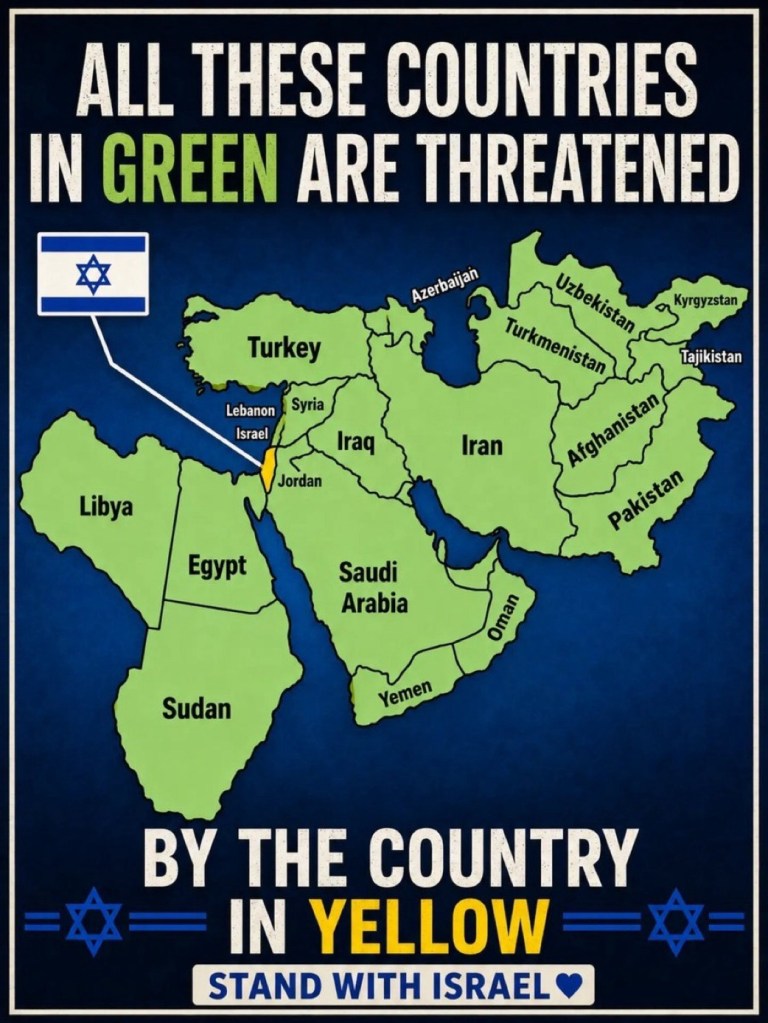
A: Stand with a country formed on occupied lands of others, has history of persecution multiple times due to their acts as mentioned in their holy books.. association with losers with known history may not be a good strati. Choose wisely your destiny..
Grk:
- The post quotes a map graphic labeling multiple Middle East and Central Asian countries in green as “threatened” by Israel (in yellow), with text urging viewers to “Stand with Israel.”
- It counters the image by claiming Israel was formed on occupied lands and has faced repeated persecution due to its own acts referenced in holy books, labeling it a poor alliance choice.
- The reply frames historical Jewish experiences as self-caused patterns and advises choosing sides carefully in geopolitical conflicts involving Israel.
Q:
When imams tell you they are here to conquer, believe them.
Iraq: Was Christian. Now 99% Muslim.
Syria: Was Christian. Now 93% Muslim.
Libya: Was Christian. Now 97% Muslim.
Egypt: Was Christian. Now 95% Muslim.
Sudan: Was Christian. Now 91% Muslim.
Jordan: Was Christian. Now 97% Muslim.
Turkey: Was Christian. Now 99% Muslim.
Algeria: Was Christian. Now 99% Muslim.
Lebanon: Was Christian. Now 61% Muslim.
Tunisia: Was Christian. Now 99.5% Muslim.
Morocco: Was Christian. Now 99% Muslim.
Albania: Was Christina. Now 50.7% Muslim.
Kosovo: Was Christian. Now 93.5% Muslim.
Palestinian territories: Was Christian. Now 98% Muslim.
Bosnia and Herzegovina: Was Christian. Now 51% Muslim.
Not just Christian. They conquer everyone:
Iran: Was Zoroastrian. Now 99.5% Muslim.
Malaysia: Was Hindu and Buddhist. Now 63.5–66%.
Indonesia: Was Hindu and Buddhist. Now 87% Muslim.
Pakistan: Was Hindu and Buddhist. Now 96.5% Muslim.
Bangladesh: Was Hindu and Buddhist. Now 91% Muslim.
Afghanistan: Was Zoroastrian and Buddhist. Now 99.7% Muslim.
A: Study the spread of Christianity to learn lessons how a faith spreads across the whole world. From one individual to billions of followers. Only two faiths have this kind of history and this happened not easily… phobias, persecution etc.
Grk:
- The post quotes a viral message listing historical demographic shifts in over a dozen countries from Christian, Zoroastrian, Hindu, or Buddhist majorities to overwhelming Muslim majorities, framing it as evidence of Islamic conquest.
- The author counters by urging study of Christianity’s own global expansion from one founder to billions of followers, positioning it as a comparable model of faith spread.
- It notes that only Christianity and Islam achieved this scale of growth, both overcoming significant obstacles including persecution and societal phobias.
Q: If religion proves that God is real, will you become religious?
A:
No signs, no proves, no eye witnesses etc would convince those souls who deny facts…
Don’t you see … people make deities with their own hands from earthly material, they speak to these, they expect blessings from them, they fear them known well that these deities can’t move, protect themselves. There are people who believe the dead pious people have powers and revere them and seek help from them. There is a known history of Jesus peace be upon him born miraculously and people believe as a God himself.. etc etc. one can make points with wisdom and best manner though convincing to embrace truth is eventually to almighty GOD. Guides whom ever CHOOSES to do so.
Grk:
- The post replies to a query asking if proof of God through religion would prompt someone to become religious, asserting that no evidence or eyewitness accounts would sway those who deny facts.
- It critiques various forms of perceived false worship, including handmade idols expected to provide blessings despite their immobility, veneration of dead saints for help, and the Christian belief in Jesus as God despite accounts of his miraculous human birth.
- From a monotheistic perspective, the author stresses that while wisdom and good manners can present arguments, true guidance to embrace truth ultimately comes from God to individuals who choose it.
Q:
When you leave religion.
Satan disappears. You leave fear. You become free. You realized you lived a lie, you realize religion is bondage.
A:
Let me give you example to compare it.
Robbers invade the banks with assets and don’t even look at ruined buildings with no valuables in these empty buildings. Robbers disappear like you mentioned about Satan. Would be like a precious building with precious commodities well protected or like a valueless ruined building? Choice is yours. Faiths if real give values.
Grk:
- @Zs496S1 quotes a post claiming leaving religion eliminates Satan, fear, and bondage, then counters with an analogy comparing Satan to robbers who target banks with valuables but ignore empty ruined buildings.
- The argument posits that spiritual opposition only appears where there is real value, implying authentic faiths function like protected assets worth attacking while valueless structures attract none.
- This frames religion as a source of inherent worth rather than deception, directly challenging the original post’s view of faith as bondage by suggesting its “threat” proves its substance.
Q:
President Trump came out in strong favor of banning Sharia Law across America!
Do you fully agree?
Response: A Muslim .. fully agree as we cannot do justice to the victims of criminals so why insult a law which people don’t want. A law which prohibits fornication, drug uses, abuses by interest base lending even for purposes of funerals, educations etc, prohibits stealing, making false promises by politicians, freeing criminals etc. at least sanctity of laws to be observed.
Grk:
- A self-identified Muslim poster agrees with Trump’s recent support for banning Sharia Law in the US, stating that people who reject it should not have it imposed, especially given the existing justice system’s inability to adequately protect crime victims.
- The author praises aspects of Sharia for prohibiting fornication, drug use, interest-based lending (even for funerals or education), theft, political false promises, and leniency toward criminals, while advocating for respect toward the sanctity of laws.
- The post quotes a claim about Trump’s stance following his August 26, 2026 interview on The Glenn Beck Program, where he affirmed he would prohibit Sharia, noting “pockets” of it in the US and warning against European-style parallel systems.
Q: If God created evil, can we say God is the root of all evil?
Response:
Trying to understand this matter.
Father leaves some traps to see how weak are his kids . He gave all the warnings , to take precautions to avoid falling in these traps. Some kinds study, obey to instructions and avoid the traps. Some don’t believe in fathers advise “ I don’t care” “ he is not my real father as i didn’t witness the intimate movements of my parents which lead my mom to become impregnated” some kids hate their dad “ who is he to tell me do this and don’t this” some kids would say my dad is cruel to put me through the test”
Choose the category your fit in…
Grk:
- The X post responds to the quoted question “If God created evil, can we say God is the root of all evil?” by deploying a father-children analogy, where God sets intentional “traps” (temptations or tests) accompanied by explicit warnings to assess obedience and character.
- It categorizes human responses into groups: those who study instructions and avoid pitfalls, skeptics who question God’s reality or authority due to lack of direct evidence, rebels who resent the rules, and critics who view the setup itself as cruel.
- The post frames the existence of evil as a deliberate test of free will and faith rather than divine malice, prompting readers to reflect on their own stance toward divine guidance without resolving the underlying philosophical problem of evil.
Glad it landed.
The analogy treats evil as a supervised test rather than a design flaw: warnings exist, so falling in is framed as a choice. That sidesteps the classic problem-of-evil claim that an all-powerful, all-good God would not permit unnecessary suffering, but it still leaves open why the traps are lethal, unevenly distributed, or sometimes fall on people who never heard the warnings.
The original post asks a single loaded question: if God created evil, is God therefore the root of all evil? It treats “created” as a given and then asks what that implies for God’s character. That is the classic problem-of-evil move in compressed form. It does not distinguish moral evil (sin, cruelty, rebellion) from calamity or disaster, which is the distinction most theistic replies immediately make. In Isaiah 45:7 the Hebrew ra‘ is often translated “evil” in older English Bibles, but in context it is paired with peace and is usually read as calamity or judgment, not as God inventing wickedness.3
The quote-post does not answer that question directly. It reframes the setup: God is a father who plants traps, issues warnings, and watches how the children respond. Obedient kids study and avoid the traps; others dismiss the father as unreal, resent his authority, or call the test cruel. The implied claim is that evil is a supervised test of free will, so falling in is the child’s choice, not the father’s malice. That is a free-will / soul-making theodicy in homely language.
The two posts therefore talk past each other in one important place. The first asks whether creating the possibility or presence of evil makes God its source. The second answers a different question: once the traps exist and the warnings are given, who is responsible for walking into them? Classic replies in the thread and in theology take the same split: God created free agents and a world in which harm can occur; moral evil is a privation or a misuse of that freedom, not a substance God manufactured.4
Where the analogy is weakest is exactly where the original question is strongest: it assumes the traps are fair, the warnings reach everyone, and the harm is proportional to the test. Natural disasters, infant suffering, and people who never heard the “instructions” sit outside the family-test picture. So the first post can still ask why a father who could design a world without lethal traps chose this one; the second post can still insist that once the design is granted, blame for stepping in belongs to the kids who ignore the warnings. Both can be consistent on their own terms. They do not settle each other.
Q:
Trump vows to prohibit Sharia law in the US.
And honestly, no Muslim should be angry about it. America is not an Islamic country, and it does not belong to Muslims. Practise Islam freely, yes. But Sharia does not get to override the laws of a country that never chose it.
Response: Agree… when people and politicians don’t like a law then there is not point on looking for it though the irrational fear reaching to levels of psychological disorder named paranoia is very evident. Most of the Muslims may not even know what is sharia who made it, what are benefits , is it good for humanity, is it man made? Etc. USA tried to ban alcohol which is also prohibited in Islam and this attempt failed miserably. GOD promised of not changing the behaviors of people who themselves don’t want to… period.
Islam prohibited alcohol 1400 yrs ago and majority Muslims practice in personal lives and countries with Muslim majorities implemented with its beneficial effects confirmed by stats about crimes related to alcohol in addition to effects on health. Can pull the stats of other recreational drugs effects, pornography, sex slavery etc which are prohibited in shariah. Why opposition to shariah? Is it because it prohibits crimes?
Alcohol related crones and benefits noted by nannies….
Grk;
- The post quotes and partially agrees with Trump’s recent statement vowing to prohibit Sharia law in the US, while arguing that opposition stems from paranoia rather than evidence, noting most Muslims may lack deep knowledge of Sharia’s origins and benefits.
- It contrasts the failed US alcohol Prohibition (1920-1933), which led to black markets and enforcement issues, with Islam’s 1400-year ban on alcohol, claiming it yields lower alcohol-related crimes and health benefits in Muslim-majority countries where implemented.
- Peer-reviewed studies support reduced violent crime from alcohol restrictions, including 14-21% drops in injury deaths and homicides during South Africa’s temporary ban and similar declines in Bihar, India, aligning with lower overall crime rates observed in some Islamic countries per UN data.
On issue of deporting illegal migrants who are contributing billions to our country
Grk: response
- The post is a direct reply to Congressman Ronny Jackson’s call for deporting all illegal immigrants as a national security threat, instead urging use of government data on their fiscal contributions while accusing the rhetoric of spreading hatred incompatible with Christian values of compassion.
- Data from sources like the Institute on Taxation and Economic Policy show undocumented immigrants paid $96.7 billion in federal, state, and local taxes in 2022, including $25.7 billion to Social Security and $6.4 billion to Medicare—programs they are largely ineligible for.
- The exchange reflects the polarized US immigration debate, where security and cultural concerns from figures like Jackson contrast with economic analyses highlighting migrant labor’s role in tax revenue and workforce participation.
Q:
Let’s assume God exists. What role is he playing right now?
He isn’t literally making it rain, providing our food, or even talking to us. So what exactly is he doing?
A:
One hand GOD makes it rain in the amount appropriate to the needs and some places in excess where rain can cause flooding… can any one change the course?
GOD brings other natural disasters like earthquakes, tsunamis, tornados etc .. do we have means of averting them even though our knowledge informs us about their coming? Who else is going to save us? Any power, any authority strong enough to avert them? Tonnes of meteorites fall daily, not on us and who is averting them from falling our us ?
GOD is ever living watching over us , doesn’t even blink …How do we know? Holy book says so. Do we have any one else to refute the claims, any other authority claiming and doing these acts?. Study faiths, explanations of holy books specifically the last one Holy Quran to know all these issues.
Grk:
- The post quotes a skeptical query on God’s role if He exists, countering that God actively regulates rainfall, orchestrates natural disasters like earthquakes and tsunamis, and diverts daily meteorites from Earth.
- It highlights human limitations in preventing foreseen calamities, positioning God as an ever-watchful protector whose actions are detailed in holy books with no rival authorities refuting them.
- The author urges studying various faiths and scriptures, especially the Quran, as the source for verifying these claims of divine intervention and oversight.
Q: Nothing makes a religious person happier than seeing an unbeliever in trouble, just so they can claim it’s a punishment from their imaginary God
A: Keep aside the foolish idea of imaginary GOD….. bring a power, a treatment or solutions of sufferings of human beings when they are afflicted? Do one have it? Sufferings could be a test, could be a punishment.. have found solutions? Natural disasters solutions?
Q:
I was born knowing nothing.
I knew no God which mean I was born an atheist.
Not just me, we all are born atheistic.
A:Majority of world population believe in a super being. We all are given knowledge and skills appropriate to the age. Like suckling, crying, swallowing, breathing etc. as we grow more skills are given. Dint say we are not given any knowledge without paying attention to what blessings for survival are given. As we grow, more quest given to seek knowledge for survival . Theology too is inherently present some deny some seek by active exploration, some are blessed being born in houses of faithfuls, some follow things which are illogical though majority still believe in a super being for ages as history says.
Grk:
- The post rebuts the quoted claim of universal birth atheism by asserting that humans are endowed with age-appropriate knowledge and survival skills, including an inherent theological awareness, as evidenced by the historical and ongoing majority belief in a super being across cultures.
- Developmental psychology studies, such as those by Justin Barrett and Deborah Keleman, describe children as “intuitive theists” who naturally attribute purpose, design, and supernatural agency to the world from an early age, even in non-religious environments.
- Worldwide surveys show 70-85% of adults affirm belief in God or a higher power in most countries, with the highest rates in Africa, Latin America, and parts of Asia, underscoring the post’s point on widespread theistic inclination despite rising secular trends in the West.
Q: Should the US ban Sharia Law?
A: At one point us banned alcohol in the best interest of it’s citizens. Citizens, interest groups didnot like it so alcohol is freely available on streets with all its evils , harms to health, social and economic impacts… no law can bring change people if they don’t want it. Chose your laws which pleases irrespective who makes them , irrespective of their effects which may not be in the best interest of citizens.
Grk:
- The post quotes Rep. Nancy Mace asking if the US should ban Sharia Law and responds by comparing it to America’s failed Prohibition era, noting alcohol’s return despite known health, social, and economic harms.
- It argues that laws cannot effectively change behavior without public buy-in, criticizing top-down rules that ignore citizens’ preferences regardless of who enacts them.
- The reply implies skepticism toward banning Sharia, suggesting governance should prioritize pleasing the populace over imposing measures claimed to serve citizens’ best interests.
2 .
- The post replies to a call for federally banning Sharia law by noting that alcohol prohibition—a core Sharia rule—is part of Islamic law and was tried in the US via the 18th Amendment from 1920-1933.
- US Prohibition was repealed after widespread failure, including rises in organized crime, bootlegging, tax revenue losses, and social harms, showing public resistance to enforced alcohol bans.
- The author claims Sharia originates from divine wisdom for human benefit and warns against rejecting it, framing the US experience as inadvertent validation of one Sharia principle despite its ultimate reversal.

