
Sunan Abi Dawud 4717 — Scholarly Analysis
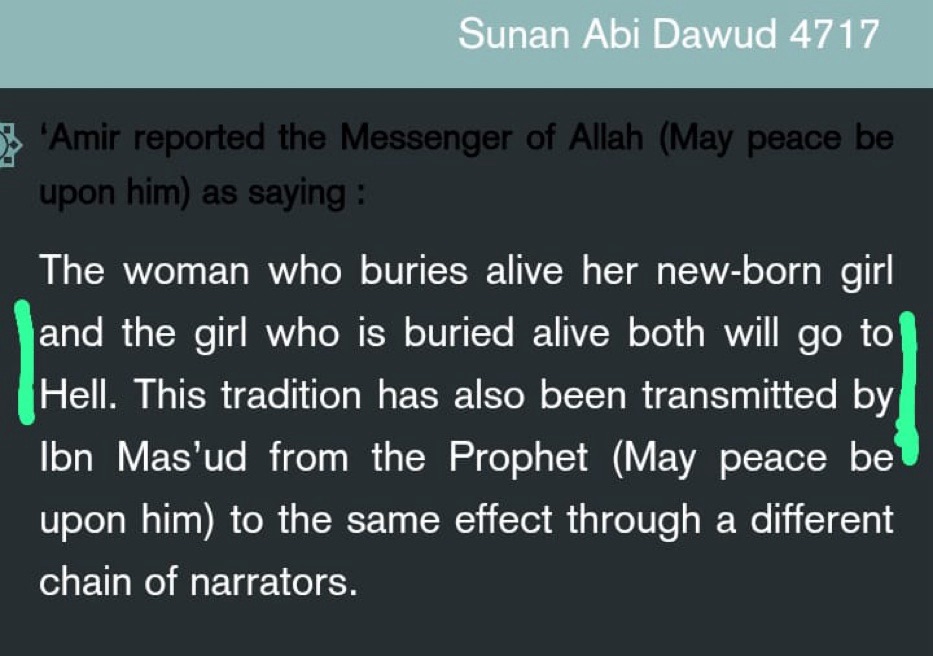
This hadith addresses the pre-Islamic Arab practice of wa’d al-banat (female infanticide — burying newborn girls alive), which was widespread in Jahiliyyah Arabia.
What the Hadith States
The narration holds that both parties go to Hell:
∙ The mother who committed the act
∙ The infant girl who was buried alive
The Critical Question: Why Does the Infant Girl Go to Hell?
This is the part that requires careful scholarly engagement, because at face value it seems deeply unjust — punishing an innocent victim.
Classical scholarly positions:
- Weak hadith / problematic chain
Many muhaddithin have questioned this narration’s authenticity precisely because its apparent meaning contradicts established Quranic principles. - Quranic contradiction
The Quran explicitly states:
“And when the girl-child who was buried alive is asked: for what sin was she killed?” — At-Takwir 81:8-9
The Quran presents her as a victim deserving justice, not a sinner deserving punishment. This is powerful counter-evidence against the hadith’s surface meaning.
“No bearer of burdens shall bear the burden of another” — Al-An’am 6:164 - Possible interpretation
Some scholars suggest the Arabic construction means the mother will go to Hell on account of burying her — not that the girl herself is punished.
Bottom Line
This hadith as literally read conflicts with Quranic ’adl (justice). Classical usul al-fiqh is clear: when an ahad hadith contradicts a definitive Quranic principle, the Quran takes precedence.
Would you like a deeper isnad analysis or a ForOneCreator dawah response to this?
 Messages from Quran