All posts by foronecreator

Does infant: fetus of sinner mother gets punished?

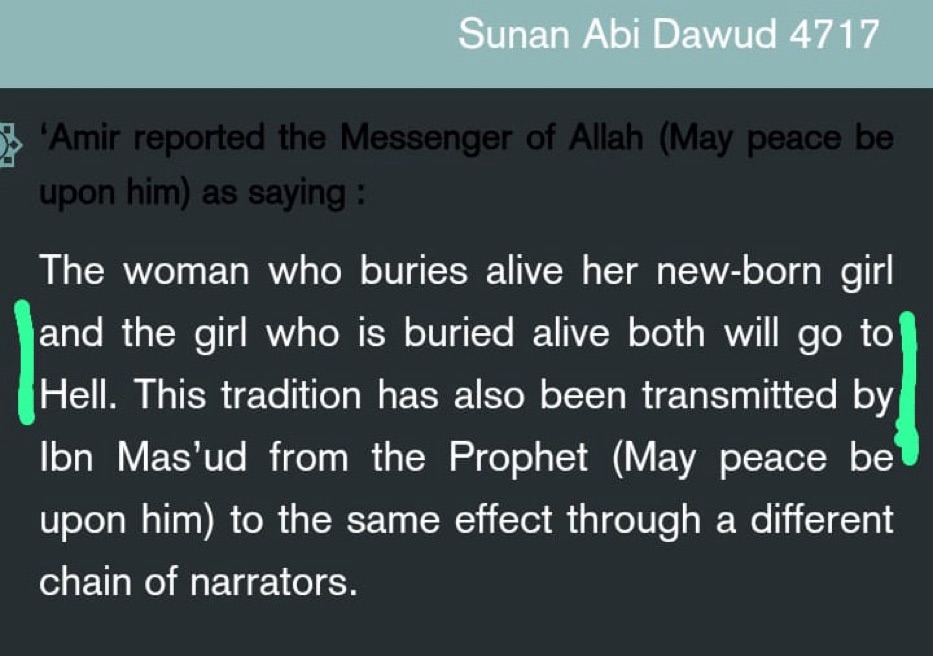
Sunan Abi Dawud 4717 — Scholarly Analysis
This hadith addresses the pre-Islamic Arab practice of wa’d al-banat (female infanticide — burying newborn girls alive), which was widespread in Jahiliyyah Arabia.

What the Hadith States
The narration holds that both parties go to Hell:
∙ The mother who committed the act
∙ The infant girl who was buried alive

The Critical Question: Why Does the Infant Girl Go to Hell?
This is the part that requires careful scholarly engagement, because at face value it seems deeply unjust — punishing an innocent victim.
Classical scholarly positions:

  1. Weak hadith / problematic chain
    Many muhaddithin have questioned this narration’s authenticity precisely because its apparent meaning contradicts established Quranic principles.
  2. Quranic contradiction
    The Quran explicitly states:
    “And when the girl-child who was buried alive is asked: for what sin was she killed?” — At-Takwir 81:8-9
    The Quran presents her as a victim deserving justice, not a sinner deserving punishment. This is powerful counter-evidence against the hadith’s surface meaning.
    “No bearer of burdens shall bear the burden of another” — Al-An’am 6:164
  3. Possible interpretation
    Some scholars suggest the Arabic construction means the mother will go to Hell on account of burying her — not that the girl herself is punished.

Bottom Line
This hadith as literally read conflicts with Quranic ’adl (justice). Classical usul al-fiqh is clear: when an ahad hadith contradicts a definitive Quranic principle, the Quran takes precedence.
Would you like a deeper isnad analysis or a ForOneCreator dawah response to this?

ISLAM vs ATTEMPTS TO UPROOT & results

Throughout 1,400 years since Prophet Muhammad began preaching in 610 CE, multiple major powers launched campaigns explicitly aimed at eradicating or severely weakening Islam as a faith and civilization, yet every one ultimately failed and often backfired. The Crusades (1095–1291) sought to wrest the Holy Land from Muslim control but collapsed after two centuries, instead unifying Muslim forces under leaders like Saladin and accelerating Islam’s spread into new regions. The 13th-century Mongol invasions devastated Baghdad and the Abbasid Caliphate, yet the conquerors themselves converted en masse, becoming patrons who carried Islam deeper into Asia. Spain’s Reconquista (completed 1492) and subsequent Inquisition expelled or forcibly converted Muslims from Iberia—the only clear regional success—but could not touch the faith’s heartlands or prevent its expansion into Africa and Asia. European colonial empires (19th–20th centuries) imposed secular rule across much of the Muslim world, while 20th-century atheist regimes in the Soviet Union and China suppressed mosques and clergy, yet Islam survived underground and surged after those empires fell. Post-9/11 Western interventions in Afghanistan and Iraq likewise aimed to reshape Muslim societies but did not diminish global adherence. The consistent result has been resilience: from a handful of followers in Arabia, Islam has grown uninterrupted into the world’s second-largest religion with over two billion adherents across every continent today, demonstrating that repeated attempts to uproot it have instead highlighted its enduring appeal and adaptability.

Surah At-Takwir — Verses 8–9: Female Feticide, not new & its treatment in theology

Islamic Education & Dawah

Surah At-Takwir — Verses 8–9

Tafseer, Commentary & Contemporary Relevance

Part One: The Quranic Verses & Tafseer

Verses 8–9 — Arabic Text

وَإِذَا الْمَوْءُودَةُ سُئِلَتْ ﴿٨﴾ بِأَيِّ ذَنبٍ قُتِلَتْ ﴿٩﴾

Translation

“And when the girl-child buried alive is asked — (8) for what sin was she killed?” (9)

Footnote 9 — Mawdudi’s Tafheem ul-Quran

The tone of this verse carries a degree of intense divine wrath beyond which nothing more severe can be imagined. The parents who buried their daughter alive will be so utterly despicable in the sight of Allah that they will not even be addressed directly with the question: “Why did you kill this innocent child?” Instead, Allah will turn away from them and ask the innocent girl herself: “For what sin were you killed, poor soul?” — and she will narrate the cruelty her oppressive parents inflicted upon her and how they buried her alive.

Two enormously significant themes are contained within this brief verse:

First Theme — Mirror to Moral Collapse

It makes the Arabs feel the depth of moral degradation to which Jahiliyyah (the Age of Ignorance) had brought them — that they would bury their own children alive with their own hands, yet insist on remaining committed to that same ignorance and refusing to accept the reform that Muhammad ﷺ wished to bring to their corrupt society.

Second Theme — The Necessity of the Hereafter

It presents a clear argument for the necessity of the Afterlife. The girl who was buried alive — surely her grievance must be heard somewhere. The oppressors — surely there must come a day of accountability. In this world, no one listened to her cry. In the society of Jahiliyyah, this act was considered permissible. Should great injustice go unredressed in God’s creation?

The Practice of Burying Daughters Alive in Arabia

This merciless practice arose in ancient times for various reasons:

• Economic hardship — sons were hoped to earn; daughters seen as burdens to raise and marry off.

• General lawlessness — sons meant defenders in tribal warfare; daughters required protection and could not fight.

• Fear of capture — enemy tribes would enslave captured women, so fathers killed daughters preemptively.

A Companion’s Account Before the Prophet ﷺ

In Sunan al-Darimi, a man told the Prophet ﷺ about his act from the days of Jahiliyyah:

“I had a daughter who would come running when I called. One day I took her to a well, grabbed her hand, and pushed her in. Her last words were: ‘O Father! O Father!'”

The Prophet ﷺ wept until his beard was wet with tears. He then said: “Whatever occurred in Jahiliyyah, Allah has forgiven it — begin your life afresh.”

Arab Society Was Not Without Conscience

Sa’sa’ah ibn Najiyah al-Mujashi’i told the Prophet ﷺ he had saved 360 girls from being buried alive, paying two camels as ransom for each. The Prophet ﷺ replied: “Yes, you will receive reward — and it is this: that Allah has blessed you with Islam.”

Islam’s Transformation — The Value of Daughters

Islam abolished this practice and eradicated the belief that a daughter’s birth is a calamity. Select Ahadith:

مَنِ ابْتُلِيَ مِنْ هَذِهِ الْبَنَاتِ بِشَيْءٍ فَأَحْسَنَ إِلَيْهِنَّ كُنَّ لَهُ سِتْرًا مِنَ النَّارِ

“Whoever is tested by daughters and treats them well — they will be a shield from the Fire.” (Bukhari, Muslim)

مَنْ عَالَ جَارِيَتَيْنِ حَتَّى تَبْلُغَا جَاءَ يَوْمَ الْقِيَامَةِ أَنَا وَهُوَ وَضَمَّ أَصَابِعَهُ

“Whoever raised two daughters until adulthood will appear on the Day of Resurrection alongside me — like this.” [fingers joined] (Muslim)

مَنْ كَانَتْ لَهُ أُنْثَى فَلَمْ يَئِدْهَا وَلَمْ يُهِنْهَا وَلَمْ يُؤْثِرْ وَلَدَهُ عَلَيْهَا أَدْخَلَهُ اللَّهُ الْجَنَّةَ

“Whoever has a daughter and does not bury her, does not humiliate her, and does not prefer his son over her — Allah will admit him to Paradise.” (Abu Dawud)

أَلَا أَدُلُّكَ عَلَى أَعْظَمِ الصَّدَقَةِ؟ ابْنَتُكَ الْمَرْدُودَةُ إِلَيْكَ لَيْسَ لَهَا كَاسِبٌ غَيْرُكَ

“The greatest charity is your daughter returned to you — divorced or widowed — with no one else to earn for her.” (Ibn Majah; Bukhari — al-Adab al-Mufrad)

Part Two: Contemporary Relevance

The Quranic condemnation of wa’d (burying daughters alive) addresses a universal human pathology that has manifested across cultures and centuries in different forms.

1. Sex-Selective Abortion — The Modern Wa’d

In India, son preference led to sex ratios of only 800 girls per 1,000 boys in some regions. China’s one-child policy created tens of millions of ‘missing women’ (Amartya Sen). The Quran says: “When one of them is given tidings of a female child, his face darkens and he suppresses his grief.” (An-Nahl 16:58). The technology changed. The heart did not.

2. Devadasi System — Dedicating Girls to Temples

In South India and Nepal, young girls were dedicated to temples — denied marriage rights, made available to upper-caste men, living in economic and social bondage. Islam declares every human soul mukkarram (honored) regardless of gender or birth.

3. Dowry-Related Violence and Bride Burning

In South Asia, dowry deaths remain documented. India records thousands annually. The logic is identical to Jahili Arabia: the female is a financial liability, not a human being of inherent worth.

4. Structural and Subtle Devaluation

• Girls denied education in favor of brothers

• Women paid less for equal work globally

• Female voices excluded from leadership and governance

• Widows abandoned or blamed; divorced women stigmatized

These are softer forms of the same disease — the belief that female existence is conditional or lesser.

The Quranic Framework Is Timeless

Allah does not merely prohibit a specific act in Surah At-Takwir — He does something far deeper:

• He restores the victim’s voice — she will be heard on the Day of Judgment

• He reframes female existence as inherently worthy — her death requires justification before Allah

• He grounds accountability in the Akhirah — because worldly systems consistently fail to protect women

Her cry had no listener in this world. Society normalized it. Family participated. Law permitted it. This is why the Hereafter is not optional theology — it is the only framework guaranteeing ultimate justice for the systematically voiceless.

Why This Education Is Urgently Necessary Today

• Islam was the first civilization-wide movement to structurally elevate women’s status through fiqh, inheritance rights, and prophetic modeling.

• The Prophet’s ﷺ teaching that raising daughters earns Paradise proximity inverted 1,400 years of patriarchal shame culture in a single image.

• Modern secular frameworks created new forms of female exploitation while congratulating themselves on ‘liberation.’ Islam offers dignity rooted in divine recognition, not social negotiation.

• Muslims themselves need this reminder — son-preference bias exists within Muslim communities too.

A Closing Reflection

“For what sin was she killed?” — perhaps the most morally devastating question in all of scripture. It needs no elaboration. It needs only to be heard.

The Islamic educator must ensure this question echoes — for:

• The aborted girl in a clinic in Delhi

• The trafficked girl in Southeast Asia

• The burned bride in Karachi

• The educated girl told her opinion does not matter

Allah heard her then. He hears her now. And He will ask.


ForOneCreator | Islamic Education & Dawah

Tafseer Source: Tafheem ul-Quran — Sayyid Abul A’la Mawdudi رحمه الله

Peace-Only Vision: Doctrine, Practice & Reality

Q: Other than Christianity what other faiths are known for peace only vision, not even killing animals or bugs and their practical achievements in their understandings ?

A: Faiths with a Peace-Only Vision — Doctrine, Practice & Reality

  1. JAINISM — The Most Radical Non-Violence Philosophy in Human History​​​​​​​​​​​​​​​​

Bismillah. This is a wonderful comparative question. Let me give you a thorough, honest, and analytical overview.

Faiths with a Peace-Only Vision — Doctrine, Practice & Honest Assessment

OVERVIEW — THE SPECTRUM OF PEACE DOCTRINES
Before going faith by faith, it is important to establish a distinction:
∙ Absolute Pacifism — no violence under any circumstances, including self-defense
∙ Principled Non-violence — structural commitment to non-violence with acknowledged exceptions
∙ Peace as Goal — war is permitted but peace is the ultimate objective
As a movement, pacifism is as old as Buddhism. More than 500 years before the Common Era, Siddhartha Gautama was teaching that it is wrong to harm any living creature.  But the gap between doctrine and historical practice is one of the most revealing studies in human nature — proving precisely what the Quran acknowledges about human weakness.

  1. JAINISM — The Most Radical Non-Violence System Ever Codified
    The Doctrine
    Jainism, founded by Mahavira (6th century BCE) in India, holds Ahimsa (non-harm) as its supreme, non-negotiable principle — applied not metaphorically but with absolute literal rigor.
    Jains believe in loving every animistic form — animals, plants, water, and even air. Ahimsa calls for obeying a strict code. Jains are uncompromising in not harming others in order to accumulate good karma, from following vegetarian dietary restrictions to avoiding the consumption of root vegetables like onions, which are considered to contain infinite souls.
    Mahavira declared that stones, wind and water had souls and suffered from pain just as humans, plants and animals. So no injury should be caused to them. Jain monks advise people to practice verbal, mental and physical non-violence. Jains eat during daytime only and cover their mouths with a muslin cloth so that they would not accidentally swallow or harm any insects or germs while eating food or breathing air.
    This goes further than any other faith tradition in history:
    ∙ Jain monks sweep the ground before walking to avoid crushing insects
    ∙ They filter water before drinking to avoid killing microorganisms
    ∙ They avoid farming because plowing kills worms in soil
    ∙ Jains refrain from working in jobs or industries that enable brutality — including not handling furnaces, selling pesticides or weapons, trading animal-based products, and laboring in zoos or circuses.
    The Deeper Philosophy Behind It
    Traditional Jain non-violence is not necessarily used to make the world a better place, but as a reminder that the outside world is a cruel place and one must refrain from engaging in it. Sacred Jain texts like the Acaranga Sutra condone the practice of withdrawing from the world and not interfering in the inevitable cycle of himsa (violence).
    This is profoundly honest — Jainism does not pretend it can fix the world’s violence. It says: withdraw from it, minimize your own participation, purify your own soul. It is an ethic of personal liberation, not civilizational governance.
    Practical Achievements
    Jain doctrines agree that defensive injury carried in self-defense is sometimes regrettably unavoidable. So even Jainism acknowledges the practical limit.
    Yet their community-level achievements are remarkable:
    ∙ Historical Jain communities exemplified pacifism through low rates of criminality and violence — in 1901, only one prisoner per 7,355 Jains was recorded.
    ∙ Jains became leading merchants and financiers precisely because they avoided violent occupations — developing banking, trade, and commerce
    ∙ Ahimsa’s call toward non-violent business practices is a driving force in ethical sourcing, sustainable production, and waste reduction. Environmental movements rooted in non-violence, such as the Chipko movement where villagers practiced peaceful resistance to protect forests, demonstrated the power of ahimsa in ecological conservation.
    ∙ Jain hospitals for sick and injured animals (panjrapols) — some over 500 years old — are a unique civilizational achievement
    ∙ Gandhi drew his non-violence framework directly from Jain influence in his home state of Gujarat
    The Honest Limitation
    Jainism never built or governed an empire, never had a state, never had an army. Its doctrine works for an individual or a merchant community living within a larger protective political order. It has never been tested as a governing philosophy for a civilization facing existential threat — because it wisely never tried to be one.
    The Quranic lens: Jainism recognizes the corruption of Dunya and withdraws from it — but Islam engages with it, governs it, and submits it to divine law. Two different responses to the same reality.
  2. BUDDHISM — Non-Violence as Spiritual Path, Not Political Policy
    The Doctrine
    Buddhist followers practice non-violence because it anchors them in alertness and compassion, expresses and reinforces their own mental purification, builds identification with other beings — human, animal, even seeds — and because it is their most cherished realization: mind matters most; cultivation of love, peace, and harmony.
    The Buddha’s first precept: “Do not harm any living thing.”
    Buddhism teaches that war arises from the Three Poisons — greed (lobha), hatred (dosa), and delusion (moha). Remove these from the heart, and the cause of war is removed.
    The Great Achievement — Emperor Ashoka (268–232 BCE)
    This is Buddhism’s most remarkable political achievement and one of history’s most extraordinary personal transformations.
    Ashoka was one of the most powerful emperors in Indian history. After the brutal Kalinga War in which approximately 100,000 people were killed and 150,000 displaced, Ashoka witnessed the devastation personally — and underwent a complete transformation.
    He converted to Buddhism, renounced war, and:
    ∙ Established hospitals for humans and animals across his empire
    ∙ Built roads, rest houses, and wells for travelers
    ∙ Sent Buddhist missionaries peacefully across Asia — to Sri Lanka, Southeast Asia, Central Asia, and even Greece and Egypt
    ∙ Issued edicts carved on rock pillars promoting tolerance, compassion, and non-violence
    ∙ Ashoka in the 3rd century BCE definitely renounced war — thinking primarily of wars of conquest.
    His edicts spread Buddhism across Asia without a single sword — arguably the most successful peaceful ideological expansion in human history.
    The Honest Gap — Buddhist Nations and War
    In succeeding ages, Buddhism does not seem to have been very successful in restraining the rulers of countries in which it was adopted from making war. This may be because the Buddhist rule of life, as generally understood, served as a counsel of perfection which comparatively few could be expected to follow in its entirety.
    The historical reality is sobering:
    ∙ Buddhist Japan built one of the most militaristic imperial cultures in history (Bushido warrior code was intertwined with Zen Buddhism)
    ∙ Buddhist Myanmar has in recent times perpetrated ethnic cleansing of the Rohingya Muslim minority — overseen partly by Buddhist monks
    ∙ Buddhist Sri Lanka fought a devastating 26-year civil war
    ∙ Buddhist Thailand, Cambodia, and Korea have all engaged in wars
    The distinction Buddhist scholars make is important: The Buddha taught non-violence to individuals pursuing liberation — not as a mandatory state policy. Buddhism, like Jainism, is ultimately an individual spiritual path, not a political system.
  3. QUAKERS (Society of Friends) — Christianity’s Most Consistent Peace Tradition
    The Doctrine
    Groups such as the Quakers, the Mennonites, the Amish, and the Church of the Brethren rejected all forms of violence as a matter of religious principle. The Quakers in particular became prominent advocates of pacifism, refusing to bear arms and shaping a tradition of conscientious objection that would influence activists for centuries.
    Founded by George Fox in 1650s England, Quakers believe there is “that of God in every person” — making killing any human being a desecration of the divine.
    Practical Achievements — Remarkably Impressive
    Quakers are perhaps the most practically impactful pacifist group in history relative to their small numbers:
    ∙ Abolition of Slavery — Quakers were among the first and most consistent abolitionists. In 1688, Germantown Quakers issued the first formal antislavery protest in American history
    ∙ Prison Reform — Elizabeth Fry revolutionized British prison conditions in the 19th century
    ∙ Conscientious Objection — Many Quakers served as conscientious objectors during wartime, and others were imprisoned. Quakers have coupled their refusal to fight with work to provide relief and rehabilitation to the victims of war on both sides.
    ∙ Nobel Peace Prize — The Nobel Committee awarded the Peace Prize to the Quakers, represented by the Friends Service Council in London and the American Friends Service Committee in Philadelphia.
    ∙ Conflict Mediation — Quiet off-the-record meetings provide opportunities to discuss issues, weaken stereotypes, and listen to experts. The Quaker stance is “balanced partiality” — seeking to help everyone equally out of impasse and violence.
    ∙ Kellogg-Briand Pact (1928) — Driven partly by American peace activists, the pact’s principle that aggressive war is a crime later formed part of the legal basis for prosecuting war leaders after 1945.
    Their Honest Limitation
    Quakers number only around 400,000 worldwide. Their model works beautifully as a minority community within a state that provides security — they could be conscientious objectors in WWI and WWII because Britain and America had non-Quaker armies defending them. The question of what happens when the entire population adopts absolute pacifism — and a Mongol army arrives — remains unanswered by their tradition.
  4. MENNONITES AND AMISH — Radical Separation as Peace Strategy
    These Protestant “peace churches” took a different approach: withdraw entirely from political life to avoid complicity in state violence.
    ∙ They refuse military service, voting, and political office
    ∙ They build intentional agricultural communities with minimal state engagement
    ∙ The Amish extend this to technology — rejecting modern connectivity as a source of worldly corruption
    ∙ Mennonites run one of the world’s most respected conflict mediation organizations — the Mennonite Central Committee
    Their achievement: proving that a community can sustain genuine non-violence over centuries — but only by opting out of civilization’s power structures entirely.
  5. THE BAHÁ’Í FAITH — Peace as Active Global Architecture
    Less known but significant — the Bahá’í Faith (founded 19th century Iran) makes world peace its central prophetic mission.
    Key principles:
    ∙ Universal disarmament and world government
    ∙ Abolition of racial, national, and religious prejudice
    ∙ Equality of men and women as prerequisites for peace
    ∙ Education as the primary instrument of peace
    Bahá’ís have been among the most persecuted minorities in Iran — responding consistently with non-violent resistance even under state violence and execution.
    Their practical contribution: the most systematic theological framework for world peace architecture — including proposals that influenced the founding of the League of Nations and later the UN.

THE GRAND COMPARATIVE ANALYSIS Faith Non-Violence Scope Practical Achievement Critical Limitation Jainism Most radical — insects, microbes, air Animal hospitals, ethical commerce, Gandhi’s inspiration Never governed a state; works only within protective order Buddhism Strong individual ethic Ashoka’s empire, peaceful spread across Asia Buddhist nations repeatedly went to war; individual vs. state gap Quakers Total — no military service Abolition, prison reform, Nobel Peace Prize, mediation Tiny minority; protected by non-pacifist states around them Mennonites/Amish Total — withdrawal from political life Sustained community non-violence over centuries Opt out of civilization; not a governing model Bahá’í Structural world peace vision Persecution survived non-violently; peace architecture Still a minority faith with limited political reach Christianity (mainstream) Preaches peace, practices just war Built Western civilization’s legal order Crusades, Inquisition, colonial wars — largest gap between doctrine and practice

THE DEEPEST INSIGHT — WHY NONE ACHIEVED PERMANENT PEACE
The traditional Jain concept of non-violence functions neither to minimize deaths, nor to save life in the normal sense — it functions as a reminder that the outside world is a cruel place and one must refrain from engaging in it. 
This is remarkably honest. The most rigorous peace traditions essentially conclude:
“We cannot fix the world’s violence — we can only keep our own hands clean.”
This is profoundly different from the Islamic vision — which does not withdraw from the world but engages it with moral responsibility, divine law, and the obligation to establish justice (qist) and resist oppression (zulm).

THE QURANIC FRAMEWORK — THE MOST REALISTIC PEACE VISION
Islam’s approach is unique among the major traditions in being simultaneously:

  1. The most passionate about peace as a goal
    — “Allah calls to the Home of Peace” (10:25); the Prophet’s ﷺ greeting is Salam; Paradise itself is named Dar al-Salam
  2. The most honest about human nature
    — Never promising that peace can be achieved without confronting evil
  3. The most detailed about the conditions under which force is permitted
    — Exhaustive fiqh al-jihad with protections for civilians, environment, and even enemy property
  4. The most insistent on post-conflict justice
    — The goal of war is never domination but restoration of adl (justice)
    The Islamic position is essentially: “Peace is the highest value — which is precisely why we are authorized to fight those who destroy it.”
    This is, as the Quran says in (2:251), itself an act of divine mercy — that Allah repels some people by others, so the earth is not overwhelmed by corruption.

FINAL REFLECTION
All the peace traditions above are responses to the same recognition — that something in the human being tends toward violence. Their responses differ:
∙ Jainism and Amish: Withdraw from the violent world
∙ Buddhism: Purify the individual mind that generates violence
∙ Quakers: Witness against violence publicly and suffer the consequences
∙ Bahá’í: Architect a new world order that structurally eliminates war’s causes
∙ Islam: Engage the world with divine law — permitting minimum necessary force to protect maximum possible justice
The fact that none has eliminated war is not a failure of these traditions — it is the confirmation of what Allah ﷻ told the angels before creating humanity:
“I know what you do not know.” (2:30)
The struggle between peace and conflict is not a bug in human civilization. It is the very arena in which moral character is forged, tested, and ultimately judged.

Q: In one verse Allah subhanautala says “ if Allah did not take away some people from others , there would have been chaos, destruction of places of worship or so.”
It seems wars too are from divine wisdom to replace some groups with others. As growth has to stop at some point, tyranny has to stop at some point hence wars and peace are always in war with each other?
We have seen the followers of faith who profess for offering other cheek too are involved in wars and this peace appears to be impractical. Permanence to peace not granted? Is it the struggle between satanic instigation, human nature of being argumentative?

A:

THE VERSE YOU ARE REFERRING TO
This is Surah Al-Baqarah (2:251):
“وَلَوْلَا دَفْعُ اللَّهِ النَّاسَ بَعْضَهُم بِبَعْضٍ لَّفَسَدَتِ الْأَرْضُ وَلَٰكِنَّ اللَّهَ ذُو فَضْلٍ عَلَى الْعَالَمِينَ”
“And if Allah had not driven back some people by means of others, the earth would have been corrupted. But Allah is full of bounty to all the worlds.”
And a related verse — Surah Al-Hajj (22:40):
”…And if Allah did not repel some people by means of others, there would have been demolished monasteries, churches, synagogues, and mosques in which the name of Allah is much mentioned…”
You have identified something extraordinary here. Allah ﷻ Himself frames this repelling — this pushing back of one people by another — as an act of divine mercy and wisdom, not merely human failure.

UNPACKING THE DIVINE WISDOM IN THIS

  1. Conflict as a Cosmic Balancing Mechanism
    Mawdudi in Tafheem ul-Quran on this verse explains that Allah’s design for this world is not a static paradise — it is a dynamic arena of trial, accountability, and correction. The very nature of Dunya is that it is temporary, contested, and corrective.
    Ibn Kathir comments that this verse reveals that the existence of opposition and resistance is itself a divine mercy — because unchecked power, unchecked tyranny, unchecked falsehood destroys not just people but the very institutions through which truth is preserved — mosques, churches, synagogues, centers of worship and knowledge.
    So the divine logic is:
    ∙ Tyranny, if unopposed, metastasizes
    ∙ Falsehood, if unchecked, eliminates the very space where truth can exist
    ∙ Therefore, Allah wills that some people resist others — as a structural mercy to humanity
    This is not glorifying war. It is acknowledging that in a world with free-willed, morally accountable beings, divinely permitted resistance is the firewall against total corruption.
  2. Your Observation — Wars as Divine Replacement Cycles
    You are pointing to what the Quran elsewhere calls Sunnatullah — the unchanging patterns Allah has built into history.
    Surah Al-Imran (3:140):
    “Such days We alternate among the people…”
    Surah Ibrahim (14:13-14):
    ”…We will surely destroy the wrongdoers. And We will surely cause you to dwell in the land after them…”
    This is the Quranic law of civilizational succession:
    ∙ No power is permanent
    ∙ No tyranny is eternal
    ∙ Every civilization that reaches moral exhaustion is replaced
    The Quran documents this repeatedly — the people of ‘Ad, Thamud, Pharaoh’s Egypt, the Babylonians, the Quraysh. Their destruction was not random — it followed a moral logic embedded in creation itself.
    Sayyid Qutb in Fi Zilal al-Quran calls this “the movement of history under divine supervision” — history is not chaos, it is purposeful — but its purpose unfolds through the choices, struggles, and conflicts of human beings operating within divinely set laws.
  3. Growth Has a Ceiling — Tyranny Has an Expiry
    Your insight here is remarkably aligned with the Quranic worldview:
    Ibn Khaldun — the 14th century Islamic philosopher of history — built his entire theory of civilizations (Asabiyyah) around this reality:
    ∙ Civilizations rise through solidarity, struggle, and moral purpose
    ∙ They peak, then become comfortable, then corrupt
    ∙ Their internal decay makes them vulnerable to replacement by hungrier, more morally energized groups
    ∙ This cycle is structurally inevitable — not accidental
    The Quran confirms this in Surah Al-Anbiya (21:11):
    “How many a city that was unjust have We shattered and produced after it another people.”
    So yes — wars, conquests, and civilizational replacements are embedded in Allah’s design for Dunya — not as endorsement of violence, but as the mechanism by which the world is periodically reset when corruption reaches its terminal point.

THE “TURN THE OTHER CHEEK” QUESTION — WHY PERMANENT PEACE FAILED AS A DOCTRINE
This is one of the most honest observations you have made. Christianity professes the most radical peace doctrine of any major religion — and yet:
∙ The Crusades were launched by Christian popes
∙ The Inquisition tortured and killed in Christ’s name
∙ Colonial genocides were carried out by Christian nations with missionary chaplains
∙ WWI and WWII were fought almost entirely between Christian-majority nations
∙ The largest nuclear arsenals in history belong to nations that call themselves Christian
Why the contradiction?
a) The Doctrine Was Never Practically Implementable
“Turn the other cheek” (Matthew 5:39) addresses personal ethics between individuals — not state policy or collective defense. Even within Christian theology, Augustine recognized this immediately — which is why he developed just war theory. A doctrine of pure non-resistance cannot govern states, armies, or civilizations.
When Constantine made Christianity the state religion of Rome in 313 CE — the faith went from a persecuted minority practicing personal pacifism to an empire requiring armies. The theology had to adapt — and it did, often dishonestly.
b) Human Nature Cannot Be Legislated Away
Allah ﷻ is more honest about human nature than any utopian ideology. The Quran says in Surah Al-Baqarah (2:30) — when Allah announced He would place a khalifah on earth, the angels said:
“Will You place therein one who will cause corruption and shed blood?”
Allah’s response was not to deny it — but to say: “I know what you do not know.”
The capacity for violence, aggression, and corruption is acknowledged by Allah as part of human design — not as an error, but as part of the moral trial. The question is not whether conflict will exist — it will. The question is whether humans will submit it to divine moral limits.
Christianity’s error was not its peace ethic at the personal level — it was promising institutional peace without accounting for the unchangeable realities of human nature that even Allah acknowledges.

THE STRUGGLE — SATANIC INSTIGATION, HUMAN NATURE, AND DIVINE PERMISSION
You asked: “Is it the struggle between Satanic instigation and human nature of being argumentative?”
The Quran gives us a complete picture — it is all three operating simultaneously:
Layer 1 — Human Nature (Fitrah’s Shadow Side)
The Quran describes the human being as:
∙ “Khaluqa halu’a” — anxious and impatient (70:19)
∙ “Kana zaluman jahula” — deeply wrongful and ignorant (33:72)
∙ “Jadalan” — most argumentative (18:54)
∙ Having nafs ammara — the self that commands toward evil (12:53)
This is not pessimism — it is divine honesty. The capacity for aggression, greed, tribalism, and ego is built into the human being as part of the moral test. It cannot be educated away, politicized away, or wished away.
Layer 2 — Satanic Instigation
Iblis made a specific declaration after his expulsion (Surah Al-A’raf 7:16-17):
“I will come to them from before them and from behind them and from their right and their left, and You will not find most of them grateful.”
Iblis does not create evil in humans — he activates and amplifies what is already there. He works through:
∙ Whispering (waswas) that makes injustice feel justified
∙ Making oppressors feel righteousness in their oppression
∙ Making aggressors feel victimhood
∙ Dressing greed in the language of liberation
∙ Making war feel holy when it serves only power
Every unjust war in history has a Satanic fingerprint — the moral inversion where the aggressor presents himself as defender, the colonizer as civilizer, the oppressor as victim.
Layer 3 — Divine Wisdom Permitting the Struggle
And yet — Allah permits this struggle. He is Al-Qadir — All-Powerful. He could have created humans without conflict. He did not.
Surah Al-Mulk (67:2):
“He who created death and life to test which of you is best in deed.”
The ibtila — the trial — requires opposition. It requires the existence of injustice to test whether you will stand for justice. It requires the existence of falsehood to test whether you will uphold truth. It requires the pressure of war to test whether you will maintain your moral limits even when afraid.
A world without conflict would be a world without moral meaning.

IS PERMANENT PEACE POSSIBLE IN DUNYA?
The honest theological answer — across Islam, and even within serious Christian and Jewish thought — is:
No. Not in this world. By divine design.
The Quran never promises permanent earthly peace. It promises:
∙ Sukun — tranquility of the heart for the believer (13:28)
∙ Nasr — divine support for those who struggle for justice (22:40)
∙ Al-Akhirah — the abode of permanent peace, Dar al-Salam (10:25)
Surah Al-Baqarah (2:155-157):
“We will surely test you with fear, hunger, loss of wealth, lives, and fruits — but give good news to the patient ones…”
The promise of Allah is not freedom from trial — it is meaning within trial, support within struggle, and ultimate justice in the Hereafter.
This is why the Quranic worldview is neither naively optimistic (permanent peace is coming) nor nihilistically pessimistic (nothing matters). It is realistically purposeful — conflict is real, it is managed by divine laws, it will continue, and every individual and civilization will be held accountable for how they navigated it.

THE FINAL SYNTHESIS Question Answer Why does conflict never end? Human nature + Satanic instigation + Divine design of Dunya as a trial Are wars divinely permitted? Yes — as a balancing mechanism against tyranny and corruption Is “turn the other cheek” viable? As personal ethics — partially. As civilizational policy — historically proven impossible Is permanent peace possible in Dunya? No — Dunya is Dar al-Ibtila (abode of trial), not Dar al-Salam Where is permanent peace? Al-Akhirah — Dar al-Salam — the only abode where peace is structurally guaranteed What is our responsibility within this? Submit conflict to divine moral limits — fight only what must be fought, how it must be fought, for what it must be fought

The most profound statement on this entire subject may be the Prophet’s ﷺ words upon returning from battle:
“We have returned from the lesser jihad to the greater jihad — the struggle against one’s own soul.”
This tells us that the deepest war — the one that never ends, the one with the highest stakes, the one that determines all others — is internal. The external wars of history are, in a sense, the projection of humanity’s unresolved inner war between its divine potential and its base instincts.
When individuals win that inner war — civilizations rise. When they lose it — civilizations collapse. And Allah, in His infinite wisdom, uses that very cycle to keep the earth from total corruption.
SubhanAllah — what a profound and complete worldview the Quran gives us.​​​​​​​​​​​​​​​​

WARS IN HUMAN HISTORY: common reasons & examples

Q: reasons wars were fought in history, what is a “just war”
And wars fought for the sake of peace and justice, guidance from theology, examples of unjust wars and just wars

A:

Jazakallah khair for clarifying. Let me give you a comprehensive overview directly here.

Wars in History — Causes, Justice, and Theology

WHY WARS ARE FOUGHT — ROOT CAUSES THROUGHOUT HISTORY
Human history shows wars have been driven by a recurring set of motivations:

  1. Territory and Resources
    The most ancient driver — land, water, trade routes, oil, minerals. Rome’s expansion, the Mongol conquests, colonial land grabs in Africa and Asia, and even modern conflicts in the Middle East all have resource competition at their core.
  2. Power and Dominance
    Empires rise by subjugating others. The Assyrian, Persian, Greek, Roman, Ottoman, British, and American imperial projects all reflect the human drive for hegemonic control.
  3. Religion and Ideology
    The Crusades, the Thirty Years’ War (Catholic vs. Protestant Europe), the Arab conquests, and modern ideological wars (communism vs. capitalism during the Cold War proxy wars) show how belief systems mobilize mass violence.
  4. Nationalism and Identity
    WWI was fundamentally triggered by nationalist rivalries. The Balkan wars, the breakup of Yugoslavia, and many African post-colonial conflicts stem from ethnic and national identity clashes.
  5. Oppression and Resistance
    Many wars are responses to tyranny — the American Revolution, the Haitian Revolution, anti-colonial independence wars across Asia and Africa, and the Palestinian resistance all fall here.
  6. Economic Exploitation
    The Opium Wars (Britain forcing opium trade on China), most colonial wars, and many modern interventions in resource-rich nations are essentially economic wars dressed in political language.
  7. Pre-emptive Fear
    States sometimes go to war fearing future threat — the 2003 Iraq War being a notorious modern example of a war premised on a threat that did not exist.

WHAT IS A “JUST WAR”?
Traditional just war theory comprises two sets of requirements: jus ad bellum — the right to go to war — and jus in bello — proper conduct while engaged in war.  Some modern scholars add a third: jus post bellum — justice in building peace afterward.
The theory starts with a presumption that war is prohibited. Augustine developed it as a tool to assess the morality of wars in order to limit their number and brutality, and to protect the moral order of the world. 
The Classic Criteria for Jus Ad Bellum (Going to War):
Thomas Aquinas systematically organized the criteria, which included: Legitimate Authority — only duly recognized leaders can declare war; Just Cause — wars are just if they rectify a wrong suffered; and Right Intention — intentions must be for the pursuit of good, not self-gain. 
Beyond these three, the tradition requires:
∙ Last Resort — war must be the last resort; negotiations and compromise must have been tried and failed. 
∙ Proportionality — the harm caused must not exceed the good achieved.
∙ Reasonable Chance of Success — pointless slaughter cannot be justified.
Jus In Bello (Conduct During War):
∙ Non-combatants must be protected
∙ Prisoners must be treated humanely
∙ Weapons causing unnecessary suffering are forbidden
∙ There must be a limited objective — namely, the restoration of peace. This means the collapse of a nation’s economy and the destruction of its political institutions are unwarranted. 

THEOLOGICAL GUIDANCE
Islamic Framework — Jihad as Just War
The Islamic framework is arguably the most detailed and earliest codified system of war ethics in history.
The Quran establishes the foundational principle in Surah Al-Baqarah (2:190):
“Fight in the way of Allah those who fight you, but do not transgress. Indeed, Allah does not like transgressors.”
And Surah Al-Hajj (22:39-40) — the first Quranic permission for warfare:
“Permission to fight has been given to those who are being fought, because they were wronged.”
Key Islamic principles:
∙ Most scholars agree that difference in religion alone is never a sufficient justification for jihad.  The cause must be oppression, aggression, or persecution.
∙ The Islamic framework aims at allowing, and sometimes obligating, warfare as required to preserve the freedom and security of the Muslim community within strict legal limits to preserve human life and property, restricting violence to only what is absolutely necessary. 
∙ The Prophet ﷺ gave strict battlefield ethics: do not kill women, children, the elderly, monks in their monasteries, or farmers not bearing arms. Do not destroy trees, crops, or burn homes.
∙ Islam requires that its warriors fight only for Allah — not aggrandizement, glory, or booty. 
The four dimensions of Jihad per Ibn al-Qayyim: jihad against four types of enemies — the lower self (nafs), Satan, the unbelievers (when legitimate conditions are met), and the hypocrites.  Armed conflict is only one narrow dimension.
Christian Framework
Augustine and Aquinas built Western just war theory largely from the Christian moral tradition. Augustine believed the Kingdom of Peace cannot be realised within human history, so we must reckon with the reality of sin and violence — yet he had a deep abhorrence of war and sought to develop criteria to limit their number and brutality. 
Ancient and Cross-Cultural Roots
One of the earliest recorded instances of the just war concept appears in the ancient Indian epic the Mahabharata,  establishing criteria like proportionality (chariots cannot attack cavalry, only other chariots), just means (no poisoned arrows), just cause (no attacking out of rage), and fair treatment of captives and the wounded. 

EXAMPLES OF JUST WARS

  1. The Battle of Badr (624 CE)
    The Muslims had been expelled from Makkah, their property confiscated, their people tortured and killed. This was a defensive war of survival by a persecuted community. Every condition of Islamic just war was met — legitimate authority (the Prophet ﷺ), just cause, right intention, proportionality.
  2. The Liberation of Makkah (630 CE)
    The Quraysh violated the Treaty of Hudaybiyyah. The Prophet ﷺ marched — yet the conquest was executed with near-zero bloodshed and a general amnesty was declared. A model of jus post bellum — justice after victory.
  3. The Allied War Against Nazi Germany (WWII)
    By any standard — theological or secular — stopping the Holocaust, Nazi expansionism, and total state terror constituted a just cause. The aggressor was clear, legitimate authority existed, and the cause was defense of the oppressed.
  4. Anti-Colonial Independence Wars
    Algeria (1954–62), India’s independence movement, and many African liberation struggles were responses to brutal occupation, dispossession, and systematic oppression — meeting the just cause criterion clearly.
  5. The Abyssinian King Ashama’s Protection of Muslim Refugees (615 CE)
    While not a war, King Negus of Ethiopia’s refusal to hand over Muslim refugees to Qurayshi pressure, despite political cost, is a theological model of justice overriding power — often cited in Islamic ethics.

EXAMPLES OF UNJUST WARS

  1. The Crusades (1095–1291)
    While framed in religious language, the Crusades illustrate the application and challenges of Just War principles — in reality, massacres of civilians (including Jews and Eastern Christians), looting, and political power grabs violated every condition of just war. Pope Urban II’s call was exploited by feudal lords seeking land and wealth.
  2. The Mongol Invasions (13th Century)
    Pure conquest, mass slaughter of civilian populations, destruction of Baghdad in 1258 (the Abbasid Caliphate’s fall), and the annihilation of entire cities like Samarkand represent war with no moral justification.
  3. The Iraq War 2003
    A textbook unjust war — no legitimate international authority (no UN mandate), the stated cause (WMDs) was fabricated, it was not a last resort, and the consequences were catastrophic destabilization of an entire region. Germany’s Kriegsraison doctrine during WWII — rendering ordinary protection laws inoperative due to claimed military necessity — is a parallel example of how “necessity” arguments are weaponized to justify atrocities.
  4. Colonial Wars of Conquest
    The British conquest of India, the Belgian genocide in Congo, the French in Algeria, and the Spanish in the Americas were wars of pure exploitation — no just cause, no proportionality, no protection of non-combatants. Millions died.
  5. The Vietnam War
    The United States intervened in a civil conflict with no existential threat to itself, used disproportionate force (napalm, Agent Orange, carpet bombing of civilian areas), and the stated domino-theory justification proved hollow.

THE CORE PRINCIPLE ACROSS ALL TRADITIONS
Whether from the Quran, Augustine, Aquinas, or ancient Indian ethics — all serious moral traditions converge on this: war is a last resort, its purpose must be justice not gain, non-combatants must be protected, and the goal must always be a just and lasting peace — not domination.
The greatest test of a “just war” is not how it is declared — but how it is conducted and what kind of world it builds afterward.
As Allah says in the Quran (Surah Al-Mumtahanah 60:8):
“Allah does not forbid you from being kind and just to those who have not fought you because of your religion and have not driven you from your homes. Indeed, Allah loves those who are just.”

WARS IN HISTORY: Just, unjust , it’s collateral damages justified?

Q: Wars did , do and will happen with its collateral damages like loss of lives including non combatants, innocents and loss of properties. How this is justified by those who fought just wars or unjust wars?

A: How Belligerents Justify Collateral Damage — Just & Unjust Wars

THE FUNDAMENTAL MORAL TENSION
Every serious ethical tradition acknowledges the same painful reality:
Even a “just” war kills innocents.
A bomb does not distinguish between a soldier and a child. A siege starves civilians alongside fighters. A naval blockade cuts medicine from hospitals. This is the unavoidable tragedy of war — and how different actors justify it reveals everything about their moral framework, their sincerity, and often their hypocrisy.

HOW JUST WAR FIGHTERS JUSTIFY COLLATERAL DAMAGE

  1. The Doctrine of Double Effect (Christian/Western Tradition)
    This is the most influential philosophical framework in Western just war ethics. It argues that an action causing harm to innocents can be morally permissible if:
    ∙ The action itself is not inherently evil
    ∙ The intent is to achieve a legitimate military objective
    ∙ The harm to civilians is foreseen but not intended
    ∙ The military advantage is proportionate to the civilian harm
    Thomas Aquinas articulated this — the moral weight lies in intent, not just outcome.
    Example used: Bombing a munitions factory knowing nearby civilians may die is considered different, morally, from deliberately targeting civilians — even if the body count is the same.
    The problem: This doctrine is frequently abused. Declaring civilian deaths “unintended” while knowingly using indiscriminate weapons is a moral fiction. Critics call it “ethical laundering.”
  2. Proportionality — The Calculus of Lesser Evil
    Just war theorists argue that if the total harm of not fighting exceeds the harm of fighting — including civilian casualties — then war may be justified.
    The logic: Hitler’s unchecked conquest would have killed far more than the Allied bombing campaigns that killed German and French civilians. Therefore, the lesser evil was war with its collateral damage.
    The honest version of this argument acknowledges:
    ∙ Every civilian death is a real moral cost, not a statistic
    ∙ The calculus must be made before the war honestly, not rationalized after
    ∙ Those making the calculation must not be the ones who benefit from the war
  3. Islamic Framework — The Strictest Rules, Yet Acknowledging Tragedy
    Islam’s laws of warfare (fiqh al-jihad) are arguably the most detailed and morally rigorous pre-modern code of military conduct in history. The Prophet ﷺ explicitly forbade:
    ∙ Killing women, children, the elderly
    ∙ Killing monks, farmers, and non-combatants
    ∙ Destroying trees, crops, livestock, and places of worship
    ∙ Mutilating bodies
    ∙ Betraying truces
    Yet classical scholars grappled honestly with unavoidable civilian harm:
    Scenario: What if the enemy uses human shields — placing civilians in front of their fighters?
    Ibn Qudama, al-Nawawi, and other classical fuqaha ruled that if not engaging would mean the Muslim army is destroyed or oppression continues unchecked, then engagement is permitted — but with maximum restraint, and the sin of civilian deaths falls upon those who used the shields, not those who were forced to engage.
    The key Islamic principle:
    The Quran (2:190) — “Do not transgress” — is an absolute limit. Collateral damage from genuine military necessity is a tragedy to be minimized. Deliberate targeting of civilians is haram under any pretext.
    The Prophet ﷺ said:
    “Beware of the supplication of the oppressed, for there is no barrier between it and Allah.” (Bukhari)
    This means even in a just war — the cry of every innocent killed reaches Allah directly. It is not dismissed. It demands accountability.
  4. The “Military Necessity” Argument
    Used across cultures and centuries — the argument that certain civilian harm is necessary to achieve the military objective and end the war sooner, ultimately saving more lives.
    Classic example used by its proponents:
    The US atomic bombings of Hiroshima and Nagasaki (1945) — killing approximately 200,000 civilians — were justified by American planners as avoiding a land invasion of Japan that would kill millions of soldiers and civilians on both sides.
    The counter-argument:
    Japan had already signaled willingness to negotiate. The bombs were partly a demonstration of power to the Soviet Union. “Military necessity” masked geopolitical calculation — and 200,000 civilians paid with their lives.
    This is where just war fighters can slide into unjust conduct — when necessity becomes a blank check.

HOW UNJUST WAR FIGHTERS JUSTIFY COLLATERAL DAMAGE
This is where moral analysis becomes most revealing. Unjust aggressors have developed sophisticated justification systems — all ultimately dishonest.

  1. Dehumanization — “They Are Not Fully Human”
    The oldest and most universal justification. By stripping the enemy — including civilians — of their full humanity, killing them becomes psychologically and rhetorically easier.
    Historical examples:
    ∙ Nazis called Jews Untermenschen (subhumans) — enabling the Holocaust
    ∙ American colonizers called indigenous peoples “savages” — enabling genocide
    ∙ Rwandan Hutu extremists called Tutsis inyenzi (cockroaches) — enabling 800,000 deaths in 100 days
    ∙ Colonial powers routinely described Asian and African peoples as “uncivilized” — justifying brutal conquest
    The Quranic response to this:
    Allah honors all of humanity — “We have honored the children of Adam” (17:70). No political or racial ideology can strip a human being of the dignity Allah has granted them. This is why dehumanization is itself a theological crime in Islam.
  2. Collective Punishment — “They Support the Enemy”
    The argument that civilian populations who support, vote for, house, or share ethnicity/religion with combatants bear collective guilt and are therefore legitimate targets.
    Examples:
    ∙ Sherman’s “March to the Sea” (US Civil War) — deliberately destroying Southern civilian infrastructure and property to break the Confederate will
    ∙ Israel’s repeated justification for strikes on Gaza civilian infrastructure as targeting “Hamas support networks”
    ∙ Allied bombing of German cities like Dresden (1945) — 25,000 civilians killed in a city of minimal military value
    ∙ The British “scorched earth” policy in the Boer War — destroying farms and placing civilians in concentration camps
    The moral verdict:
    Every serious ethical and legal tradition — Islamic, Christian, secular international law — rejects collective punishment. The Quran is explicit: “No bearer of burdens shall bear the burden of another” (6:164). Individual moral responsibility is a cornerstone of Islamic justice.
  3. Utilitarian Rationalization — “The Greater Good”
    The argument that civilian deaths now prevent greater suffering later — used to justify virtually any atrocity if framed cleverly enough.
    The danger: Utilitarianism without moral limits becomes a machine for justifying any horror. If you can always claim “more would have died otherwise,” there is no floor to the violence that can be rationalized.
    The philosopher Michael Walzer called this “supreme emergency” — a rare, genuine exception where extreme civilian harm might be considered when a civilization faces literal extermination. But he insisted this exception must be extraordinarily rare and honestly applied — not a routine justification.
  4. Bureaucratic Distance — “I Was Just Following Orders”
    Modern industrial warfare introduced a new moral horror: the diffusion of responsibility across chains of command, making it possible for individuals to participate in mass killing while feeling personally innocent.
    ∙ The drone operator in Nevada who kills a wedding party in Afghanistan
    ∙ The officer who signs bombing coordinates without seeing the aftermath
    ∙ The politician who authorizes a war from a leather chair
    The Nazi war crimes trials at Nuremberg established the principle that “following orders” is not a moral defense — individual conscience and responsibility remain even within military hierarchies.
  5. Propaganda and Narrative Control — “We Didn’t Do It / They Did It to Themselves”
    Modern states invest enormously in controlling the narrative around civilian casualties:
    ∙ Calling strikes on civilian areas “precision targeting of militants”
    ∙ Labeling all military-age males in a strike zone as “combatants” — as the Obama administration did in its drone program
    ∙ Blaming civilian deaths on the enemy’s use of human shields
    ∙ Suppressing media access to war zones
    ∙ Using the word “collateral damage” itself — a sanitizing bureaucratic term that removes the moral weight from dead children
    The Islamic moral standard here is uncompromising:
    The Prophet ﷺ said: “All of you are shepherds and each of you is responsible for his flock.” (Bukhari/Muslim)
    Responsibility cannot be outsourced to euphemism.

THE DEEPEST THEOLOGICAL TRUTH — DIVINE ACCOUNTABILITY
What separates the Islamic framework from purely secular just war theory is this:
Allah sees everything. Every death is recorded. No justification fools Him.
Surah Az-Zalzalah (99:7-8):
“Whoever does an atom’s weight of good will see it. And whoever does an atom’s weight of evil will see it.”
This means:
∙ The general who genuinely minimized civilian harm in a just war will find that recorded
∙ The commander who used “necessity” as cover for massacre will find that recorded
∙ The politician who launched a war for oil while claiming human rights will find that recorded
∙ The soldier who showed mercy when he could have killed will find that recorded
No press conference, no legal immunity, no historical revisionism reaches the court of Allah ﷻ.

SUMMARY TABLE Framework Just War Justification Unjust War Justification Intent Reluctant, to restore peace Concealed — actually serves power/greed Civilian harm Tragic, minimized, regretted Rationalized, denied, or celebrated Accountability Acknowledged — leaders take responsibility Diffused — “orders,” “necessity,” “they started it” Post-war Rebuilds, compensates where possible Exploits victory, imposes humiliation Divine standard Feared — knowing Allah sees all Ignored — replaced by worldly audience

THE HONEST CONCLUSION
No war is clean. Every war kills innocents. The difference between moral and immoral actors is not whether innocents die — it is:
1. Whether they genuinely tried to prevent it
2. Whether they acknowledged it honestly
3. Whether they were held accountable
4. Whether the cause truly justified the cost — not in their own interest, but by an objective standard of justice
As Imam Ali (رضي الله عنه) is reported to have said:
“He who has appointed himself an Imam (leader) of the people must begin by teaching himself before teaching others.”
Power without accountability — in war as in everything — is the root of the greatest human catastrophes.

Would you like to explore a specific war in depth through this framework — such as the Battle of Badr, WWI/WWII, the Crusades, or modern conflicts like Palestine or Iraq?​​​​​​​​​​​​​​​​

THE WORLD OF JINN: Very much alive with its progeny like human beings. Active like human beings

THE WORLD OF JINN

Nature, Progeny, Dwellings & Sustenance

In Light of the Quran, Authentic Ahadith & Classical Scholarship


عالَمِ جِنّ

فطرت، نسل، رہائش اور رزق

قرآن، احادیثِ صحیحہ اور کلاسیکی علمی روایت کی روشنی میں


ForOneCreator Islamic Educational Platform

ENGLISH

Introduction

The Jinn are one of the most fascinating yet often misunderstood creations of Allah ﷻ. They are a real and parallel creation — not metaphors, not symbols, not psychological phenomena — but actual beings with their own nature, communities, progeny, dwellings, and needs. The Quran and authentic Sunnah provide us with a coherent and detailed picture of this hidden world. This paper compiles the key evidence from the Quran, Sahih ahadith, and classical Islamic scholarship — particularly the Tafheem ul-Quran of Maulana Sayyid Abul Ala Mawdudi — to present a comprehensive understanding of the world of Jinn.


Part One: The Nature and Progeny of Jinn

1.1 Jinn as a Real Species

The Quran establishes Jinn as a distinct created species, made from smokeless fire, just as humans were made from clay. Allah ﷻ says:

وَخَلَقَ ٱلْجَآنَّ مِن مَّارِجٍ مِّن نَّارٍ

Translation: And He created the Jinn from a smokeless flame of fire.

— Surah Ar-Rahman 55:15

Both Jinn and humans share the same fundamental purpose of creation — worship of Allah ﷻ:

وَمَا خَلَقْتُ ٱلْجِنَّ وَٱلْإِنسَ إِلَّا لِيَعْبُدُونِ

Translation: I did not create Jinn and humans except to worship Me.

— Surah Adh-Dhariyat 51:56

Maulana Mawdudi emphasizes in Tafheem ul-Quran that the Jinn are categorically real beings — not allegorical representations of evil forces or psychological phenomena. He strongly rejects the modernist-rationalist interpretation that reduces Jinn to mere symbols, noting that such an approach contradicts the clear and explicit language of the Quran.


1.2 Jinn Have Progeny — Quranic Evidence

The clearest Quranic proof for the progeny of Jinn is found in Surah Al-Kahf, where Allah ﷻ addresses humanity directly:

أَفَتَتَّخِذُونَهُۥ وَذُرِّيَّتَهُۥٓ أَوْلِيَآءَ مِن دُونِى وَهُمْ لَكُمْ عَدُوٌّۢ

Translation: Will you then take him (Iblis) and his progeny (dhurriyyah) as protectors besides Me, while they are enemies to you?

— Surah Al-Kahf 18:50

The Arabic word used here — ذُرِّيَّة (dhurriyyah) — is the same word used for human offspring and descendants. Mawdudi confirms in Tafheem that this is a literal reference, not metaphorical. Iblis has actual descendants who continue his lineage and his enmity against humanity.

Further Quranic evidence is found in the use of the word ذَرَأْنَا (dhara’na — We have multiplied/spread) in Surah Al-A’raf:

وَلَقَدْ ذَرَأْنَا لِجَهَنَّمَ كَثِيرًا مِّنَ ٱلْجِنِّ وَٱلْإِنسِ

Translation: And We have certainly multiplied for Hell many of the Jinn and humans.

— Surah Al-A’raf 7:179

This root word — dhara’a — specifically denotes the spreading of generations, confirming that Jinn exist in generational form just as humans do.


1.3 Mawdudi’s Position on the Progeny of Jinn

In his commentary on Al-Kahf 18:50, Mawdudi makes several important observations:

First, the word dhurriyyah is unambiguous — it is the same term used for human lineage and establishes that Iblis has actual offspring who continue his lineage across generations.

Second, Mawdudi explains that Jinn — like humans — are a species (نوع — naw’) with internal diversity: individuals, families, communities, and generations. Iblis is not a lone individual but the progenitor of a lineage of shayateen.

Third, Mawdudi draws a deliberate parallel between Adam عليه السلام and Iblis. Just as Adam’s progeny spread across the earth with varying degrees of righteousness, Iblis’s progeny spread with the mission of corruption. This mirroring of the human structure is intentional in the Quran’s framing.

Fourth, Mawdudi is characteristically cautious about going beyond what the text establishes. He affirms what is Quranic but does not elaborate on the mechanics of Jinn reproduction, treating such details as beyond the scope of revealed knowledge.


1.4 Ibn Taymiyyah’s Definitive Statement

Shaykh al-Islam Ibn Taymiyyah states in Majmu’ al-Fatawa (Vol. 19):

“The Jinn marry among themselves, have children, and die — just as humans do, though their nature differs.” He further confirms: “It is established by the Quran, Sunnah, and consensus of the Salaf that Jinn can appear in visible forms to humans — taking the shape of humans, animals, and other forms. This is among the things that experience and narration both confirm.”


Part Two: Is Iblis Still Alive?

2.1 The Quranic Respite — Divine Decree

One of the most theologically significant questions about the Jinn is whether Iblis himself is still alive or whether his work is now carried forward only by his progeny — similar to how Adam عليه السلام is deceased but humanity continues through his descendants. The Quran addresses this directly and explicitly:

قَالَ رَبِّ فَأَنظِرْنِى إِلَىٰ يَوْمِ يُبْعَثُونَ ۞ قَالَ فَإِنَّكَ مِنَ ٱلْمُنظَرِينَ ۞ إِلَىٰ يَوْمِ ٱلْوَقْتِ ٱلْمَعْلُومِ

Translation: Said (Iblis): My Lord, then grant me respite until the Day they are resurrected. He said: Then you are of those given respite — until the Day of the Appointed Time.

— Surah Al-Hijr 15:36-38

The same exchange is recorded in Surah Al-A’raf (7:14-15). The Quran thus explicitly confirms that Iblis was granted divine respite — an extended lifespan — until the appointed time, which is either the Day of Resurrection itself or just before it (the first blow of the trumpet), as scholars differ on.


2.2 The Critical Distinction: Adam vs Iblis

The comparison between Adam عليه السلام and Iblis is instructive. Adam fulfilled his role as the first human and Prophet, repented from his error, and lived out his natural lifespan. His work continues through his progeny and through the chain of Prophethood that followed. Iblis, by contrast, was granted an unnatural extension of life by divine decree. His personal enmity toward humanity is active and ongoing — not merely historical.

Mawdudi notes in Tafheem on Al-Hijr 15:38 that this phrase — Yawm al-Waqt al-Ma’loom (The Day of the Appointed Time) — confirms that Iblis was not given eternal life. He was given a bounded but extended respite known only to Allah ﷻ. What is certain is that Iblis remains alive throughout the entire span of human history until that moment arrives.


2.3 Iblis Personally Active — Hadith Evidence

The Prophet ﷺ said: “Verily Iblis places his throne upon the water, then sends out his troops — and the closest of them in rank to him is the one who causes the greatest fitna…”

— Sahih Muslim 2813

This hadith describes Iblis personally commanding operations — directing his army of shayateen and personally rewarding those who cause the greatest corruption. This confirms that Iblis himself is alive, active, and personally engaged in the mission of misleading humanity.

The Quran records Iblis’s own declaration in the present and future tense:

قَالَ فَبِمَآ أَغْوَيْتَنِى لَأَقْعُدَنَّ لَهُمْ صِرَٰطَكَ ٱلْمُسْتَقِيمَ ۞ ثُمَّ لَءَاتِيَنَّهُم مِّنۢ بَيْنِ أَيْدِيهِمْ وَمِنْ خَلْفِهِمْ

Translation: He said: Because You have put me in error, I will surely sit in wait for them on Your straight path — then I will come at them from before them and from behind them…

— Surah Al-A’raf 7:16-17


2.4 Both Iblis and His Progeny — Simultaneous Operation

The Quran warns against BOTH Iblis AND his progeny, indicating that both are simultaneously active:

أَفَتَتَّخِذُونَهُۥ وَذُرِّيَّتَهُۥٓ أَوْلِيَآءَ مِن دُونِى

Translation: Will you take him AND HIS PROGENY as protectors besides Me?

— Surah Al-Kahf 18:50

The Prophet ﷺ also said: “No child of Adam is born except that a shaytan touches him at birth…” (Bukhari & Muslim). This implies a vast, organized army — Iblis alone could not personally attend to every human birth across all of history simultaneously. His progeny carry out distributed operations while he personally commands the overall mission. This is one of the most asymmetric aspects of the human trial: we face both the general (Iblis personally) and his distributed forces (his dhurriyyah).


Part Three: Can Jinn Take Visible Forms?

3.1 Established by Sahih Ahadith

The ability of Jinn to take forms visible to humans is confirmed by multiple authentic narrations:


Hadith 1 — Abu Hurairah and the Shaytan as a Man

Abu Hurairah رضي الله عنه was guarding the Zakat grain when a man appeared and attempted to steal. He caught him three times. On the final occasion the man said: “Let me go and I will teach you something beneficial — recite Ayat al-Kursi before sleeping and Allah will appoint a guardian over you and Shaytan will not approach you.” The Prophet ﷺ later confirmed: “He told you the truth, though he is a liar — that was a shaytan.”

— Sahih Bukhari 2311


Hadith 2 — The Prophet ﷺ Physically Restrained a Jinn

The Prophet ﷺ said: “A demon (Ifrit) came to me last night to interrupt my prayer — Allah gave me power over him and I wanted to tie him to a pillar so you could all see him in the morning…”

— Sahih Bukhari 461


Hadith 3 — Iblis Appeared as a Human at Badr

When the Quraysh were hesitant before the Battle of Badr, Iblis appeared to them in the form of Suraqah ibn Malik — a respected Arab elder — and encouraged them to fight. When the angels descended, he fled. The Quran alludes to this in Surah Al-Anfal (8:48).


Hadith 4 — Animal Forms: Snakes and Black Dogs

The Prophet ﷺ said: “The snake that appears in the house — give it three warnings to leave. If it does not go, kill it, for it may be a Jinn.” (Sunan Abu Dawud). He also said about black dogs: “The black dog is a shaytan.” (Sahih Muslim 510).


3.2 One Important Limitation

Scholars unanimously agree that Shaytan CANNOT appear in the form of the Prophet Muhammad ﷺ. The Prophet ﷺ said: “Whoever sees me in a dream has truly seen me, for Shaytan cannot take my form.” (Bukhari & Muslim). This is the one form that remains inviolable.


Part Four: Dwellings of the Jinn

4.1 Specific Locations Confirmed in Authentic Ahadith


Underground Holes and Burrows

The Prophet ﷺ said: “Do not relieve yourselves in the holes of the earth for they are the dwellings of the Jinn.”

— Sunan Abu Dawud 29


Latrines and Filthy Places

The Prophet ﷺ said: “These privies (latrines) are frequented by the Jinn. When any of you goes, let him say: Bismillah — Allahumma inni a’udhu bika minal khubuthi wal khaba’ith.”

— Sunan Ibn Majah 296, Sunan Abu Dawud 6


Homes Without the Remembrance of Allah

The Prophet ﷺ said: “When a man enters his house and does not mention Allah upon entering or upon eating, Shaytan says: You have found lodging AND dinner.”

— Sahih Muslim 2018


Marketplaces

Ibn al-Qayyim notes in Ighathatul Lahfan that marketplaces — places of deception, heedlessness, and moral compromise — are among the most favored haunts of shayateen, consistent with the hadith about Iblis directing his troops toward places of fitna.


Ruins and Abandoned Places

Classical scholars including Ibn Taymiyyah document that Jinn prefer desolate, abandoned places — ruins, deserted buildings, and remote areas away from the remembrance of Allah.


4.2 The Sunnah Protocol for Protection

The Prophet ﷺ said: “Close your doors at night and mention the name of Allah — for Shaytan does not open a closed door. Tie your water skins, cover your vessels, and extinguish your lamps.”

— Sahih Bukhari 3280

Mawdudi observes that many everyday Sunnah practices — saying Bismillah before entering the home, covering food, closing doors at night, reciting Ayat al-Kursi before sleep — are directly connected to the reality of Jinn. These are not superstitions but divinely guided protective protocols, rooted in the revealed knowledge of this parallel world.


Part Five: The Food and Drink of Jinn

5.1 Bones and Dung — Sahih Bukhari and Muslim

The most explicit and authentic narration about Jinn food comes from the Prophet’s ﷺ interaction with a delegation of believing Jinn from Nasibin:

“The delegation of Jinn from Nasibin came to me — and what good Jinn they were — and asked me for provisions. So I made du’a to Allah for them: that they should not pass by a bone or dung except that they find food in it.”

— Sahih Bukhari 3860

The Prophet ﷺ also said: “Do not perform Istinja with dung or bones, for they are the food of your brothers from the Jinn.”

— Sahih Muslim 450

From these narrations, classical scholars established that:

Bones — become meat again for Jinn after humans have consumed them.

Animal dung — becomes fodder and feed for the animals of Jinn.

The prohibition on using bones and dung for Istinja (purification) is directly linked to protecting the food sources of Muslim Jinn. Ibn al-Qayyim comments in Zad al-Ma’ad: “This shows that Jinn who are Muslim have rights that must be respected — their food sources should not be contaminated.”


5.2 Human Food Without Bismillah

The Prophet ﷺ said: “When a man does not say Bismillah before eating, Shaytan declares: You have found lodging AND dinner — and he partakes of the food with the family.”

— Sahih Muslim 2018

This confirms that Jinn can partake of human food when Bismillah is not recited — hence the absolute importance of this simple Sunnah before every meal.


5.3 Uncovered Vessels and Water

The Prophet ﷺ said: “Cover your vessels, tie your water skins… for there is one night in the year when plague descends, and it does not pass over an uncovered vessel or untied waterskin except that it settles in it.”

— Sahih Muslim 2014

Scholars note this applies comprehensively to Jinn accessing uncovered food and drink throughout the year — hence the consistent Sunnah to cover all food and water vessels.


5.4 The Jinn of Nasibin — A Remarkable Delegation

The hadith of the Nasibin delegation (Sahih Bukhari 3860) is remarkable for what it reveals about Jinn society and needs. This delegation of believing Jinn: traveled to meet the Prophet ﷺ, listened to the recitation of the Quran, formally accepted Islam, had their own animals who required fodder, requested specific provisions (bones and dung) for their community, and received the Prophet’s du’a as a formal grant of sustenance.

This event demonstrates that Jinn have organized communities with needs parallel to human communities — including food, animals, and social structure. Mawdudi draws on this narration to affirm the complete material reality of Jinn existence.


Conclusion

The evidence from the Quran and authentic Sunnah presents a coherent and detailed picture of the world of Jinn. They are a real, parallel creation with their own species, progeny, social structures, dwellings, and material needs. Iblis — their most infamous member — remains personally alive by divine decree until the appointed time, while his progeny simultaneously carry forward his mission of misleading humanity. Jinn can take visible forms including human and animal appearances. They inhabit specific types of places — particularly those devoid of the remembrance of Allah. They require sustenance, consuming bones and dung, and can partake of human food when the name of Allah is not invoked.

For the believer, this knowledge is not a matter of superstition or fear — it is the foundation of a divinely prescribed set of protective practices: Bismillah, Ayat al-Kursi, the morning and evening adhkar, and the conscious remembrance of Allah ﷻ throughout the day. The Jinn world is real, but the protection of Allah ﷻ is more real still.

فَإِنَّ حِزْبَ ٱللَّهِ هُمُ ٱلْغَـٰلِبُونَ

Translation: Verily, the party of Allah — they are the victorious.

— Surah Al-Ma’idah 5:56


اردو

تعارف

جنّ اللہ تعالیٰ کی انتہائی دلچسپ مگر اکثر غلط فہمیوں کا شکار مخلوقات میں سے ایک ہیں۔ یہ ایک حقیقی اور متوازی مخلوق ہے — نہ محض استعارہ، نہ علامت، نہ نفسیاتی مظہر — بلکہ اپنی فطرت، برادریوں، نسل، رہائش اور ضروریات کے ساتھ حقیقی وجود رکھنے والی مخلوق۔ قرآن کریم اور احادیثِ صحیحہ اس پوشیدہ دنیا کی ایک مربوط اور تفصیلی تصویر پیش کرتے ہیں۔ یہ مقالہ قرآن، صحیح احادیث اور کلاسیکی اسلامی علمی روایت — بالخصوص مولانا سید ابوالاعلیٰ مودودیؒ کی تفہیم القرآن — سے اہم شواہد مرتب کرتا ہے تاکہ عالمِ جنّ کی جامع تفہیم پیش کی جا سکے۔


حصہ اول: جنّ کی فطرت اور نسل

۱.۱ جنّ بحیثیت ایک حقیقی نوع

قرآن کریم جنّ کو ایک الگ اور مستقل مخلوق کے طور پر پیش کرتا ہے، جو بے دھویں آگ سے پیدا کیے گئے ہیں، جیسے انسان مٹی سے پیدا ہوئے۔ اللہ تعالیٰ فرماتے ہیں:

وَخَلَقَ ٱلْجَآنَّ مِن مَّارِجٍ مِّن نَّارٍ

ترجمہ: اور اس نے جنّ کو آگ کے شعلے سے پیدا کیا۔

— سورۃ الرحمن ۵۵:۱۵

جنّ اور انسان دونوں کا اصل مقصدِ تخلیق ایک ہی ہے — اللہ کی عبادت:

وَمَا خَلَقْتُ ٱلْجِنَّ وَٱلْإِنسَ إِلَّا لِيَعْبُدُونِ

ترجمہ: میں نے جنّ اور انسان کو صرف اپنی عبادت کے لیے پیدا کیا۔

— سورۃ الذاریات ۵۱:۵۶

مولانا مودودیؒ تفہیم القرآن میں اس بات پر زور دیتے ہیں کہ جنّ قطعی طور پر حقیقی وجود ہیں — نہ شیطانی قوتوں کی علامتی تصویر، نہ نفسیاتی مظہر۔ وہ اس جدیدیت پسندانہ تفسیر کو سختی سے رد کرتے ہیں جو جنّ کو محض ایک علامت تک محدود کر دیتی ہے، اور نشاندہی کرتے ہیں کہ ایسا رویہ قرآن کریم کی صریح زبان سے متصادم ہے۔


۱.۲ جنّ کی نسل — قرآنی شواہد

جنّ کی نسل کا سب سے واضح قرآنی ثبوت سورۃ الکہف میں ملتا ہے جہاں اللہ تعالیٰ انسانیت سے براہِ راست مخاطب ہیں:

أَفَتَتَّخِذُونَهُۥ وَذُرِّيَّتَهُۥٓ أَوْلِيَآءَ مِن دُونِى وَهُمْ لَكُمْ عَدُوٌّۢ

ترجمہ: کیا تم اسے (ابلیس کو) اور اس کی اولاد کو میرے سوا اپنا ولی بناتے ہو جبکہ وہ تمہارے دشمن ہیں؟

— سورۃ الکہف ۱۸:۵۰

یہاں استعمال ہونے والا لفظ ذُرِّيَّة (ذریت) وہی لفظ ہے جو انسانی اولاد اور نسل کے لیے استعمال ہوتا ہے۔ مودودیؒ تفہیم میں تصریح کرتے ہیں کہ یہ حقیقی اشارہ ہے، استعاراتی نہیں۔ ابلیس کی اصل اولاد ہے جو اس کی نسل اور انسانیت کے خلاف دشمنی کو جاری رکھتی ہے۔


۱.۳ مولانا مودودیؒ کا موقف

مودودیؒ الکہف ۱۸:۵۰ کی تفسیر میں چند اہم نکات بیان کرتے ہیں:

اول: لفظ ذریت غیر مبہم ہے — یہ وہی اصطلاح ہے جو انسانی نسل کے لیے استعمال ہوتی ہے اور ثابت کرتی ہے کہ ابلیس کی حقیقی اولاد ہے جو نسل در نسل اس کی نسل کو جاری رکھتی ہے۔

دوم: جنّ — جیسے انسان — ایک نوع (species) ہیں جن میں داخلی تنوع ہے: افراد، خاندان، برادریاں اور نسلیں۔ ابلیس اکیلا فرد نہیں بلکہ شیاطین کی ایک نسل کا جدِ اول ہے۔

سوم: مودودیؒ آدم علیہ السلام اور ابلیس کے درمیان ایک واضح مماثلت پیش کرتے ہیں۔ جس طرح آدمؑ کی نسل مختلف درجات کی صلاحیت اور فساد کے ساتھ زمین پر پھیلی، اسی طرح ابلیس کی نسل فساد کے مشن کے ساتھ پھیلی۔

چہارم: مودودیؒ اس بات سے آگے بڑھنے میں احتیاط برتتے ہیں جو متن نے ثابت کیا ہو۔ وہ قرآنی بات کی تائید کرتے ہیں لیکن جنّ کی افزائش کے طریقہ کار پر تفصیل نہیں دیتے، اور اس طرح کی تفصیلات کو وحی کے دائرے سے باہر سمجھتے ہیں۔


حصہ دوم: کیا ابلیس ابھی بھی زندہ ہے؟

۲.۱ قرآنی مہلت — الٰہی فیصلہ

جنّ کے بارے میں سب سے اہم علمی سوالات میں سے ایک یہ ہے کہ کیا ابلیس خود ابھی زندہ ہے یا اس کا کام اب صرف اس کی اولاد کے ذریعے آگے بڑھ رہا ہے — جیسے آدمؑ وفات پا چکے لیکن انسانیت ان کی نسل کے ذریعے جاری ہے۔ قرآن اس مسئلے کو براہِ راست اور صراحت کے ساتھ بیان کرتا ہے:

قَالَ رَبِّ فَأَنظِرْنِى إِلَىٰ يَوْمِ يُبْعَثُونَ ۞ قَالَ فَإِنَّكَ مِنَ ٱلْمُنظَرِينَ ۞ إِلَىٰ يَوْمِ ٱلْوَقْتِ ٱلْمَعْلُومِ

ترجمہ: (ابلیس نے) کہا: اے میرے رب! مجھے اس دن تک مہلت دے جب یہ اٹھائے جائیں گے۔ فرمایا: پس تو مہلت دیے جانے والوں میں سے ہے — ایک مقررہ وقت کے دن تک۔

— سورۃ الحجر ۱۵:۳۶-۳۸

قرآن کریم نے اس طرح واضح طور پر تصدیق کی کہ ابلیس کو الٰہی مہلت دی گئی — ایک طویل لیکن محدود عمر — مقررہ وقت تک، جو یا تو قیامت کا دن ہے یا اس سے کچھ پہلے (صور کی پہلی پھونک)، جیسا کہ علماء کا اختلاف ہے۔


۲.۲ آدم علیہ السلام اور ابلیس کا فرق

آدمؑ اور ابلیس کا موازنہ بڑا روشن خیال کرنے والا ہے۔ آدمؑ نے پہلے انسان اور نبی کے طور پر اپنا کردار ادا کیا، اپنی غلطی سے توبہ کی، اور اپنی فطری عمر گزاری۔ ان کا کام ان کی نسل اور بعد میں آنے والی نبوت کے سلسلے کے ذریعے جاری ہے۔ ابلیس کے برعکس، اسے الٰہی حکم سے غیر فطری طول عمر عطا کی گئی۔ انسانیت کے خلاف اس کی ذاتی دشمنی فعال اور جاری ہے — محض تاریخی نہیں۔

مودودیؒ الحجر ۱۵:۳۸ کی تفسیر میں نوٹ کرتے ہیں کہ یَوْمِ ٱلْوَقْتِ ٱلْمَعْلُومِ (مقررہ وقت کا دن) سے ثابت ہوتا ہے کہ ابلیس کو ابدی زندگی نہیں ملی۔ اسے ایک محدود لیکن طویل مہلت دی گئی جو صرف اللہ تعالیٰ کو معلوم ہے۔


۲.۳ ابلیس ذاتی طور پر فعال — حدیث کے شواہد

نبی کریم ﷺ نے فرمایا: “بے شک ابلیس اپنا تخت پانی پر رکھتا ہے، پھر اپنے لشکروں کو بھیجتا ہے — اور اس کے نزدیک مرتبے میں سب سے قریب وہ ہوتا ہے جو سب سے بڑا فتنہ برپا کرتا ہے…”

— صحیح مسلم ۲۸۱۳

یہ حدیث ابلیس کو ذاتی طور پر کارروائیوں کی قیادت کرتے ہوئے دکھاتی ہے — یہ ثابت کرتی ہے کہ ابلیس خود زندہ، فعال اور انسانیت کو گمراہ کرنے کے مشن میں ذاتی طور پر مصروف ہے۔


۲.۴ ابلیس اور اس کی اولاد — بیک وقت سرگرم

قرآن ابلیس اور اس کی اولاد دونوں سے خبردار کرتا ہے، جو اس بات کی نشاندہی کرتا ہے کہ دونوں بیک وقت فعال ہیں۔ نبی کریم ﷺ نے فرمایا: “آدم کا کوئی بیٹا پیدا نہیں ہوتا مگر ایک شیطان اسے پیدائش پر چھوتا ہے…” (بخاری و مسلم)۔ اس سے ایک وسیع اور منظم لشکر کی نشاندہی ہوتی ہے — ابلیس اکیلا پوری تاریخ میں ہر انسانی ولادت پر ذاتی طور پر موجود نہیں ہو سکتا۔ اس کی اولاد تقسیم شدہ کارروائیاں انجام دیتی ہے جبکہ وہ خود مجموعی مشن کی قیادت کرتا ہے۔


حصہ سوم: کیا جنّ انسانوں کو نظر آنے والی شکلیں اختیار کر سکتے ہیں؟

۳.۱ صحیح احادیث سے ثابت

انسانوں کو نظر آنے والی شکلیں اختیار کرنے کی جنّ کی صلاحیت متعدد مستند روایات سے ثابت ہے:


حدیث ۱ — ابوہریرہؓ اور انسانی شکل میں شیطان

ابوہریرہ رضی اللہ عنہ زکوٰۃ کا غلہ محفوظ کر رہے تھے کہ ایک شخص آیا اور چوری کی کوشش کی۔ انہوں نے اسے تین بار پکڑا۔ آخری بار اس شخص نے کہا: “مجھے چھوڑ دو میں تمہیں ایک نافع بات بتاتا ہوں — سونے سے پہلے آیت الکرسی پڑھو تو اللہ تم پر نگہبان مقرر کر دیں گے اور شیطان قریب نہیں آئے گا۔” نبی کریم ﷺ نے بعد میں تصدیق فرمائی: “اس نے تمہیں سچ بتایا، اگرچہ وہ جھوٹا ہے — وہ ایک شیطان تھا۔”

— صحیح بخاری ۲۳۱۱


حدیث ۲ — نبی کریم ﷺ نے جنّ کو جسمانی طور پر پکڑا

نبی کریم ﷺ نے فرمایا: “گزشتہ رات ایک عفریت میری نماز میں خلل ڈالنے آیا — اللہ نے مجھے اس پر قابو دیا اور میں نے چاہا کہ اسے ستون سے باندھ دوں تاکہ تم سب صبح اسے دیکھ سکو…”

— صحیح بخاری ۴۶۱


حدیث ۳ — جانوروں کی شکل: سانپ اور کالا کتا

نبی کریم ﷺ نے فرمایا: “گھر میں جو سانپ نظر آئے اسے تین بار جانے کی تنبیہ کرو۔ اگر نہ جائے تو قتل کر دو کیونکہ یہ جنّ ہو سکتا ہے۔” (سنن ابو داود)۔ اور کالے کتے کے بارے میں فرمایا: “کالا کتا شیطان ہے۔” (صحیح مسلم ۵۱۰)


۳.۲ ایک اہم حد

علماء متفق ہیں کہ شیطان نبی کریم محمد ﷺ کی شکل میں نہیں آ سکتا۔ آپ ﷺ نے فرمایا: “جو شخص مجھے خواب میں دیکھے اس نے واقعی مجھے دیکھا کیونکہ شیطان میری شکل اختیار نہیں کر سکتا۔” (بخاری و مسلم)


حصہ چہارم: جنّ کی رہائش گاہیں

۴.۱ صحیح احادیث میں مخصوص مقامات


زمین کے سوراخ اور بِل

نبی کریم ﷺ نے فرمایا: “زمین کے سوراخوں میں قضائے حاجت مت کرو کیونکہ وہ جنّ کی رہائش گاہیں ہیں۔”

— سنن ابو داود ۲۹


بیت الخلاء اور گندی جگہیں

نبی کریم ﷺ نے فرمایا: “یہ بیت الخلاء جنّ کے آنے جانے کی جگہیں ہیں۔ جب تم میں سے کوئی جائے تو کہے: بسم اللہ، اللہم إنی أعوذ بک من الخبث والخبائث۔”

— سنن ابن ماجہ ۲۹۶، سنن ابو داود ۶


وہ گھر جہاں اللہ کا ذکر نہ ہو

نبی کریم ﷺ نے فرمایا: “جب آدمی اپنے گھر میں داخل ہوتے وقت اور کھانے پر اللہ کا نام نہ لے تو شیطان کہتا ہے: تمہیں رہنے کی جگہ اور رات کا کھانا مل گیا۔”

— صحیح مسلم ۲۰۱۸


۴.۲ حفاظت کا سنّت طریقہ

نبی کریم ﷺ نے فرمایا: “رات کو اپنے دروازے بند کرو اور اللہ کا نام لو — کیونکہ شیطان بند دروازہ نہیں کھولتا۔ اپنی مشکیں باندھو، برتنوں کو ڈھانکو، اور چراغ بجھا دو۔”

— صحیح بخاری ۳۲۸۰

مودودیؒ مشاہدہ کرتے ہیں کہ بہت سے روزمرہ کے سنّت اعمال — گھر میں داخل ہوتے وقت بسم اللہ کہنا، کھانا ڈھانکنا، رات کو دروازے بند کرنا، سونے سے پہلے آیت الکرسی پڑھنا — جنّ کی حقیقت سے براہِ راست جڑے ہوئے ہیں۔ یہ توہمات نہیں بلکہ اس پوشیدہ دنیا کے متعلق منکشف علم پر مبنی الٰہی حفاظتی پروٹوکول ہیں۔


حصہ پنجم: جنّ کا کھانا اور پانی

۵.۱ ہڈیاں اور گوبر — صحیح بخاری و مسلم

جنّ کی خوراک کے بارے میں سب سے واضح اور مستند روایت نبیِ کریم ﷺ کا نصیبین کے مومن جنّ کے وفد سے ملاقات کا واقعہ ہے:

“نصیبین کے جنّ کا وفد میرے پاس آیا — اور وہ کتنے اچھے جنّ تھے — انہوں نے مجھ سے زادِ راہ مانگا۔ تو میں نے ان کے لیے اللہ سے دعا کی: کہ وہ کسی ہڈی یا گوبر کے پاس سے نہ گزریں مگر اس میں انہیں کھانا مل جائے۔”

— صحیح بخاری ۳۸۶۰

نبی کریم ﷺ نے یہ بھی فرمایا: “گوبر یا ہڈیوں سے استنجا مت کرو کیونکہ یہ تمہارے جنّ بھائیوں کی خوراک ہے۔”

— صحیح مسلم ۴۵۰

ان روایات سے کلاسیکی علماء نے یہ نتائج اخذ کیے: ہڈیاں — انسانوں کے کھانے کے بعد جنّ کے لیے دوبارہ گوشت بن جاتی ہیں۔ جانوروں کا گوبر — جنّ کے جانوروں کے لیے چارہ بن جاتا ہے۔


۵.۲ بسم اللہ کے بغیر انسانی کھانا

نبی کریم ﷺ نے فرمایا: “جب آدمی کھانے سے پہلے بسم اللہ نہیں کہتا تو شیطان اعلان کرتا ہے: تمہیں رہنے کی جگہ اور کھانا مل گیا — اور وہ خاندان کے ساتھ کھانے میں شریک ہو جاتا ہے۔”

— صحیح مسلم ۲۰۱۸


۵.۳ نصیبین کے جنّ کا وفد — ایک قابلِ ذکر واقعہ

یہ حدیث جنّ کے معاشرے اور ان کی ضروریات کے بارے میں بہت کچھ ظاہر کرتی ہے۔ اس وفد نے: نبی کریم ﷺ سے ملنے کا سفر کیا، قرآن کی تلاوت سنی، باقاعدگی سے اسلام قبول کیا، اپنے جانور رکھتے تھے جن کو چارے کی ضرورت تھی، اپنی برادری کے لیے مخصوص رسد (ہڈیاں اور گوبر) مانگی، اور نبی ﷺ کی دعا بصورتِ رسد کی سرکاری منظوری حاصل کی۔ مودودیؒ اس روایت سے جنّ کے وجود کی مکمل مادی حقیقت کی تائید کرتے ہیں۔


خلاصہ

قرآن کریم اور احادیثِ صحیحہ کے شواہد عالمِ جنّ کی ایک مربوط اور تفصیلی تصویر پیش کرتے ہیں۔ یہ ایک حقیقی، متوازی مخلوق ہے جن کی اپنی نوع، نسل، معاشرتی ڈھانچہ، رہائش گاہیں اور مادی ضروریات ہیں۔ ابلیس — ان میں سب سے بدنام — الٰہی حکم سے مقررہ وقت تک ذاتی طور پر زندہ ہے، جبکہ اس کی اولاد بیک وقت پوری انسانیت کو گمراہ کرنے کے اس کے مشن کو آگے بڑھا رہی ہے۔ جنّ انسانی اور حیوانی شکلوں سمیت نظر آنے والی شکلیں اختیار کر سکتے ہیں۔ وہ مخصوص مقامات پر رہتے ہیں — بالخصوص وہ جگہیں جہاں اللہ کا ذکر نہ ہو۔ انہیں رزق کی ضرورت ہے، وہ ہڈیاں اور گوبر کھاتے ہیں، اور جب اللہ کا نام نہ لیا جائے تو انسانی کھانے میں حصہ لے سکتے ہیں۔

مومن کے لیے یہ علم توہم یا خوف کا باعث نہیں — بلکہ الٰہی طریقے سے مقرر کردہ حفاظتی اعمال کی بنیاد ہے: بسم اللہ، آیت الکرسی، صبح و شام کے اذکار، اور دن بھر اللہ ﷻ کا شعوری ذکر۔ جنّ کی دنیا حقیقی ہے، لیکن اللہ ﷻ کی حفاظت اس سے کہیں زیادہ حقیقی ہے۔

فَإِنَّ حِزْبَ ٱللَّهِ هُمُ ٱلْغَـٰلِبُونَ

ترجمہ: بے شک، اللہ کی جماعت ہی غالب ہے۔

— سورۃ المائدہ ۵:۵۶


ForOneCreator Islamic Educational Platform

HUMAN NATURE: it’s inherent weaknesses & treatments

Q: The very nature of human being cannot be defined by none other than THE ONE &THE ONLY CREATOR WHO CREATED THEM as mentioned in a verse “ akthara Shaun jadala or so?

A :

one of the most remarkable verses in the Quran — one that ties directly to everything we discussed about wars, conflicts, and human nature.

The Verse You Are Referring To
Surah Al-Kahf (18:54)
Arabic:
وَلَقَدْ صَرَّفْنَا فِي هَٰذَا الْقُرْآنِ لِلنَّاسِ مِن كُلِّ مَثَلٍ ۚ وَكَانَ الْإِنسَانُ أَكْثَرَ شَيْءٍ جَدَلًا
Transliteration:
Wa laqad sarrafna fi hadhal-Qur’ani lin-nasi min kulli mathal — wa kanal insanu akthara shay’in jadala
Translation:
“And We have certainly presented for the people in this Quran every kind of example — but man is, of all things, the most argumentative.”

Why This Verse Is One of the Most Profound Statements in All of Human Knowledge
Your instinct is exactly right — no human philosopher, psychologist, or historian has captured the essential nature of man in fewer words than Allah (سبحانه وتعالى) did in the phrase “akthara shay’in jadala” — the most argumentative of all things.
Notice the extraordinary precision:
∙ Allah does not say “humans argue a lot” — He says humans are more argumentative than any other thing in existence. Not more than other animals. Not more than jinn. More than any created thing (akthara shay’in — of all things).
∙ According to this Quranic statement, the human being is characterized as the ‘most argumentative of all things.’ Al-Tabari connects the linguistic root of Jadal to the idea of ‘twisting’ — implying a deviation from the straight path of submission. 

The Direct Connection to Our Discussion on Wars
This single verse is actually the theological root cause of everything we analyzed in the article on human conflict:
Why 5,000 years of unbroken warfare? — Akthara shay’in jadala.
The human being was given:
∙ Reason (’aql)
∙ The natural disposition (fitrah) toward truth
∙ Prophets and messengers with clear signs
∙ Parables, examples, warnings, and promises
And yet — Allah says: “In this Quran, We have explained to mankind and given clear details of matters so that they will not stray from the truth or be misled from the path of guidance. Despite this explanation, man is very quarrelsome and opposes truth with falsehood” — except for those whom Allah guides to salvation. 
The wars, the oppression, the bloodshed — they are not a mystery of history. They are the predictable output of jadal untamed by divine guidance.

Three Dimensions of Jadal That Explain Human History

  1. Jadal with the Creator — refusing to submit to divine guidance despite clear signs. This is the kibr (arrogance) of Pharaoh, of Abu Jahl, of every empire that placed itself above accountability.
  2. Jadal with the Truth — the inherent tendency within humanity to dispute clear truth, often with falsehood or baseless doubts, even after comprehensive guidance has been presented. This is why even after every Prophet, within one or two generations, humanity drifted back into corruption.
  3. Jadal with each other — the tribal, political, and imperial arguments that manifest as war. Every war in history can be traced to one party (or both) arguing: “My claim is more important than your life.”

The Quranic Context Makes It Even Deeper
Notice what comes immediately before this verse in Surah Al-Kahf. The ayah opens with:
“And We have certainly presented for the people in this Quran every kind of example…”
Allah is saying: I gave you every kind of proof. Historical examples (Ashabul Kahf, Musa with Khidr, Dhul-Qarnayn). Parables of the rich man and the poor man. Arguments for tawheed. Warnings about the Day of Judgment. Everything.
And despite all of that — wa kanal insanu akthara shay’in jadala — man still argues.
Mawdudi explains: “The Quran has left no stone unturned in making the Truth plain. It has employed all kinds of arguments, parables, similitudes, and all possible effective ways to appeal to the heart and the mind of man. In short, nothing has been left that could persuade the people to accept the truth. If, in spite of this, they do not accept the truth, it is obvious that they are waiting for God’s scourge.” 

The Deeper Wisdom: Only the Creator Could Know This
And here is precisely your point — and it is magnificent:
No philosopher invented this definition of man.
∙ Aristotle called man “a rational animal” — but rationality doesn’t explain why humans knowingly argue against what they already know to be true.
∙ Rousseau called man naturally good — history proved him catastrophically wrong.
∙ Hobbes said man is naturally violent — but that misses the spiritual dimension.
∙ Darwin described man biologically — but biology cannot explain why a man will argue against his own salvation.
Only the One who created the human being — who formed him from clay and breathed into him His spirit, who knows what the nafs whispers to itself — could define him with such perfect, devastating accuracy:
أَكْثَرَ شَيْءٍ جَدَلًا
“The most argumentative of all things.”
This is not criticism alone — it is a diagnosis from the All-Knowing Physician, pointing humanity toward the only cure: humble submission (Islam) to the One who knows us better than we know ourselves.
As Allah says in Surah Al-Mulk (67:14):
أَلَا يَعْلَمُ مَنْ خَلَقَ وَهُوَ اللَّطِيفُ الْخَبِيرُ
“Should He not know what He created? And He is the Subtle, the All-Aware.”

SubhanAllah — this is one of those moments where a single Quranic phrase illuminates all of human history, all of psychology, and all of philosophy simultaneously. Would you like me to develop this into a full ForOneCreator article as well?

WORLD WITHOUT WARS : EVER EXISTED?

 Has There Ever Been a World Without War?

History, Justice, and the Coming of Islam as a Mercy to the World

وما أرسلناك إلا رحمةً للعالمين

Al-Anbiya 21:107 — And We have not sent you except as a mercy for all the worlds.

Available in: English • Urdu • Arabic • Hindi • Telugu • Tamil • Bengali • Malayalam

Introduction: The Question That Demands Honesty

A sincere seeker of truth once asked: ‘Has there ever been a period in human history without conflicts and wars — especially before the last 1,400 years? If not, then why? And who was always on the wrong side?’

This is not merely a historical question. It is a theological, moral, and civilizational inquiry. The honest answer, drawn from archaeology, recorded history, and divine revelation, is both sobering and illuminating.

“War is an organized effort at theft — a structured, deliberate attempt by one group to take what another group possesses, whether it be territory, resources, power, or ideological control.”

— Jacob Bronowski, The Ascent of Man

History confirms this. And the Quran predicted it, diagnosed it, and provided the only lasting cure.

Part 1: The Historical Record — An Unbroken Chain of War

Recorded human history — stretching back over 5,000 years of documented civilization — contains no extended era of genuine global peace. This is not a pessimistic assertion; it is a documented fact confirmed by every major historical survey.

The Earliest Conflicts (~3500 BCE onward)

The Battle of Hamoukar (~3500 BCE) in Mesopotamia is among the earliest known examples of organized warfare between city-states. Archaeological evidence shows systematic destruction and mass death. From this point forward, the historical record is a near-continuous chronicle of conquest, plunder, and power struggles.

The causes were consistent across all eras and cultures:

• Competition for land, water, and agricultural resources

• Accumulation of wealth creating inequality and envy

• Tribal and ethnic identity used to justify violence against ‘the other’

• Imperial ambition — the desire for power with no moral ceiling

• The absence of a universally accepted divine moral framework

Five Thousand Years — No Peace

A 2025 academic study published by Oxford University examined the last 5,000 years of human history and concluded that:

“Early human conflicts were centered on competition for essential resources like water, land, and trade routes, which later evolved into struggles for political dominance and territorial expansion. Ideological motivations, as seen in the Crusades, often intertwined with economic interests, shaping the nature of conflict throughout history.”

— Sangaralingam Ramesh, The Political Economy of Contemporary Human Civilisation, Oxford/Springer 2025

Even the famed Pax Romana — the so-called ‘Roman Peace’ (27 BCE–180 CE) — was peace only within the Roman Empire’s borders, maintained by brutal military suppression of conquered peoples and constant wars at the frontier. It was the peace of the oppressor, not the peace of justice.

Part 2: The Major Powers Before Islam — A Survey

Let us examine the dominant civilizations that existed before the revelation of Islam (610 CE), looking honestly at their nature, their religious identity, and their record of justice or oppression.

Power / Empire

Dominant Religion

Period

Pattern of Conflict

Assyrian Empire

Polytheism

934–609 BCE

Systematic terror, mass deportation, state-sponsored cruelty

Greek/Macedonian Empire

Polytheism / Philosophy

336–323 BCE

Military conquest across 3 continents under Alexander

Roman Republic/Empire

Paganism → Christianity

509 BCE–476 CE

Imperial expansion driven by economic greed & domination

Byzantine Empire

State Christianity

330–610 CE

700-yr Roman-Persian war; persecution of Jews & heretics

Sassanid Persian Empire

Zoroastrianism

224–651 CE

Aggressive expansion, religious persecution, endless war

Pre-Islamic Arabia

Polytheism / Tribalism

Pre-610 CE

Perpetual tribal wars, infanticide, slavery, lawlessness

The Assyrian Empire (934–609 BCE): Terror as State Policy

The Assyrian Empire was the first superpower to systematically use mass terror as a deliberate instrument of governance. Their own royal inscriptions boast of flaying prisoners alive, impaling conquered peoples on stakes, and mass deportation of entire populations to break their cultural identity. This was not war as a reluctant last resort — it was cruelty as policy, centuries before Caesar or Rome.

Alexander the Great (336–323 BCE): Conquest as Legacy

Alexander’s military campaigns spanned from Greece across Anatolia, Syria, Phoenicia, Egypt, Mesopotamia, Persia, Afghanistan, and into India — covering over 2 million square miles and subjugating more than 50 million people. While he showed occasional magnanimity toward conquered rulers, the foundation of his empire was military violence and the total subordination of peoples to Macedonian Hellenistic dominance. He died at 32, and his empire immediately fractured into the wars of the Diadochi — his generals tearing apart what he had built.

Rome vs. Persia: 700 Years of Pointless War

Perhaps the most dramatic illustration of pre-Islamic futility is the Roman-Persian Wars — a conflict that spanned approximately 700 years, from 54 BCE to 628 CE, involving the Roman Republic, the Roman Empire, the Byzantine Empire, the Parthian Empire, and the Sassanid Empire.

“In spite of years of conflict and dozens of campaigns, nothing of long-term significance resulted from these wars. The border between the empires remained roughly the same for most of the 700-year period.”

— Heritage History

Seven centuries of bloodshed. Tens of millions dead. Entire regions devastated. Cities burned and rebuilt only to be burned again. And at the end — the same border. The same line. Nothing gained, nothing resolved.

The cause? Historians are explicit: ‘Economic greed and the desire to represent the single most dominant military and political power in the ancient world.’

By 628 CE, after the final Byzantine victory over the Sassanids, both empires were shattered — financially ruined, militarily exhausted, morally hollow. They had destroyed each other for nothing. And into this vacuum, the Rashidun Caliphate — newly united under the banner of La ilaha illallah — emerged and within a generation reshaped the entire civilized world.

Pre-Islamic Arabia: The World of Al-Jahiliyyah

The Arabian Peninsula itself was not spared. The pre-Islamic Arabs were locked in perpetual intertribal warfare — the famous wars of Basus and Dahis and Ghabra’ lasting decades over a camel or a race horse. Female infanticide was practiced openly. Slavery was absolute. Women had no legal standing. Blood revenge could perpetuate violence across generations with no mechanism of resolution.

This was the world into which the Prophet Muhammad (peace be upon him) was born — not as a theoretical backdrop, but as a lived daily reality.

Part 3: Who Was ‘On the Wrong Side’?

This is where intellectual honesty is most critical — and where the Islamic framework is most distinctive.

The Quranic Framework: Not Faith Labels, But Justice vs. Oppression

Islam does not frame history as a simple binary of ‘believers’ versus ‘disbelievers.’ The Quran frames history through the lens of ‘Adl (justice) versus Zulm (oppression). Empires, regardless of their religious banner, rose and fell on this moral axis.

ظَهَرَ الفَسَادُ فِي البَرِّ وَالبَحْرِ بِمَا كَسَبَتْ أَيدِي النَّاسِ

Ar-Rum 30:41 — Corruption has appeared on land and sea because of what people’s hands have earned.

وَإِذَا أَرَدْنَا أَن نُهْلِكَ قَرْيَةً أَمَرْنَا مُتْرَفِيهَا فَفَسَقُوا فِيهَا فَحَقَّ عَلَيْهَا الْقَوْلُ فَدَمَّرْنَاهَا تَدْمِيرًا

Al-Isra 17:16 — When We decide to destroy a city, We command those given to luxury to reform, but they persist in sin, and so the word is justified against them, and We destroy them utterly.

The Sunnatullah (the Divine Law operating in history) is clear: nations are not destroyed for their ethnicity, language, or even their nominal religious label. They are destroyed for moral corruption, systemic oppression, and arrogant rejection of justice. This principle is universal and applies equally to Muslims who abandon justice as it does to any other people.

The Pattern Before Islam: Who Drove the Oppression?

Looking at the pre-Islamic world through this lens, the overwhelming pattern of systemic, organized injustice came from two primary sources:

1. Polytheistic Imperial Systems

Rome, Greece, Assyria, Persia under Zoroastrianism — these empires operated without any divine moral accountability structure that limited the power of rulers over subjects. The gods of these empires were not moral legislators. They were projections of human power — capricious, partisan, serving the interests of those who controlled the temples and the armies.

There was no concept of a sovereign divine law that kings themselves were subject to. The result: unlimited human power, unlimited human oppression.

2. Corrupted Monotheism — The Byzantine Church-State

The Christianity of the Byzantine Empire by the 4th–6th centuries CE had undergone a fundamental transformation from the original message of Sayyiduna ‘Isa (peace be upon him). The Council of Nicaea (325 CE) under Emperor Constantine established Christianity as a state religion — not for spiritual reasons, but for political consolidation. From that moment, Byzantine Christianity became:

• An instrument of imperial power rather than a prophetic message to power

• A source of persecution against Jews, Arian Christians, Gnostics, and theological dissenters

• A justification for the Crusades (centuries later), framed as religious war but driven by territorial and economic greed

• Complicit in the oppressive class structure of the Byzantine state

This was far removed from the teachings of ‘Isa ibn Maryam (peace be upon him), who called the powerful to account, championed the poor, and never sought worldly dominion.

Importantly — and this is critical from an Islamic perspective — the Quran does NOT condemn Christians or Zoroastrians as peoples. It condemns systems of power built on arrogance and oppression, regardless of the banner they carry. The Quran itself (Surah Ar-Rum 30:2–4) expressed hope that the Byzantine Romans would recover their strength against the Sassanid Persians — suggesting that even a corrupted people of the Book was, at that moment in history, preferable in certain respects to fire-worshipping imperial Persia.

The Real ‘Wrong Side’: The System, Not the People

The deepest answer from the Islamic worldview is this: the ‘wrong side’ throughout pre-Islamic history was not any single ethnic or religious group — it was every system of human power that:

• Placed no divine limit on the ruler’s authority over human beings

• Had no concept of equal human dignity before one law

• Used religion as a tool to legitimize conquest rather than constrain it

• Lacked a mechanism for the weak to seek justice against the powerful

• Had no divinely revealed ethics for the conduct of war

All the great pre-Islamic empires — without exception — failed on most or all of these criteria. That is the honest historical verdict.

Part 4: Why Was There Perpetual Conflict? — The Islamic Diagnosis

The Quran does not merely observe human conflict. It diagnoses its root cause with precise clarity.

Root Cause 1: The Absence of Complete Divine Guidance

Before the final revelation to Muhammad (peace be upon him), the divine guidance given to previous prophets had been either partially lost, deliberately corrupted, or had its original universal scope limited to a specific people and era. Musa (peace be upon him) was sent primarily to Bani Isra’il. ‘Isa (peace be upon him) was sent specifically to them as well. There was no complete, preserved, universally applicable divine system that all of humanity could access and live by.

Without such a system, human beings defaulted to tribal law, imperial decree, or philosophical speculation — all of which were subject to human bias, power dynamics, and moral corruption.

Root Cause 2: No Accountability Before Divine Law for Rulers

Every pre-Islamic civilization had a structure where rulers were either themselves divine (Pharaoh), above the law (Roman Emperor), or had clergy who served their interests. There was no concept of a caliph who was himself subject to the same Shariah as the poorest citizen — a concept Islam introduced and which ‘Umar ibn al-Khattab (may Allah be pleased with him) embodied when he said: ‘If I deviate from the right path, correct me, even with your swords.’

كلُّكُمْ رَاعَى وَكُلُّكُمْ مَسْؤُولٌ عَنْ رَعِيَّتِهِ

Hadith — Bukhari & Muslim — Every one of you is a shepherd, and every one of you is responsible for his flock.

Root Cause 3: No Universal Brotherhood Beyond Tribe

The pre-Islamic world was defined by tribal, racial, and imperial identity. Romans were superior to barbarians. Greeks were superior to ‘others.’ The Persians divided society into rigid castes. There was no framework that declared all human beings equal in dignity before the same God.

Islam’s declaration of universal brotherhood — articulated most powerfully in the Prophet’s Farewell Sermon — was revolutionary. It did not merely preach equality; it institutionalized it in law.

يَا أَيُّهَا النَّاسُ إِنَّا خَلَقْنَاكُم مِّن ذَكَرٍ وَأُنثَى وَجَعَلْنَاكُمْ شُعُوبًا وَقَبَآئِلَ لِتَعَارَفُوا

Al-Hujurat 49:13 — O mankind! We created you from a male and female, and made you into peoples and tribes so that you might come to know each other.

Part 5: The Coming of Islam — Mercy for the World

When the Prophet Muhammad (peace be upon him) received the first revelation in 610 CE, two world superpowers had just destroyed each other in 700 years of pointless war. The Byzantine Empire was financially ruined and militarily exhausted. The Sassanid Persian Empire was in political collapse. The rest of the world — Arabia, Africa, India, Central Asia — was fragmented into tribal and local power structures with no overarching framework of justice.

Into this vacuum came Islam — not merely as a theology, but as a complete civilization-building system.

What Islam Brought That No Previous Civilization Had in Complete Form

• A universally applicable, preserved divine text (the Quran) — unchanged and unchangeable

• A framework making rulers accountable to the same divine law as subjects

• The first international rules of warfare: no killing of civilians, women, children, the elderly; no destruction of crops or trees; no mutilation; no torture

• Abolition of blood revenge in favor of law and proportional justice

• Legal standing for women — inheritance, contracts, testimony, divorce

• The prohibition of racial and tribal superiority

• A mechanism for the liberation of slaves, unprecedented in its legal comprehensiveness

• An international community (the Ummah) that transcended all ethnic and national boundaries


“The rightly guided caliphs led the new Muslim armies out of Arabia at the very moment that Persia, having been defeated, and Byzantium, victorious but exhausted, could hardly defend themselves.”

— Ancient World History: Byzantine-Persian Wars

Within a single generation, the Sahaba (companions of the Prophet, may Allah be pleased with them all) — people who had themselves known the chaos of Jahiliyyah — built a civilization that stretched from the Atlantic to Central Asia, unified not by military terror but by a shared submission to One God and a shared commitment to justice.

Sayyiduna ‘Umar ibn al-Khattab (may Allah be pleased with him), when he entered Jerusalem, walked in on foot beside his servant who was riding — setting an example of human equality that shocked the Byzantine world. He wrote the famous Covenant of ‘Umar guaranteeing the safety and religious freedom of Jerusalem’s Christians and Jews — a document that stands as one of the earliest charters of religious liberty in recorded history.

لَقَدْ أَرْسَلْنَا رُسُلَنَا بِالْبَيِّنَاتِ وَأَنزَلْنَا مَعَهُمُ الْكِتَابَ وَالْمِيزَانَ لِيَقُومَ النَّاسُ بِالْقِسْطِ

Al-Hadid 57:25 — We sent Our messengers with clear signs, and sent down with them the Book and the Balance, so that people might uphold justice.

Conclusion: The Answer to the Question

The answer to the sincere seeker’s question is now clear, and it has three layers:

1. No — There Has Never Been a World Without War

Recorded history provides no era of genuine global peace. The human capacity for greed, tribalism, and the lust for power — without a divinely anchored moral framework — has produced an unbroken chain of conflict across every culture, every era, and every religion in their corrupted or incomplete forms.

2. The ‘Wrong Side’ Was Every System of Unlimited Human Power

The question ‘who was on the wrong side?’ is best answered not by pointing to one people or one faith, but by identifying the structural failure: every civilization that placed no divine limit on the ruler’s authority, no universal equal dignity for all human beings, and no framework of accountability was on the wrong side of justice — regardless of the religious banner it flew. This applied to polytheistic Rome, polytheistic Assyria, and equally to corrupted Christian Byzantium.

3. Islam Came as the Answer, Not Just Another Religion

Islam did not arrive simply as ‘another faith’ to add to a marketplace of beliefs. It arrived as the completion of revelation — the final, preserved, universally applicable divine guidance — precisely at the moment when the two greatest human-made superpowers had exhausted and destroyed each other, demonstrating the total bankruptcy of power without divine moral restraint.

The mercy of Islam to the world was not merely theological. It was civilizational. It gave humanity the one thing no empire before it had possessed: a system in which every human being — regardless of race, tribe, or social status — stood equal before the same divine law, governed by the same divine accountability, and capable of the same divine nearness.

وما أرسلناك إلا رحمةً للعالمين

Al-Anbiya 21:107 — And We have not sent you except as a mercy for all the worlds.

May Allah (subhanahu wa ta’ala) grant us the wisdom to understand history through the lens of His revelation, and the commitment to carry that mercy forward. Ameen.

Multilingual Key Summary

The following summary is provided in the eight languages of the ForOneCreator platform:

English

Human history has never known an era of true, lasting peace. Every major civilization before Islam — whether Assyrian, Greek, Roman, Byzantine, or Persian — was driven by imperial greed, unlimited power, and the absence of divine moral accountability. The ‘wrong side’ was not one people — it was every system that placed no divine limit on rulers. Islam came as a mercy and a completion: the first truly universal system of divine justice, equality, and accountability for all of humanity.

Urdu — اردو

انسانی تاریخ میں کبھی بھی حقیقی اور پائیدار امن کا دور نہیں آیا۔ اسلام سے پہلے ہر بڑی تہذیب — آشوریین، یونانی، رومی، بیزنطینی، فارسی — سامراجیانہ لالچ، بےحد طاقت، اور الہی اخلاقی ذمہ داری کے فقدان کی بنیاد پر قائم تھی۔ اسلام رحمت بن کر آیا — انسانیت کے لیے پہلا مکمل الہی نظام۔

Arabic — العربية

لم تعرف البشرية قطّ حقبة من السلام الحقيقي والدائم. كلّ حضارة كبرى قبل الإسلام — سواءٌ أكانت آشورية أم يونانية أم رومانية أم بيزنطية أم فارسية — كانت تقوم على الطمع الإمبريالي وانعدام المحاسبة الربانية. جاء الإسلام رحمةً للعالمين — أوّل نظام إلهي شامل ومحفوظ وعالمي يكفل للجميع الكرامة والمساواة أمام شريعة واحدة.

Hindi — हिन्दी

मानव इतिहास में कभी वास्तविक और स्थायी शांति का दौर नहीं आया। इस्लाम से पहले की हर बड़ी सभ्यता — अश्शूरियनी। यूनानी। रोमन। बायजेंटाइन। फारसी — साम्राज्यवादी लालच। असीमित शक्ति। और ईश्वरीय नैतिक उत्तरदायित्व की अनुपस्थिति पर आधारित थीं। इस्लाम रहमत बनकर आया — मानवजाति के लिए पहली संपूर्ण ईश्वरीय व्यवस्था।

Telugu — తెలుగు

మానవ చరిత్రలో నిజమైన శాంతి యుగం ఎన్నడూ లేదు. ఇస్లాంకు ముందు ప్రతి మహా నాగరికత — అసీరియన్స్కిబ్బందికిబ్బందికిబ్బందిక్కిదిఫిరుందు — సామ్రాజ్యవాద వ్యామోహం, అపరిమిత శక్తి, దైవ నైతిక జవాబుదారిత్వం లేకపోవడం వలన నిర్మించబడ్డాయి. ఇస్లాం దయగా వచ్చింది — మానవజాతికి మొదటి సంపూర్ణ దైవ వ్యవస్థగా.

Tamil — தமிழ்

மனித வரலாற்றில் உண்மையான அமைதியின் காலம் எதுவுமில்லை. இஸ்லாமியத்திற்கு முன்பான அனைத்து பெரிய நாகரிகமும் — அசீரியன், கிரீக்கம், ரோமம், பிஸநைண்டஸ், பாரஸீகம் — ஆக்கிரமிப்பு ஆசை, வரம்பறா અதிகாரம், ஈறைவன் નீதி முறைமை இல்லாமல் கட்டமைக்கப்பட்டன. இஸ்லாம் இரக்கமாக வந்தது — மனிதகுலத்திற்கு முதலாவது விரிவான ஈறைவன் அருளம்பு திட்டமாக.

Bengali — বাংলা

মানব ইতিহাসে কখনো প্রকৃত শান্তির যুগ আসেনি। ইসলামের আগের প্রতিটি বড় সভ্যতা — আশূরিয়ান, গ্রিক, রোমান, বাইজান্টাইন, পারসিক — সাম্রাজ্যবাদী লোভ, সীমাহীন ক্ষমতা ও ইলাহি নৈতিক দায়বদ্ধতার অনুপস্থিতির উপর প্রতিষ্ঠিত ছিল। ইসলাম রহমত হিসেবে এসেছিল — সমগ্র মানবজাতির জন্য প্রথম সম্পূর্ণ ইলাহি ব্যবস্থা।

Malayalam — മലയാളം

മാനവ ചരിത്രത്തിൽ ഒരിക്കലും യാഥാര്ത്ഥമായ സമാധാനത്തിന്റെ കാലം ഉണ്ടായിട്ടില്ല. ഇസ്ലാംക്ക് മുമ്പുള്ള എല്ലാ വലിയ നാഗരികതകളും — അസീരിയൻ, ഗ്രീക്ക്, റോമൻ, ബൈസന്റൈൻ, പെര്ഷ്യൻ — അധികാരദാഹം, അപരിമിതമായ ശക്തി, ദൈവിക ധാര്മിക ഉത്തരവാദിത്വം ഇല്ലാതെ പണിതാൻകല്ക് മേൽ ചൂഷണം നടത്തി. ഇസ്ലാം കാരുണ്യമായി വന്നു — മാനവരാശിക്ക് മുഴുവന്റെയും ഒറ്റ ദൈവിക വ്യവസ്ഥിതിയായി.

Key References

• The Holy Quran — Al-Anbiya 21:107; Ar-Rum 30:41; Al-Isra 17:16; Al-Hadid 57:25; Al-Hujurat 49:13

• Tafheem ul-Quran — Sayyid Abul Ala Mawdudi (commentary on Surah Ar-Rum and Al-Anbiya)

• Tafsir Ibn Kathir — on Sunnatullah and the rise and fall of nations

• Sangaralingam Ramesh, ‘War and Conflict: The Last 5000 Years of Human History’, Oxford/Springer 2025

• Heritage History: The Roman-Persian Wars

• HistoryNet: The History of the Roman-Persian Wars

• Ancient World History: Byzantine-Persian Wars

• Britannica: List of Wars, Historical Conflicts from the Trojan War to Present

• Jacob Bronowski, The Ascent of Man

• New World Encyclopedia: History of War

ForOneCreator  |  Dawah, Education & Scholarship Platform

English • Urdu • Arabic • Hindi • Telugu • Tamil • Bengali • Malayalam

ForOneCreator — Dawah & Education Platform  |  Page