
A Hadith explained by scholars
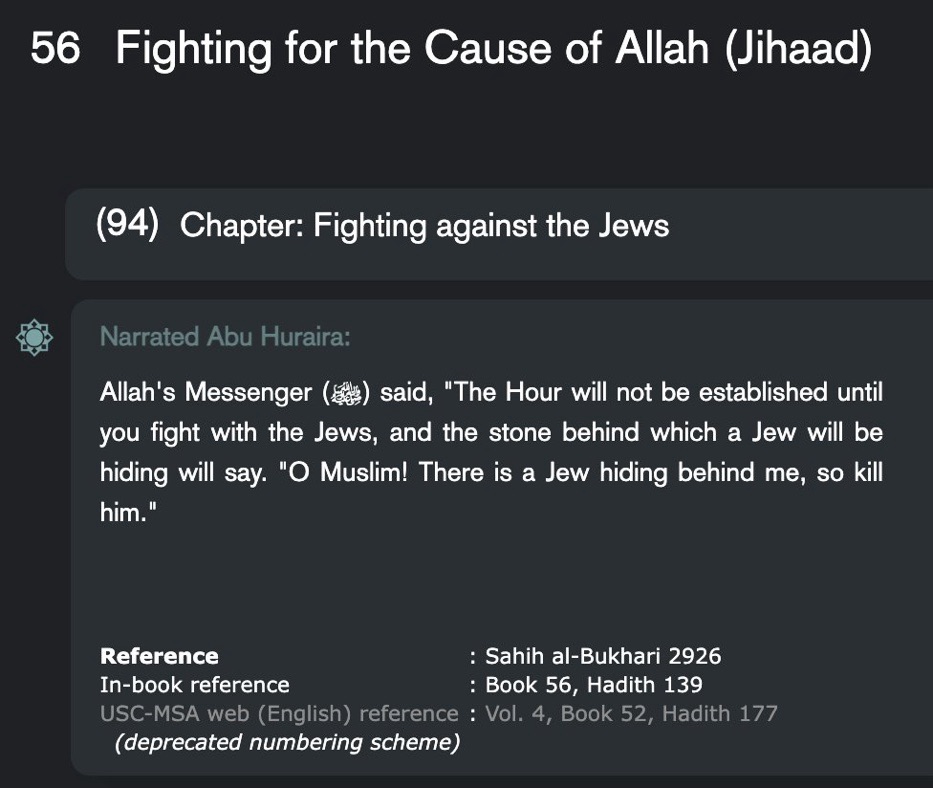
حَدَّثَنَا إِسْحَاقُ بْنُ إِبْرَاهِيمَ، أَخْبَرَنَا جَرِيرٌ، عَنْ عُمَارَةَ بْنِ الْقَعْقَاعِ، عَنْ أَبِي زُرْعَةَ، عَنْ أَبِي هُرَيْرَةَ ـ رضى الله عنه ـ عَنْ رَسُولِ اللَّهِ صلى الله عليه وسلم قَالَ “ لاَ تَقُومُ السَّاعَةُ حَتَّى تُقَاتِلُوا الْيَهُودَ حَتَّى يَقُولَ الْحَجَرُ وَرَاءَهُ الْيَهُودِيُّ يَا
مُسْلِمُ، هَذَا يَهُودِيٌّ وَرَائِي فَاقْتُلْهُ ” . 0
Introductory note
Prophetic prophecies are foretelling people about upcoming events.
Prophecies are to warn about wrong behaviors and to save from eventualities if precautions are not taken.
The above mention Hadith foretells about the end events of wrong doers. A lesson to change the course to avoid the scenario as being foretold.
This Hadith doesnot instruct believers to take action against wrong doers whenever , wherever they are found. Since 1400 yrs , there is no example of taking such actions by Muslims though this Hadith has been present and available to billions of Muslims all over the world for ages. Had this been a clear order from ALLAH subhanautala and his messenger, probably there would not a single Jew/ wrong doer left. Jews probably were never this strong like today and have history of persecution at hands of other than Muslims for their history of 2000 yrs.
TO AVOID THE END TIMES SCENARIO, DONT BE A JEW, A WRONG DOER, AN ENABLER OF WRONG DOERS AND BE A BELIEVER… STONES WONT FIND ANYONE TO REVEAL THE IDENTITIES.
GOD WONT CHANGE SITUATIONS OF PEOPLE IF THEY THEMSELVES DONT WANT THE CHANGE TO AVOID WRATH AND TO ENJOY BENEFITS OF THE CHANGE.
The Hadith in question is not a verse from the Quran but a prophetic narration (Hadith) attributed to the Prophet Muhammad. It appears in multiple authentic collections, including Sahih al-Bukhari and Sahih Muslim. One common version from Sahih al-Bukhari (Book 56, Hadith 139) states: “The Messenger of Allah (peace be upon him) said, ‘The Hour will not be established until you fight with the Jews, and the stone behind which a Jew will be hiding will say, ‘O Muslim! There is a Jew hiding behind me, so kill him.'” 0 A fuller variant from Sahih Muslim (Book 41, Hadith 6985) includes trees and an exception: “The Last Hour would not come unless the Muslims will fight against the Jews and the Muslims would kill them until the Jews would hide themselves behind a stone or a tree and a stone or a tree would say: ‘Muslim, or the servant of Allah, there is a Jew behind me; come and kill him;’ but the tree Gharqad would not say, for it is the tree of the Jews.” 16 24
This Hadith is part of Islamic eschatology (end-times prophecies) and has been interpreted in various ways by scholars across different traditions. Below, I’ll outline key explanations from a range of sources, including Sunni Muslim scholars (both traditional and modern), academic or interfaith perspectives, and critical viewpoints from non-Muslim or opposing stakeholders. These represent a distribution of interpretations, from contextual defenses within Islam to accusations of promoting antisemitism.
Traditional Sunni Interpretations (e.g., Salafi and Classical Scholars)
Scholars like Shaykh Ibn Baz and Ibn Taymiyyah view the Hadith as authentic and prophetic, describing a future event during the emergence of the Dajjal (Antichrist) and the descent of Jesus (Isa). According to Ibn Baz, Jesus will lead Muslims in battle against the Dajjal at Lod (near Jerusalem), where Muslims will defeat his followers, including a group of Jews aligned with him. The stones and trees speaking is a miracle revealing hidden enemies in this apocalyptic war, not a call for general violence against Jews today. Ibn Taymiyyah notes that 70,000 Jews from Isfahan will follow the Dajjal, but this is limited to his army, and the Hadith emphasizes a fight between truth (iman) and falsehood (kufr). It’s not prescriptive for current actions but a sign of the end times, similar to other prophecies. 23 18 Commentaries like those in Fayd al-Bari (by Anwar Shah Kashmiri) clarify that only a small faction of Jews (less than 0.5% of the global population) is involved as combatants, while righteous Jews may convert and join the side of good. 21 24
Modern Moderate Sunni Interpretations (e.g., Yaqeen Institute and Sheikh Yasir Qadhi)
Contemporary scholars like those at the Yaqeen Institute argue that the Hadith is not antisemitic but a supernatural prophecy about a battle between Jesus’s forces of good and the Dajjal’s army of evil, which includes evildoers from Muslim, Christian, Jewish, and other backgrounds—not targeting Jews as a people. Variants replace “Jew” with “rejector of truth” or “follower of Dajjal,” emphasizing actions over ethnicity. It’s contextualized as post-Jesus’s return, where most Jews, Christians, and Muslims unite under monotheism (per Quran 4:159). The Hadith condemns violence against civilians and is misused by extremists or Islamophobes; Islam’s teachings (e.g., Quran 5:32 forbidding unjust killing) prohibit applying it to harm peaceful Jews today. Sheikh Yasir Qadhi describes it as predictive (foretelling events) rather than prescriptive (commanding actions), rejecting any genocidal intent. 21 17 24 Historical examples cited include the Prophet’s respect for Jews, such as giving charity to them or standing for a Jewish funeral.
Interfaith and Reformist Perspectives (e.g., Washington Institute Dialogue)
In interfaith discussions, some Muslim participants argue the Hadith contradicts the Quran’s emphasis on justice and peace (e.g., Quran 60:8 allowing kindness to non-hostile non-Muslims), so it should be rejected or reinterpreted. The Prophet reportedly instructed followers to discard any Hadith conflicting with the Quran, which is seen as God’s word versus Hadith as human transmission. This view promotes dialogue to address discrepancies and build mutual understanding between Muslims and Jews, framing the narration as potentially inauthentic or metaphorical rather than literal. 22 10
Critical Interpretations (e.g., Jewish and Christian Perspectives)
From a Jewish viewpoint, as in the Jewish Chronicle, the Hadith is seen as inherently antisemitic and genocidal, promoting the idea of Muslims hunting and killing Jews en masse. It’s criticized for appearing in radical texts like Saudi schoolbooks post-9/11 and the 1988 Hamas charter (Article 7), where it’s quoted to justify ongoing conflict. Sermons, such as one by Imam Mohamed Tataiat in 2017 linking it to Jerusalem events, are viewed as inciting hatred, though French courts acquitted him, ignoring the Hadith’s militant history. Christian sources, like Christians for Israel, highlight its use in prophecies of Jewish doom, tying it to the Gharqad tree as a “tree of the Jews” that won’t betray them, and note modern conspiracy theories about Israel planting Gharqad for protection. 20 3 19 24 Critics also point out its late collection (over 150 years after the Prophet) and potential for fueling anti-Jewish sentiment, contrasting it with similar apocalyptic texts in Christianity (e.g., Zechariah 14:12 on Armageddon) that require careful handling to avoid hate.
These interpretations vary based on theological stance, with Muslim scholars generally emphasizing context and prophecy over literal application, while critics focus on its potential for misuse in promoting violence.
FROM JEWISH & CHRISTIAN LITERATURE
Clarification on “Ante Christ”
I interpret “ante Christ” as a likely reference to the “Antichrist,” a figure in eschatological (end-times) traditions, often depicted as an opponent of the Messiah or Christ. This concept is more prominent in Christian scriptures but has analogs or related ideas in Jewish texts. Below, I’ll outline mentions of such a figure and the “end of the world” (eschatology) in Jewish and Christian books, drawing from scriptures like the Tanakh (Hebrew Bible), New Testament, and related commentaries. Interpretations vary widely, with Jewish sources often emphasizing redemption over destruction, while Christian ones include themes of tribulation and judgment. I’ll include perspectives from Jewish, Christian, and academic sources for balance.
The Antichrist in Jewish Texts
In Judaism, there is no direct equivalent to the Christian “Antichrist” as described in the New Testament, as the term itself originates from Christian writings (e.g., 1 John 2:18). 0 1 Normative Judaism (based on the Torah, Talmud, and core rabbinic texts) does not feature a singular evil figure opposing God in the end times. 2 However, later apocalyptic and midrashic literature introduces figures like Armilus (or Armilos), an evil king or anti-Messiah who emerges during the Messianic era to persecute the righteous before being defeated. 5 7 Armilus is described in texts like the 7th-century Sefer Zerubbabel as a satanic offspring, born from a stone statue in Rome, who kills the Messiah ben Joseph (a precursor Messiah) but is slain by the true Messiah ben David. 5 6 This draws from biblical prophecies like Daniel 7-12 (visions of beasts and oppressors) and Ezekiel 38-39 (Gog and Magog as end-times invaders). 3 5 Some scholars link Armilus to Christian Antichrist ideas, possibly influenced by interactions with Christianity or Islam, but Jewish texts frame him as a human tyrant rather than a supernatural entity. 0 8 Critics from Christian perspectives sometimes argue this figure implies a Jewish rejection of Jesus, while Jewish sources see it as symbolic of historical oppressors like Rome. 3 4
The Antichrist in Christian Scriptures
The Antichrist is explicitly named in the New Testament, primarily in the Johannine epistles. 1 John 2:18 states: “Children, it is the last hour, and as you have heard that antichrist is coming, so now many antichrists have come.” 9 16 This suggests both a final singular Antichrist and many “antichrists” (false teachers or opponents of Christ) already present. 10 12 1 John 2:22 defines it as “whoever denies that Jesus is the Christ,” and 2 John 7 warns of deceivers who deny Jesus came in the flesh. 9 13 Broader depictions appear in 2 Thessalonians 2:3-12 (the “man of lawlessness” who exalts himself as God in the temple) and Revelation 13 (the Beast from the sea, empowered by Satan, who demands worship and persecutes believers). 9 11 These draw from Old Testament prophecies like Daniel 7:24-27 (a king who oppresses saints) and Matthew 24:24 (false christs and prophets). 9 15 Christian interpretations vary: Some see the Antichrist as a future individual (e.g., in premillennialism), others as a spirit or system of opposition throughout history (e.g., amillennialism). 10 17 Early church fathers like Irenaeus linked it to a revived Roman Empire, while modern views debate ethnicity (Gentile or possibly Jewish, though scripture leans Gentile). 3 14
End of the World in Jewish Eschatology
Jewish texts describe the “end of days” (acharit hayamim) not as the literal destruction of the world but as the culmination of history leading to redemption and the Messianic age. 18 19 Key sources include Isaiah 2:2-4 (nations streaming to Zion for peace), Micah 4:1-5 (swords into plowshares), and Ezekiel 37 (resurrection of dry bones symbolizing national revival). 21 23 The Talmud (Sanhedrin 97a-99b) and Maimonides’ Mishneh Torah outline stages: “birth pangs of the Messiah” (tribulations like wars), ingathering of exiles, rebuilding the Temple, resurrection of the dead, and the World to Come (Olam HaBa), a perfected era of knowledge of God (Isaiah 11:9). 20 22 There’s no “apocalypse” in the sense of total annihilation; instead, it’s transformative, with evil eradicated and humanity elevated. 22 24 Some mystical texts like the Zohar add cosmic elements, but mainstream views focus on ethical renewal. 26 Jewish scholars emphasize human agency in hastening this era through tikkun olam (repairing the world), contrasting with fatalistic end-times views. 19 25
End Times in Christian Eschatology
Christian scriptures portray the end times as a period of tribulation leading to Christ’s return, judgment, and renewal. Key texts include Matthew 24 (signs like wars, famines, false christs), 2 Thessalonians 2 (apostasy and the man of lawlessness), and Revelation (seals, trumpets, bowls depicting plagues, the Beast’s reign, Armageddon battle, and Satan’s defeat). 28 32 The Antichrist plays a central role, deceiving nations before Christ’s Second Coming (Revelation 19-20). 28 35 Views differ:
- Premillennialism: Christ returns before a literal 1,000-year reign (Millennium), after tribulation; popular in evangelical circles, seeing Israel restored. 29 36
- Postmillennialism: The church ushers in the Millennium through gospel spread, then Christ returns. 29 31
- Amillennialism: The Millennium is symbolic (current church age); end times are spiritual, not literal. 29 34
- Preterism: Many prophecies (e.g., tribulation) were fulfilled in 70 AD (Temple destruction). 34
Ultimately, it ends with the resurrection, final judgment, and a new heaven and earth (Revelation 21). 30 33 Christian sources stress salvation through faith in Christ, while some Jewish critiques view these as adaptations of Hebrew prophecies. 21
CHALLENGE
Prove the prophecy is wrong by leaving the Jewish faith.. then no one would be left , no need to take refuge behind stones and trees …prophet Mohammed’s prophecy would be proven to be wrong. Is there any soul to take this challenge?
If not,
stop doing mockery, spreading hatred by taking things out of context.
 Messages from Quran